
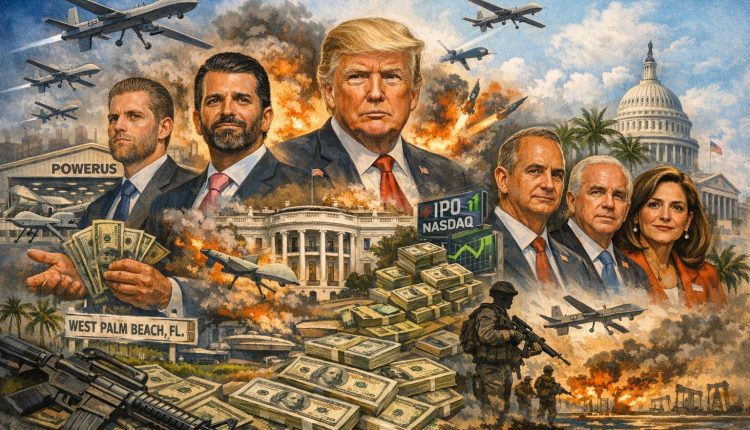
War, drones, and dollars: South Florida’s stake in Trump’s presidency for profit
The Trump sons are involved throughout the supply chain, from manufacturing to components, and are planning a public listing through a Trump-backed entity.
In South Florida, the clash of politics and money is nothing new. But what is happening now under Donald Trump is different from the usual. It’s turning the presidency into a source of profit—one that now seems to be powered, quite literally, by war.
Just up the coast in West Palm Beach, a company called Powerus is preparing to cash in. Backed by Donald Trump Jr. and Eric Trump, the firm is racing to manufacture military-grade drones at an industrial scale, pursuing Pentagon contracts and foreign sales at a time when U.S. policy has made such a business uniquely lucrative.
That policy is no accident. The Trump administration’s ban on Chinese-made drones—presented as a national security measure—eliminated key competitors and created a void. Powerus stepped in. The result is a direct link from public policy to private profit that runs straight through the president’s family.
Now add the reality of war.
As tensions rise and drone warfare becomes a key part of modern conflict, Powerus is already offering its technology to Gulf nations looking for protection against Iran. These governments rely heavily on U.S. support for their military posture—support controlled by the same administration tied to the company’s success.
This isn’t a gray area; it’s a clear conflict of interest.
The Trump sons are involved throughout the supply chain, from manufacturing to components, and are planning a public listing through a Trump-backed entity. This is not passive investing; it’s a coordinated business setup intended to benefit from defense spending, geopolitical tensions, and ongoing conflicts.
And it’s happening right here in South Florida.
Díaz-Balart and Giménez serve donor$$, not their constituents
That local reality has political implications. The region’s three Cuban American members of Congress—Mario Díaz-Balart, Carlos Giménez, and María Elvira Salazar—have been among the most steadfast defenders of the Trump presidency.
Their support goes beyond signaling party loyalty; it offers political cover.
Because at a time when the president’s family is building a business ecosystem around military technology—technology now connected to an expanding conflict—these lawmakers have chosen not to confront the obvious. No hearings. No sustained scrutiny. No meaningful challenge.
That absence isn’t neutrality; it’s complicity.
This is how normalization happens. Not through a single scandal, but through repetition—by steadily accepting behavior that once would have been unacceptable. A policy decision benefits the president’s family. A business deal is made. A war broadens the market. And elected officials look the other way.
Step by step, the unacceptable becomes routine.
The danger here isn’t theoretical. When financial rewards are linked to conflict, the risk isn’t merely corruption—it’s escalation. The incentives change. War isn’t just about strategy or necessity anymore; for those in power, it can also be a way to earn money.
That is a line democracies should not cross.
Defenders will rely on legality, as they always do. But the law often lags behind abuse and is narrower than ethics. The question is not whether this setup can navigate existing loopholes. The real question is whether the public is willing to accept a presidency where those closest to power can profit from their influence.
South Florida now plays a role in that, not only geographically but also politically.
Because when local industry, national policy, and congressional silence align so precisely, what emerges is not coincidence. It is a system. And systems like this do not correct themselves.
