
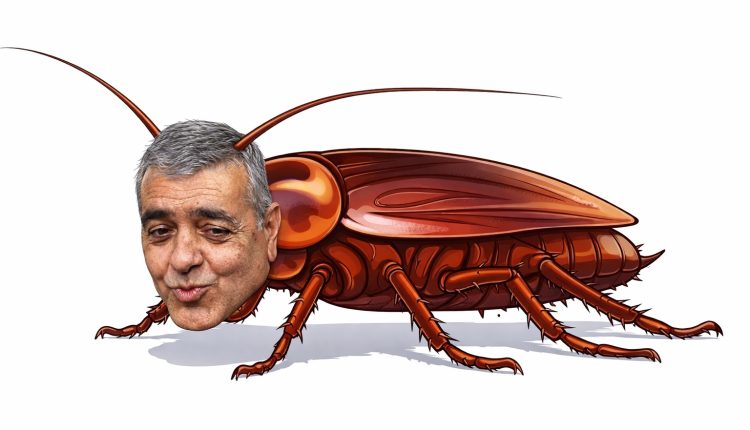
Who is David Rivera? And why does he always get away with it?
He is one of many in South Florida who helped create a corrupt political template that has flourished since the 1990s, when the Republican Party began studying the mechanics of power in a Miami dominated by Cuban American politics.
We thought we were rid of him. But like a cockroach that feigns death, he merely vanished into the shadows—only to reemerge, laughing all the way to the bank. Now he’s in trouble again, once more searching for an escape hatch. Even Secretary of State Marco Rubio, once his roommate and co-owner of a Tallahassee house, may be pulled into the mess. And if not a cockroach, then perhaps he’s a cat with far more than nine lives.
He is one of many in South Florida who helped create a corrupt political template that has flourished since the 1990s, when the Republican Party began studying the mechanics of power in a Miami dominated by Cuban American politics. That model was eventually exported nationwide, giving rise to a socially awkward parasite from New York who stumbled into the presidency of the United States.
His name is David Rivera. And like the cockroach, he has resurfaced—this time because he faces U.S. authorities investigating his dealings with the Venezuelan government.
On one side stands the United States, which accuses Rivera of acting as an unregistered foreign agent for the government of Nicolás Maduro. The charges stem from a $50 million consulting contract Rivera signed in 2017 with PDV USA, the US subsidiary of Venezuela’s state oil company. Prosecutors allege the agreement was merely a front for lobbying US officials to normalize relations with Maduro’s regime.
The trial hinges on whether Rivera’s work constituted legitimate consulting for PDV USA or illegal foreign lobbying on behalf of the Venezuelan government. Court records show Rivera received at least $20 million before the contract collapsed, with much of that money later diverted to politically connected subcontractors who were later charged with corruption. The case now sits at the intersection of U.S. foreign policy, partisan warfare, Venezuela’s political crisis, and the murky boundary between lobbying and foreign influence.
Defense attorneys, meanwhile, have asked the court to postpone the trial, arguing that Venezuela’s current political crisis makes it impossible to seat an impartial jury in Miami—home to one of the largest Venezuelan diaspora communities in the country. They claim emotions are inflamed following the U.S. military kidnapping of Maduro and insist the “sensational conflict” must cool before a fair trial can proceed. The defense also argues that more time is needed to secure testimony from key witnesses.
The case has drawn national attention because it entangles some of the most powerful figures in American politics. Rivera’s lawyers argue he was not working for Maduro but was instead attempting to remove him from power through sanctions and support for Venezuela’s opposition. They say this can be proven through testimony from Secretary of State Marco Rubio, former Trump adviser Kellyanne Conway, Congressman Pete Sessions, and White House chief of staff Susie Wiles.
It bears reminding, however, that Rivera’s political career has long been shadowed by legal and ethical controversy.
While serving in the Florida Legislature, the state Commission on Ethics found probable cause that Rivera committed multiple violations, including misuse of campaign funds, improper financial relationships with entities seeking legislative action, and failures to disclose income. An administrative law judge later ruled that Rivera acted with “corrupt intent” in double-billing taxpayers and campaign accounts for travel expenses. State prosecutors ultimately declined to pursue criminal charges, citing statute-of-limitations issues.
In the case he is now trying to scurry away from, prosecutors allege Rivera received millions of dollars to lobby U.S. officials on behalf of individuals tied to the Venezuelan government—without registering under the Foreign Agents Registration Act. A second federal indictment in 2024 expanded those allegations, accusing Rivera of secretly representing a sanctioned Venezuelan businessman and using shell companies to conceal the source of payments.
Separately, Rivera faced a major Federal Election Commission enforcement action stemming from an illegal campaign finance scheme during his 2012 reelection bid, resulting in one of the largest civil penalties the agency has ever pursued.
In the end, if you live in South Florida and possess even an ounce of rational thought, David Rivera has always been a corrupt scoundrel who has wriggled his way out of more scandals than seems humanly possible.
There have even been cases of people imprisoned (mainly women) who were used and discarded in the service of his dirty ambitions. Even his own mother, whom Rivera has always kept in hiding, paid a price for her son’s dealings.
So the question remains: who is David Rivera?
For years, I have wondered—and written—about it. Either this man has a sugar daddy sitting very, very high up in the US government, or he truly is what we might call, metaphorically, Miami’s cat with nine lives.
Now Rivera and his lawyers—and whoever else may be lurking behind the curtain, far from public view—are trying once again to stall the judicial process, hoping to let their cat slip back into the darkness.
This feels like life number ten for David Rivera.
Cats only get nine.
It’s time to throw this bum in jail—and once he’s in, lose the key.
