
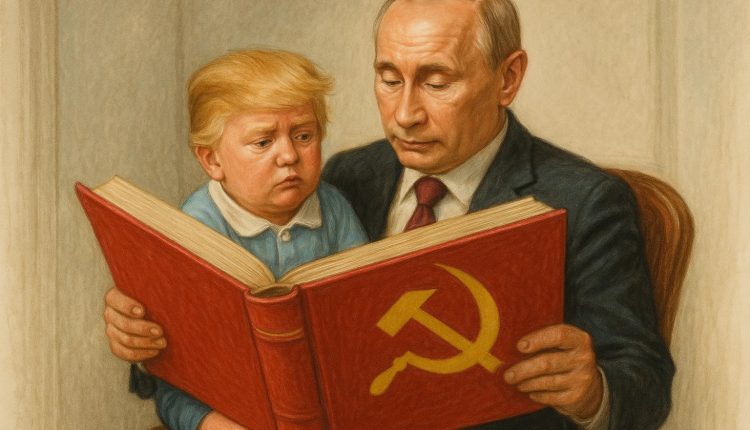
Trump’s blunder doctrine
In this farce, Putin gleefully becomes Trump's unpaid campaign manager––the incompetence would be slapstick if it weren’t fused to strategy.
It began, like many great geopolitical farces, with a misunderstanding so profound it was practically philosophical. Steven Witkoff, real-estate magnate turned foreign-policy Sherpa, heard Vladimir Putin mumble something about withdrawal. “Peaceful Russian withdrawal from Ukraine,” Witkoff announced confidently, as though quoting Tolstoy. Unfortunately, the oligarch-in-chief did not say Russia would withdraw from Ukraine.
What he demanded was the opposite: that Ukraine retreat from its own land, like a mirror told to vacate its own reflection. But Witkoff, ever eager to audition for a role he didn’t understand, spun it as a triumph of diplomacy. In the theater of Trumpism, even mistranslation counts as beautiful negotiation. But diplomacy, it turns out, is harder than flipping condos in Las Vegas.
In this farce, Putin gleefully becomes Trump’s unpaid campaign manager––the incompetence would be slapstick if it weren’t fused to strategy. Trump, ever the pupil in the Kremlin’s correspondence course, picked up a handy electoral trick directly from Putin: forget persuasion, just stop the mail-in ballots and redraw the maps.
Remember I always win bigly, Putin could have reminded Trump. No need to cancel elections outright—too messy, too obvious. Just make it harder for democrats to vote (in person only) and where to vote (through gerrymandering). If the results don’t favor Trump, then the results are self-evidently fraudulent.
The Nazi Party gained power not through a single election, but through a combination of electoral successes, the exploitation of the Great Depression, effective propaganda, and increasing political momentum that destabilized the Weimar Republic and allowed Hitler to be appointed Chancellor in 1933. This logic, straight from the Moscow field manual, carries the subtlety of a blackjack. Elections are not about choice; they are about consenting to the inevitability of the Leader.
Trump must have felt flattered by the intimacy from the Russian, perhaps taking notes on a cocktail napkin from Mar-a-Lago already stained with Diet Coke rings. The napkin might later be filed in classified archives, between a golf scorecard and a menu from the White House steak dinner. Soon the Trump campaign took tactical advice to its natural conclusion, deciding that the road to autocracy is paved with convoys: don’t just debate voter access—deploy troops. Not regular troops, of course, but armed caravans of red-state loyalists, driving into blue states with the solemn duty of “monitoring.” Their mission is simple: to intimidate, deter, and remind urban precincts that the republic now runs on pickup trucks with gun racks and gaudy military spectacles. One could imagine Jefferson, quill in hand, nodding approvingly—if Jefferson had written the “Declaration of Dependence on Russian Tactical Guidance.”
Previously, at the Hotel Captain Cook in Anchorage, eight pages of government documents detailing the Trump–Putin summit—including a lunch menu with filet mignon, seating charts, phone numbers of U.S. officials, phonetic pronunciation guidelines for “Putin” (“Poo-tin,” not “Putain”—a useful reminder if your French is rusty) and the planned gift (an American bald eagle desk statue)—were left in a public printer like forgotten boarding passes. This embarrassing lapse exposed planning details that compromised security. Critics described the incident as emblematic of administrative sloppiness, linking it to prior breaches. America’s nuclear posture now shared the same secrecy as a hotel loyalty program.
Among those prior breaches, the infamous Signal chat “oops,” stands out. National Security Advisor Mike Waltz accidentally added The Atlantic’s editor-in-chief, Jeffrey Goldberg, to a group chat discussing planned U.S. military operations in Yemen. The incident sparked controversy due to the nature of the discussion (imminent military action) and the use of an unapproved, insecure communication platform like Signal for sensitive matters, in disregard of national security protocols. Nonchalantly, Defense Secretary Pete Hegseth shared sensitive details of the impending airstrikes, such as the types of aircraft (F-18s, MQ-9 Reaper drones), missiles (Tomahawk cruise missiles), and the specific flight schedules for the strikes. He also ventured into exchanging congratulatory messages with other officials after the strikes were carried out, although none of the individuals in this group had the necessary security clearance to receive such information, raising further questions about Hegseth’s judgment and adherence to security protocols.
Inexplicably, in addition to the official chat, Hegseth created and used a separate Signal group chat reportedly named “Defense | Team Huddle” that expanded his circle of confidants. Included in a group of about a dozen people were Hegseth’s wife, Jennifer Hegseth; his brother, Phil Hegseth; and his personal lawyer, Tim Parlatore. According to reporting by The New York Times, Hegseth disclosed specific details about the March 15th strikes on Houthi rebels, including the flight schedules for F/A-18 Hornets involved in the operation. NBC News and the Associated Press later reported that Hegseth had copied this information from the secure U.S. Central Command communications channel and posted it verbatim into the unclassified Signal chat, as a teenager happily sharing a Tik-Tok video with his buddies.
When reports of the Signal chat emerged, Hegseth fired top officials for what he called “unauthorized disclosure” and appeared to blame the leaks on them. He has not, however, offered a direct public explanation for his decision to include his family and personal lawyer in the chat.
Trump’s own handling of classified information is another procession of blunders, including: (1) The Oval Office leak to Russia in 2017 where he revealed to Russian officials codeword-classified intelligence regarding an ISIL plot, compromising sensitive information and triggering emergency internal measures. (2) Flouting secrecy protocols when he disclosed the location of U.S. nuclear submarines to the Philippines, published a classified CIA program online, and shared satellite imagery of Iranian nuclear sites—behaviors repeatedly denounced as reckless. (3) Mar-a-Lago doubling as a secret archive, inasmuch as classified documents were stored insecurely at Trump’s Florida resort ballroom and other locations accessible to outsiders, leading to a federal investigation and alarm among intelligence officials.
Let’s not forget the mindless firings executed by a DOGE-branded cost-cutting scheme earlier this year. The NNSA, or National Nuclear Security Administration, is a semi-autonomous agency within the U.S. Department of Energy that maintains the U.S. nuclear weapons stockpile, works to prevent nuclear proliferation, secures nuclear materials, provides fuel for the nuclear Navy, and serves as the first responder for nuclear emergencies. Seventeen percent of the NNSA workforce—314 employees, including engineers and clearance-holders—were abruptly fired arbitrarily under a cost-cutting directive known as “DOGE Service,” overseen by Elon Musk. The firings wreaked havoc on operations, putting the nation at risk, and were reversed amid bipartisan outrage, highlighting reckless decision-making in vital national security institutions.
Another example may not reflect incompetence as much as shamelessness, but it’s worth mentioning because it reflects how the Trump administration tries to distract from its blunders: the Arlington National Cemetery Incident in 2024. During a solemn visit to Arlington National Cemetery, Trump’s entourage tried to film campaign-related content among Section 60 graves, an activity that is strictly prohibited. When a staffer from the cemetery interceded, one of Trump’s aides “abruptly pushed her aside,” according to the Army, which condemned the group’s actions as a violation of federal law and cemetery policy prohibiting political activity on the grounds. As is typical, the Trump campaign denied what happened and defamed the cemetery official, claiming she was “suffering from a mental health episode.” Campaign spokesperson Steven Cheung said they were “prepared to release footage” to support their claims, but we are still waiting.
Each of these episodes forms a bead on the same absurdist rosary: a devotion to carelessness, stitched with ambition. What emerges is less a governing philosophy than a performance style: incompetence as strategy, blunder as doctrine. If you do not foresee victory, redefine the rules of voting. If you cannot protect secrets, call them souvenirs. If you cannot govern, campaign among the dead at Arlington wrapped in the flag and use the National Guard as props. If you don’t like the statistics, fire the statistician. If the news cycle does not favor you, manufacture a crisis.
Witkoff may have misheard, but the prophecy was true in another sense. Russia will not withdraw from Ukraine, but America, under Trump and his slow-motion coup, may withdraw from democracy itself—pulled backward by convoys of armed centaurs, printers that gossip in the night, and a leader convinced that elections are fraudulent unless they mirror his reflection.
