
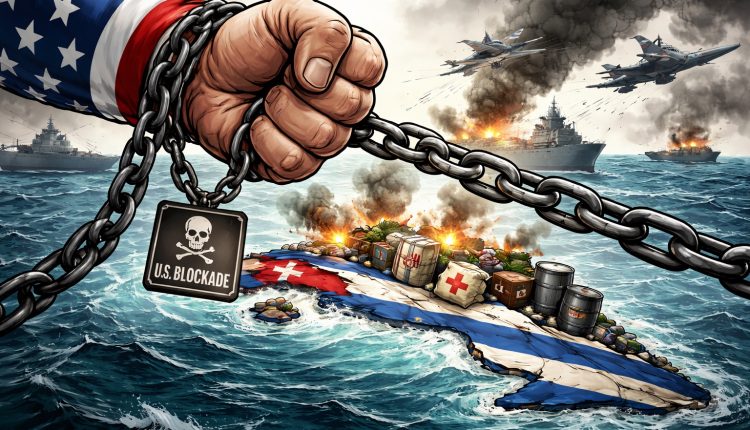
Will the US’s latest attempt to end the revolution succeed? Don’t bet on it.
Cuba is facing its worst existential threat with the Trump administration and its anti-Cuban extremists led by Marco Rubio increasing the unrelenting economic hostility.
Is this the year that America’s criminal, illegal blockade of Cuba finally achieves its objective? It wouldn’t be the first time that was the expectation. On several occasions since the Triumph of the Revolution in 1959, US hostility toward the island nation has led many ‘experts’ to confidently proclaim the end of the socialist experiment.
In the early months of the new Cuban government, the United States successfully pressured almost every nation in the Americas to stop trading with Havana. The only exceptions were Mexico and Canada. That pressure would surely have brought down the government. It didn’t.
In 1961, the Americans sent an ill-trained group of mercenaries to overthrow Fidel Castro and his supporters and end the revolution. The disaster at the Bay of Pigs did not achieve anything but the solidification of the socialist government.
A year later, the Cuban Missile Crisis brought about the end of the US’s absolute naval blockade. This certainly would have been the demise of the revolution. It wasn’t.
Fast forward to 1989. The collapse of the Soviet Union, combined with increased U.S. hostility, had the anti-revolutionaries in Miami and Washington counting the days until they’d re-establish American hegemony. Cuba’s spiral into the Special Period meant not if, but when, the revolution would fail. This would finally be the end of Fidel Castro and his regime. It wasn’t.
Then COVID hit the island hard in 2020, and the nation’s isolation led to a loss of tourism revenue and international business. This time, there would be no rescuing the revolution. Except it didn’t need to be rescued; it just adjusted.
Now, however, Cuba is facing its worst existential threat with the Trump administration and its anti-Cuban extremists led by Marco Rubio increasing the unrelenting economic hostility. Oil is being cut off from Venezuela and Mexico, and tariffs are being threatened against other countries that want to sell petroleum to the island. Cuban-American politicians want to add to the misery by calling for the end of remittances and stopping all commercial flights from the US. Cuba is at its most vulnerable, experiencing shortages and economic dislocations worse than during the Special Period. A humanitarian catastrophe is unfolding. No oil, no energy, no revolution. That’s the anticipation.
The problem, as it always has been, is that American politicians and the mainstream media simply cannot accept the reality that the majority of Cubans continue to object to any foreign power dictating to them what type of social/economic system they want. Many Cubans express a desire for substantial changes from their government, perhaps even fundamental alterations to the system they live under. But for 60 years, those who continue to reside in Cuba have made it clear they don’t want to be told by the most powerful nation on earth that they must abandon their political/economic structure — or starve.
Havana resident Heriberto Nicolas, born in the early 1960s during the revolution, is typical of those who want to see change through national consensus rather than through the consequences of American punishment. “There are a lot of problems here, and many things the government could do better. But when you are constantly threatened with being strangled, it’s hard to do anything but try to survive. Trump is the president, but people like Marco Rubio are just evil. He doesn’t care about the Cuban people.”
While admitting this is the worst it’s ever been, he remains confident the revolution will survive.
That attitude is also recognized by others outside the country. Former Canadian ambassador to Cuba, Mark Entwistle, said in a recent CBC interview:
“The Cubans are quite good planners, and they’re survivalists. The Americans have, of course, believed that they are about to fall and collapse into the ocean many, many times since 1959.
“My recommendation to policymakers in Washington is assume nothing. Don’t count them down even though they are on the mat.”
This may be the final punishment that breaks the revolution. There is only so much external harm any society can withstand. This remains the only purpose of the US blockade – to hurt the Cuban people to the extent that they will overthrow their own government. That policy dates back to 1960, as clearly stated in the famous quote by US Deputy Assistant Secretary of State for Interamerican Affairs, Lester Mallory:“through disenchantment and disaffection based on economic dissatisfaction and hardship.”
If the United States finally succeeds, it would represent the victory of the American mafia empire over this small, stubborn nation. It would be a return to 19th-century colonialism and the reemergence of US hegemony over Cuba. It would also be a complete failure of the international community to defend the rule of international law.
Regardless of what anyone thinks of the Cuban government, the people have never deserved what the United States has done to them. And for those convinced this is the straw that will break Cuba’s back, don’t underestimate the average citizen’s continued belief in fighting for their nation’s independence and right to self-determination.
Maybe this time the revolution will fall. But betting against the Cubans, who continue to support what it represents, has always been a losing proposition.
