
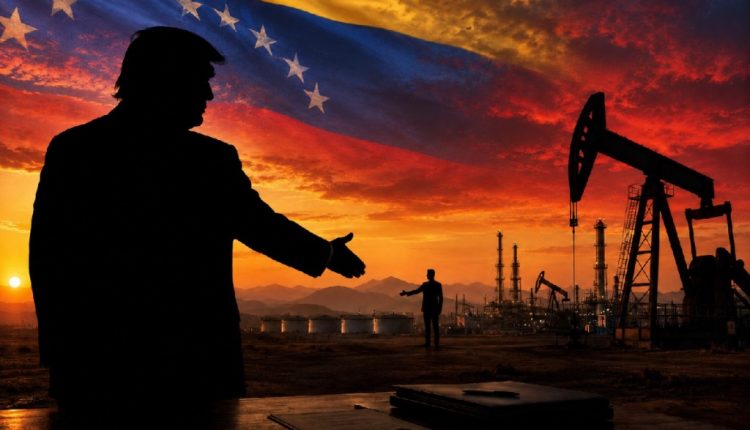
Using Iran war energy crisis as ‘cover for a resource grab’ in Venezuela
President Donald Trump was accused over the weekend of exploiting an energy crisis of his own creation to make the case for what he dubiously characterizedas “the biggest oil deal in world history” with Venezuela, a country that the US illegally attacked earlier this year in an operation to abduct its then-president, Nicolás Maduro.
“Trump drove up gas prices by launching a devastating war with Iran. Now he is using the energy crisis he created as cover for a resource grab of Venezuela’s oil,” Allie Rosenbluth, US program manager at Oil Change International, said in a statement on Sunday. “The announcement confirms his aggression against Venezuela was about securing power, profits, and fossil fuels.”
The newly announced agreement—which Trump and Venezuela’s acting president, Delcy Rodríguez, said involved the development of fields with potentially 65 billion barrels of oil—came as gas prices in the US remained above $4 per gallon. According to AAA, this month is “poised to set a new record as the most expensive August at the pump,” as the national average price for a gallon of gas has been above $4 every day of the month for the first time.
Rosenbluth, like other analysts, questioned the impact of Trump’s deal with Venezuela on the US energy crisis, which has become a major political problem for the president and his Republican Party heading into the midterms.
Trump, who has significant fossil fuel company holdings, claimed the deal would “substantially lower gas prices” and help replenish the US Strategic Petroleum Reserve, which is at its lowest level in decades after the president ordered the release of 172 million barrels following Iran’s closure of the Strait of Hormuz in response to US aggression.
Trump announced the deal with Venezuela on Friday, which marked six monthssince the US and Israel started bombing Iran.
“Oil reserves in Venezuela will do nothing to lower families’ bills today,” said Rosenbluth. “Increasing production of this extremely heavy and dirty crude would take years and billions of dollars. A bet on new Venezuelan oil production that may take a decade or more to materialize is a bet against solving the climate crisis already destroying lives and livelihoods every day. The immediate winners are the oil companies and private investors given access to Venezuela’s resources, while Venezuelans lose sovereignty, and communities in Venezuela and along the US Gulf Coast face more pollution and harm.”
“Trump’s attacks on Iran and Venezuela expose the vicious cycle of fossil fuel dependence: Wars secure access to oil, oil fuels violence and militarization, prices become more volatile, and fossil fuel companies profit while ordinary people pay,” Rosenbluth added. “Real energy security comes from phasing out fossil fuels and investing in affordable, renewable energy.”
Gerald Kepes, president of the consultancy firm Competitive Energy Strategies, noted in an interview with NPR that the US has no “government-owned operational capability per se in the oil and gas sector,” raising the question of “who’s going to operate on the ground?”
Chevron is currently the only US oil company actively producing in Venezuela. NPR reported that “there’s a private Venezuelan company involved in the deal,” but the details remain murky.
