
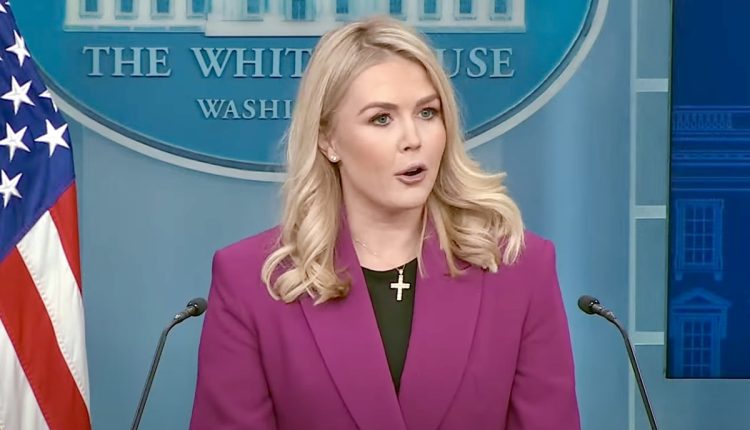
 Karoline Leavitt
U.S. warns it is maintaining the oil blockade on Cuba
Less than 24 hours after the President of the United States, Donald Trump, declared that the oil blockade on Cuba would no longer be enforced, his White House spokesperson insisted that there had been no change in policy and that Washington reserves the right to seize vessels from Mexico and other countries that send fuel to the island. She added that, despite reports of bilateral negotiations, the Republican administration continues to bet on the collapse of what it calls a “failed” nation.
Washington’s policy toward Cuba remains entangled in contradictory decisions by the U.S. president, reflecting not only internal disputes within his administration in Washington and Miami, but also the political maneuvering of Democrats.
“Cuba will be next. It’s a disaster… before long they will fail and we will be there to help them, to support our great Cuban Americans, who were driven off the island; in many cases, their relatives were mutilated and killed by (Fidel) Castro. Cuba will be next,” the president reaffirmed Sunday night on the flight back from Florida to Washington.
In that same conversation, Trump surprised observers by commenting on the arrival of a Russian oil tanker to the island and stating that “we don’t care” if shipments of crude reach Cuba, since “they have to survive.”
The tanker arrived in Cuba on Monday, the first delivery of foreign oil in three months. The U.S. president added: “I have no problem” with other nations sending crude (as reported by La Jornada on Monday), and said he preferred to allow fuel in “because people need heating, refrigeration, and all the things necessary to live.”
But hours later, White House spokesperson Karoline Leavitt stated that “there has been no formal change in sanctions policy (against the island). These decisions are being made on a case-by-case basis.”
When asked about comments by President Claudia Sheinbaum that Mexico is exploring resuming oil shipments to the island, she replied: “Again, there is no change in our sanctions policy. We reserve the right to seize vessels, if legally applicable, that violate these policies, and the president will decide.” Asked whether Russia now has a green light to continue such shipments, she repeated that it will be evaluated “case by case.”
The official White House website still includes the January 29 executive order imposing sanctions on any country that dares to send oil to Cuba—in effect establishing a naval blockade.
Uncertainty within the government
It is not easy to predict the immediate future of White House policy toward the island—not only for outside observers, but even for officials within the government, including Secretary of State Marco Rubio, a Cuban American who supports the oil blockade.
Rubio said Monday—without referring to his boss’s remarks the previous day—that “if Cuba really wants to get out of the hole it has dug itself into, that is, the hole the regime has put it in, it truly needs to undertake very serious reforms in both its government and its economy. And if they are willing to do so, we will help them.”
In an interview with Al Jazeera, he added, “We have not taken any punitive measures against the Cuban regime. They claim we have, but that is not the case. The only thing that has changed is that they no longer receive free Venezuelan oil. They no longer have subsidies.” He reiterated that “there can be no economic prosperity without a significant level of political freedom.”
The secretary of state made no reference to the January 29 executive order, nor to the pressure on Mexico and other countries to halt oil shipments to the island until this week—much less to the more than 60-year economic embargo on Cuba.
Asked what the United States wants, Rubio added: “We don’t need anything from Cuba. I mean, it is the island that needs us.”
It is worth noting that this is already an election season in the United States, and Cuba is part of that political game—for better or worse. On the one hand, the November midterm elections, in which control of both chambers of Congress is at stake, encourage caution among Republicans, who currently dominate the legislature—they do not want to make any mistakes that could benefit their opponents. At the same time, they must respond to the demands of certain sectors, in this case, the still-influential anti-Castro community in Florida.
Opponents reluctant to criticize
But Democrats are also competing and are unlikely to criticize policies against “adversaries” such as Cuba and Iran. At the same time, they will try to attract support from sectors that have favored Republicans in states like Florida.
This could, somewhat paradoxically, result in right-wing pressure on Republicans, including Trump, if Democrats criticize them for not being “tough” enough.
For example, among Democrats with presidential ambitions is California Governor Gavin Newsom, considered a centrist liberal. On policy toward Cuba, he said: “I appreciate that the Trump administration is proceeding… This quasi-blockade has created conditions where we now have 51 prisoners released, we have a different conversation with the (island’s) leadership, we are negotiating a different framework from a new position of strength.”
He then condemned the government of Nicolás Maduro in Venezuela, concluding that “we are talking about a dictatorship, the leadership in Cuba today, so we must proceed with those values, absolutely.” Although he is much more consistent on other issues, it is notable how reluctant Newsom is to criticize the Republican president’s policy toward the island.
It should also be emphasized that there has been near-total silence from liberal and even progressive Democratic politicians on Cuba, including Barack Obama, whose achievement in normalizing relations with Havana has been undone by the current administration. Representative Alexandria Ocasio-Cortez, a leader of the party’s progressive wing, dared to say a month ago that the oil blockade on Cuba is part of a “new era of depravity” promoted by the Trump administration, but has said little more since.
Among the exceptions is Democratic Senator Peter Walsh, who has called for an end to the U.S. economic embargo. Last week, Representative Ilhan Omar joined that call. “I am outraged by what Trump is doing to the Cuban people,” she said in a speech before the full House.
“The Trump administration’s oil blockade is cruel and indefensible. Cuba poses no threat to us, and yet we are strangling an entire nation with an economic war… Make no mistake, this unjustifiable suffering is happening because Trump is trying to force regime change.”
She concluded: “Across our country and around the world, people are standing in solidarity with the Cuban people, calling for dignity, for humanity, for an end to this harm. Hands off Cuba. End the blockade now.”
