
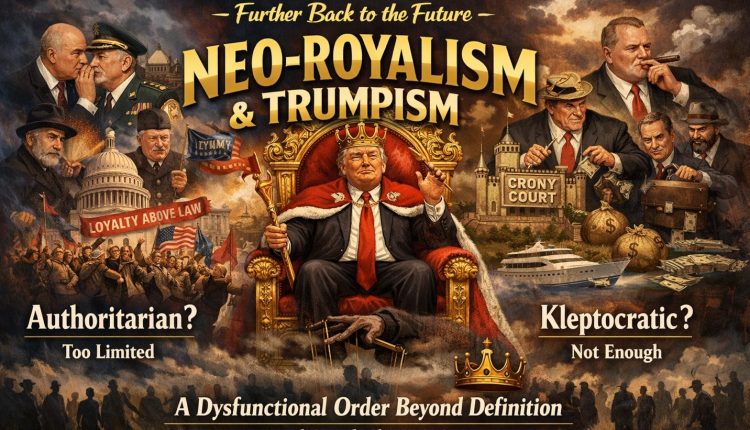
Trumpism: What is it?
Trumpism does not merely lie, distort, insult, and defames; it destroys the conditions under which truth matters.
A recent article by Stacie Goddard and Abraham Newman, Further Back to the Future, deserves to be better known and is a good road toward defining Trumpism. To capture what makes this regime distinctive rather than merely bad in familiar ways, one must move beyond standard regime labels. The article proposes the term Neo-Royalism. Descriptors such as “authoritarian” or “kleptocratic” are accurate but insufficient. What marks Trumpism is the overall composition and logic of its dysfunction, making it difficult to describe.
Additional descriptors include “patrimonial.” Power is treated as private property. The state exists to reward loyalty to the ruler and his family and punish disloyalty, not to serve impersonal law or public purpose. Offices, pardons, contracts, and protection are dispensed as favors.
The regime thrives on spectacle while hollowing out meaning. Institutions, truth, norms, and even ideology are not replaced with alternatives; they are mocked, degraded, and instrumentalized. Nothing is sacred except dominance. This is performative nihilism.
Trumpism does not merely lie, distort, insult, and defames; it destroys the conditions under which truth matters. Facts become partisan signals. Expertise becomes treason. Reality itself becomes negotiable if the leader says so loudly enough. This is a unique epistemically corrosive feature that turns reality on its head in Orwellian fashion.
Classic authoritarians build parallel institutions. Trump systematically uses existing ones while sabotaging their credibility—courts, intelligence agencies, elections, the civil service—leaving them nearly intact in form but weakened in authority. Trumpism is counter-institutional rather than anti-institutional.
The regime offers its followers emotional rewards rather than material improvement: humiliation of enemies, transgression of taboos, cruelty as entertainment. Suffering—especially of migrants, minorities, or liberals—is a feature, not a bug. Call it Sadopopulism, the socialized equivalent of schadenfreude.
Repression is outsourced in what could be called capricious-authoritarian fashion. The leader signals targets and grievances, then lets supporters, local officials, bureaucratic minions, ICE, or lone actors carry out intimidation and violence without formal orders. Plausible deniability is built in. The insurrection of January 6th exemplifies this phenomenom.
Serving wealthy interests and corporate deregulation while maintaining mass legitimacy through rallies, grievance politics, and culture wars makes Trumpism an oligarchic–plebiscitary hybrid. The base gets its circus and votes; the billionaires grow even wealthier.
Unlike fascism or communism, Trumpism has no coherent project to replace the constitutional order. It seeks to misappropriate the Constitution, not overthrow it, treating constraints as optional and precedents as loopholes. It is anti-constitutional without being either revolutionary or counter-revolutionary. It claims to defend law and order while acting unlawfully and triggering chaos.
Perhaps the most unique characteristic of Trumpism is its infantilist character, which is manifested primordially in three areas: (1) Decision-making is impulsive, emotionally driven, and punitive, as if from a strict father. Loyalty is strictly demanded and measured by public and exaggerated flattery from child-like, obedient cabinet members. Policy coherence is secondary to mood management in the kindergarten. Governance resembles a dysfunctional Mafia family system of incompetents more than a state. (2) Pronouncements, proclamations, and directives, which appear in Truth Social before the Federal Register, are expressed ungrammatically and often in capital letters framing incoherent phrases capped with exclamation points. (3) Trump revels in receiving recognitions he doesn’t deserve or didn’t earn, including the absurd gift of the Nobel Peace prize from María Corina Machado, his image on a fake cover of Time magazine’s 1 March 2009 edition, which hangs in several of his golf courses, and his penchant for cheating at golf.
What makes Trumpism so hard to name is that the regime is a form of post-ideological predation. It is not conservative in the Burkean sense, nationalist in a principled sense, or fascist in the classical sense. It lacks discipline, doctrine, and futurity. Its core drives are personal survival and enrichment through dominance, and everything else—policy, law, truth, allies, even the country—is expendable.
That combination of personal rule without ideology, mass mobilizations driven by hate, corruption without state-building, cruelty without strategic necessity, is why it feels both disturbing and unprecedented, and why ordinary political language keeps failing to pin it down. Also, the features of patrimonialism, epistemic corrosion, sadopopulism, erratic authoritarianism, and performative nihilism, are not historical anomalies. They are active governing logics ushered by instinct rather than learning and reflection. If anything, they are more dangerous now because they are no longer improvisational. They are iterative.
If one phrase must do the work, one might call Trumpism a personalized, nihilistic, kleptocratic power cult operating parasitically within a constitutional shell.
In other words, a cult that all sensible citizens are obligated to defeat with all available legal and peaceful means.
