

The trillion-dollar question
The U.S.'s military budget hits 13 digits—but at what cost?
The Budget That Broke the Scale
Washington quietly reached a milestone that would have seemed like science fiction a decade ago: a U.S. military budget topping $1 trillion. With little fanfare and even less public debate, President Trump signed into law a sweeping new spending package that boosts defense spending for 2025 to an unprecedented $1.055 trillion.
In typical Trumpian style, the legislation was branded the One Big Beautiful Bill. But behind the branding lies a stark fact: a $156 billion spike in military outlays on top of what was already the largest defense budget in the world. At the same time, the law shaves billions from domestic programs like health care and food assistance—all in the name of deficit reduction.
Here’s the catch: the $156 billion wasn’t funded by cuts elsewhere or new revenue. It was simply added to the tab. The same deficit that justified gutting social programs was conveniently ignored when the Pentagon came calling.
And yet, despite the magnitude of this shift, you probably didn’t hear much about it. There were no front-page splashes, no emergency town halls. Just a shrug—and a trillion-dollar receipt.
A Military Budget for a War That Doesn’t Exist![]()
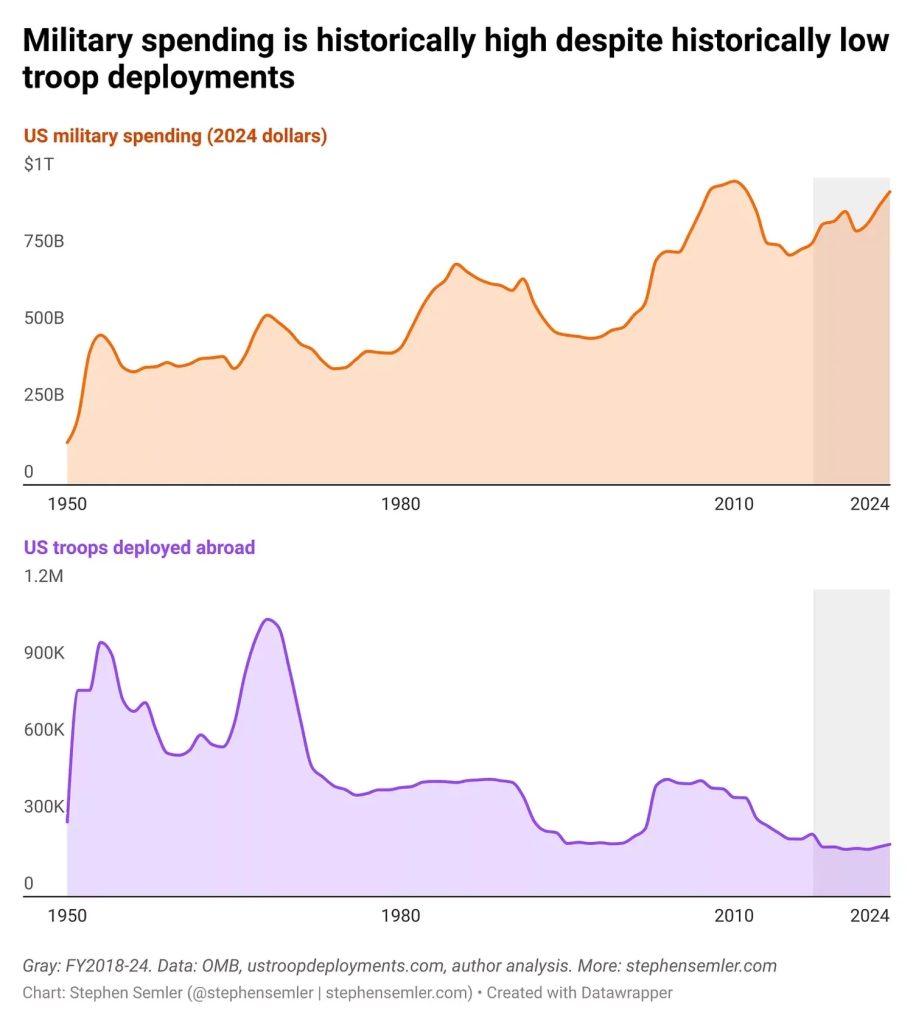
So, why is there a sudden surge in military spending? Is there an imminent threat? A new global conflict?
Not exactly.
In real-world terms, the United States is not at war in the traditional sense. U.S. troop levels are at their lowest in the modern era. International alliances, while strained, remain intact. And even with conflicts simmering in the Middle East and tensions rising in Asia, most analysts agree: we’re not in 1943. So, why are we budgeting like this?
Adjusted for inflation, this year’s military spending mirrors levels last seen during World War II. That’s a sobering comparison, especially considering the scale of that conflict—multiple theaters, tens of millions deployed, and global devastation. Today’s military challenges are real but bear little resemblance.
And yet, Congress approved the increase with bipartisan speed.
Where the Money’s Going: A Closer Look
The bulk of the added funding appears to serve three main goals: keeping defense contractors flush with cash, preparing for hypothetical high-tech wars, and expanding America’s already vast arsenal of destructive capabilities.
A sample of the spending highlights:
- $2.5 billion to offset overruns in Northrop Grumman’s troubled ICBM modernization program, which is already 80% over budget.
- $4.5 billion earmarked for the next-generation stealth bomber—despite mounting questions about its necessity or legality after its recent use in the bombing of Iran.
- $500 million for upgrades to America’s existing nuclear weapons systems.
That’s not defense. That’s deterrence theater—and expensive, opaque, and dangerous theater at that.
![]() An Alternative Vision: Checks, Not Bombs
An Alternative Vision: Checks, Not Bombs
 An Alternative Vision: Checks, Not Bombs
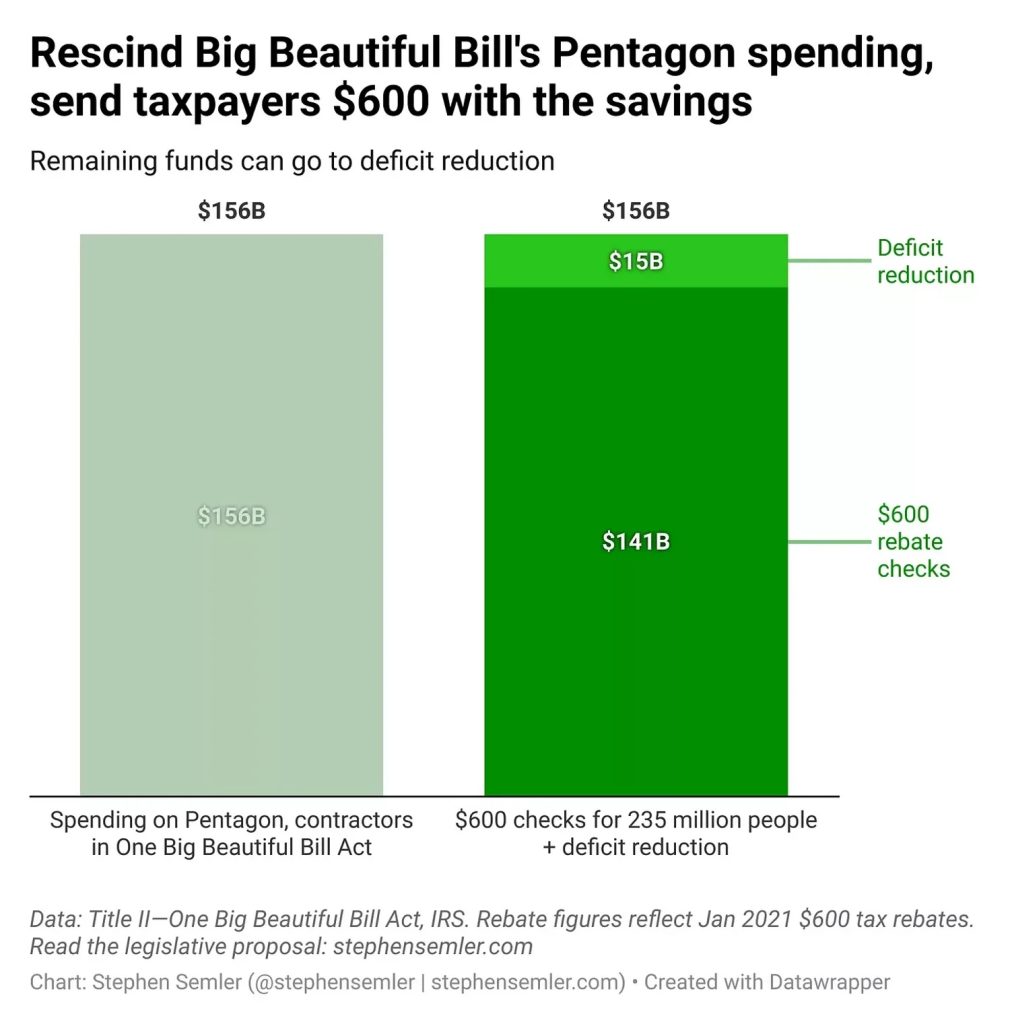
Not everyone is taking this trillion-dollar pivot lying down. A small coalition of lawmakers and policy analysts is floating an alternative: roll back the $156 billion increase and use the money to help ordinary Americans.
Their idea? A new proposal dubbed the STEPHEN’S Act—short for Stopping Taxpayer Exploitation by the Pentagon to Help Everyone’s Needs and Security. Yes, it’s a tortured acronym. But the substance is serious.
The plan calls for:
- Rescinding the $156B Pentagon increase
- Reissuing $600 checks to every taxpayer and qualifying dependent
- Putting the leftover billions—estimated at $15 billion—toward reducing the deficit
It’s not the first time this idea has been floated. The 2021 recovery rebates were similar in structure, and over 235 million Americans received them. Two-thirds of the funds went to households earning less than $50,000. None went to those making over $200,000.
In short, this isn’t just feasible—it’s already been done.
Would It Work Politically? Surprisingly, Yes
Polls show a strong public appetite for such a move. More than 56% of Americans support reducing defense spending and redirecting the funds to address social needs. Meanwhile, 63% support a new round of direct relief to help with rising costs of living.
With 66% of the country living paycheck to paycheck and nearly 40% facing financial distress, the economic rationale is clear. Politically, it also checks every box:
- Fiscal conservatives can claim deficit reduction and government accountability.
- Progressives can frame it as a blow against corporate welfare and militarism.
- Mainstream voters get cash in hand—no small thing in an election year.
And any lawmaker who votes against $600 checks to their constituents? That’s a campaign ad waiting to happen.
A Budget Is a Moral Document
As the dust settles on the trillion-dollar defense bill, Americans are left to ask: What does this budget say about our national values?
We live in a country where housing is unaffordable, medical debt is rampant, public schools are underfunded, and millions struggle to feed their families. But we somehow found space in our budget for nuclear missile upgrades and stealth bombers.
Budgets reveal priorities. And for now, Washington’s priorities are clear.
But they don’t have to stay that way.
