
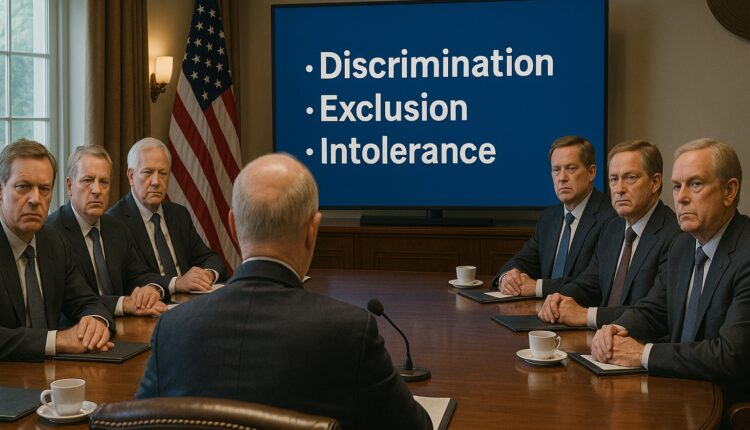
The new DEI: Discrimination, exclusion, and intolerance
In the age of the new DEI, you don’t just get shown the door—you get invoiced for touching the handle.
It begins innocently enough, as all recent American reversals do, with a noisy, incoherent press conference and a color choice. The president stands at the podium, unveils a striking blue logo, and announces the new national initiative: DEI. Not Diversity, Equity, and Inclusion—those are yesterday’s buzzwords, he explains with the satisfaction of a man who has just discovered Monopoly money is not legal tender. No, this DEI means Discrimination, Exclusion, and Intolerance, the main tenets in the New and Revised American Way Manual of 2025.
The rollout is seamless. Universities go first. Harvard announces an audacious new admissions policy: all applicants are welcome to apply, provided they are the grandsons (yes, grandsons, not granddaughters) of someone previously admitted on the basis of donations worth millions of dollars. In a show of magnanimity, Yale promises to consider “non-traditional candidates,” by which it means legacy families who have temporarily moved abroad to avoid taxes. College brochures, once full of smiling students of every hue, are reissued in stylish black-and-white, the diversity removed in post-production, as required by the university’s settlement to avoid the president’s termination of federal grants.
Government agencies soon follow. The Equal Employment Opportunity Commission rebrands as the Unequal Opportunity Commission, its new mission “to ensure every workplace has a clear hierarchy, who belongs, and who really should go back to where they came from.” Public service posters appear in airports showing Black, Hispanics, and other ethnic groups except WASPs: E Pluribus Unum (But Not You).
In law schools, Constitutional Law I is replaced with “Constitutional Commandments: God’s Greatest Gifts.” Students no longer read Brown v. Board of Education, for it is too divisive. Instead they study the less familiar White v. Comfortable Majority designed to ensure that no one is offended. Exams test a student’s ability to write “strict scrutiny is bad” in Latin and how to turn originalism and textualism into pretzels shaped like the administration’s arguments.
The military, not to be outdone, revises its code of conduct. Don’t Ask, Don’t Tell is reborn as Do Tell, Loudly, and Often, so We can Kick You Out. Boot camp adds new modules: “Ignoring Human Suffering 101” and “Advanced Staring Straight Ahead.” Drill sergeants receive medals for spotting “nonconformist vibes,” a category that includes enjoying jazz or yoga. Hundreds of admirals and generals brimming with mandarin squares, medals, and ribbons are summarily dismissed if any Russian mole spreads the rumor that they are woke or collaborators with the previous DEI regime. Their true desire, of course, is to weaken the American military and even compromise it via TikTok coded messages.
Critics suggest the new DEI is unconstitutional, but the Supreme Court reassures the nation by issuing a six-three opinion styled Shrug v. Logic. The majority clarifies that “originalism” means whatever the Founders might say after several bottles of Madeira.
Meanwhile, ordinary citizens begin to embrace the program. At town halls, residents take turns publicly excluding each other. Churches introduce Intolerance Sundays, where parishioners can shout “not in my pew” at strangers. In one particularly successful pilot program, a Midwestern library installs a “Restricted Section” consisting of every book not specifically approved by the Federalist Society.
During his appearance at the United Nations, the President calls the new DEI a triumph of American values. “For too long,” he says, “we’ve been told to open our doors to an invasion of criminal aliens.” Today we close them. Firmly. With the deadbolt engaged.” The delegates from every other country except Israel laugh, but Fox News audiences cheer. The new DEI arrives.
When I previously perused an Ivy League university brochure that promised a tour of its “new DEI program,” I naively assume they mean the old diversity, equity, and inclusion, since that’s what universities are famous for. Instead, the tour guide, a cheerful sophomore in a blazer with a crest depicting a locked gate, explains that here DEI stands for the new set of goals: Discrimination, Exclusion, and Intolerance, especially against those with student visas or defending the rights of Palestinians.
We begin at the Admissions Office, where prospective students are divided into two lines: “Legacy” and “Other.” The Legacy line is ushered inside immediately. The Other line is given complimentary binoculars to better admire the building from across the street. “We like to set expectations early,” the guide says.
Next, we visit the library, now renamed The Citadel of Approved Thought. Its collection is pared down to just three categories: “Founding Fathers,” “The Federalist Papers,” and “Cookbooks with No Spice.” When a student requests James Baldwin, she is gently escorted to the parking lot and given a pamphlet about trade school.
In the lawn of the Student Center, I observe a seminar called Learning to Exclude. The professor asks, “Who here has a friend with a suspiciously hyphenated last name?” Hands shoot up eagerly. Participation counts for ninety percent of the grade.
Lunch is served in the dining hall, where seating is divided into zones. “Inclusive seating was confusing,” the guide explains. “Now everyone knows exactly where not to sit.” I try to join a table labeled Miscellaneous but am reminded that it has been decommissioned after the last accreditation review.
Finally, we stop at the quad, where banners read: Different Is Dangerous. Equal Is Excess. Included Is Intrusion. The guide beams. “Our new DEI really prepares you for the world outside,” she says, handing me a rejection letter pre-printed with my name.
I leave campus feeling oddly enlightened. I have a clear picture of the future: one in which the doors are not only closed, but locked from the inside, with a friendly student waving at you through the glass.
Rejected from higher education but still hungry for purpose, I wander into the local military recruitment office. A poster in the window catches my eye: “Join the Army of Intolerance: Be as Obstreperous as you Want to Be.”
Inside, the décor is a mix of patriotic bunting and laminated signs clarifying what “types” are currently not welcome. The recruiter, a square-jawed sergeant whose haircut resembles a geometry proof, greets me with a firm handshake and a clipboard.
“University said no?” he asks, glancing at the rejection letter still in my hand.
I nod.
“Perfect. That means you’re resilient. Around here, exclusion isn’t a setback, it’s a qualification.”
He leads me past a display of uniforms, all one size. “No tailoring,” he explains. “Uniformity means uniformity.”
At the testing station, I am given the DEI Aptitude Exam. Section One asks me to circle which groups make me “uncomfortable” in a public park. Section Two asks me to write a 500-word essay on why House music is suspicious. Section Three is simply a blank page with the instruction: “Stare straight ahead. Do not empathize.”
I pass with flying colors—or rather, with just one approved color.
The sergeant claps me on the shoulder. “You’ll do fine,” he says. “Our boot camp replaces sensitivity training with Insensitivity Training. Recruits learn to march past suffering without blinking. You’ll soon be able to see people starving to death and not care. It’s all about discipline.”
In the corner, I notice a mural of the new slogan: “Don’t Ask, Do Tell—Especially If It’s About Your Neighbor.” Below it, a smiling drill instructor points at the words, as if daring you to disagree.
I ask about benefits. “Three square meals, four square walls, and absolutely no room for squares who don’t belong,” the sergeant replies.
I sign the paperwork. After all, if the doors of academia are locked, at least the military offers a place to stand in formation, shoulder to shoulder, while facing resolutely away from the rest of the world.
With my university dreams dashed and my military career stalled after I am discharged for humming Bad Bunny songs in the barracks, I turn to civil service. A sign at the employment office reads: “Now Hiring for Government Agencies—No Experience, Just the Right Attitude.”
I am ushered into a cubicle decorated with flags, portraits of the president, and a prominently displayed Unwelcome mat. The interviewer, a mid-level bureaucrat in a gray suit that seems allergic to sunlight, gestures for me to sit.
“Welcome to the Department of Homeland Purity,” he says. “Our mission is simple: ensure that government services are delivered to some people, some of the time.” He slides me an application stamped with the DEI seal: Discrimination, Exclusion, Intolerance.
The form asks the usual questions—name, address, social security number—followed by less usual ones: “Whom would you exclude first in a flood?” “Rate your intolerance on a scale of one to ten, with ten being your own grandmother if she voted incorrectly.”
During the interview, he tests my reflexes by holding up pictures of diverse individuals. My task is to decide, instantly, whether each person deserves a driver’s license renewal. I hesitate on one. “Too slow,” he says. “Hesitation suggests fairness.”
He then outlines the benefits. “Health insurance covers only pre-approved ailments, mostly paper cuts. Vacation days are available, provided you don’t try to visit anywhere unfamiliar. And retirement? You’ll be excluded well before then.”
At the end, he leans across the desk. “You seem like a good fit. But remember: in this office, inclusion is intrusion. We prize clarity. Everyone must know exactly who isn’t welcome.” The clarity is obvious in posters showing people of color with bullseyes on their foreheads.
I sign the offer letter. As I leave, another poster in the hallway reassures me: “The New DEI: Because Equality Is Getting Out of Hand.”
I step into the sunlight, employed at last, my future secure—at least until someone decides I don’t belong either.
It doesn’t take long. After two weeks at the Department of Homeland Purity, I am called into Human Resources (a title now shortened to Resources, since the “human” part is considered unnecessary). I am informed that my handwriting leans “too inclusive” and my lunch choices suggest “culinary diversity.” By the afternoon, I am escorted out of the building by two guards with clipboards.
Adrift again, I hire a lawyer. His office is in a strip mall between a payday loan store and a tanning salon. The door reads: Cravendish, Grovel & Flinch, Attorneys at Law. Specialists in Exclusionary Litigation.
My lawyer, Mr. Flinch, greets me with a handshake so limp it could be legally classified as an apology. He wears a tie patterned with gavels, all pointed downward.
“You’ve come to the right place,” he says. “We’re pioneers in the field of reverse-civil rights. Our motto is: We don’t get you in—we keep others out.”
I explain my case: wrongfully excluded from my government job under the new DEI initiative. Flinch listens gravely, nodding like a man who is paid by the nod. “We’ll file a suit immediately,” he says. “The charge: Failure to Discriminate Properly. Under current precedent, that’s actionable.” He scribbles on a yellow pad, every line beginning with the word whereas.
In court, the judge (part crane, part vending machine, if memory serves) asks whether I am seeking reinstatement. My lawyer objects: “Your Honor, my client is not asking to belong. He is asking to belong to the category of those who clearly do not belong, which under the statute is a recognized group.”
The prosecutor counters that my very presence violates the Department’s mission statement. The jury, composed entirely of legacy law school graduates, deliberates for eleven minutes, most of which are spent discussing whether Rhythm and Blues counts as treason.
The verdict: exclusion upheld. I am fined for attempting to include myself in the proceedings.
Outside the courthouse, Flinch assures me I have grounds for appeal. “Not to worry,” he says, handing me a bill the size of a mortgage. “The system may be intolerant, but it is never free.”
I walk away with a lighter wallet and a heavier understanding: in the age of the new DEI, you don’t just get shown the door—you get invoiced for touching the handle.
