
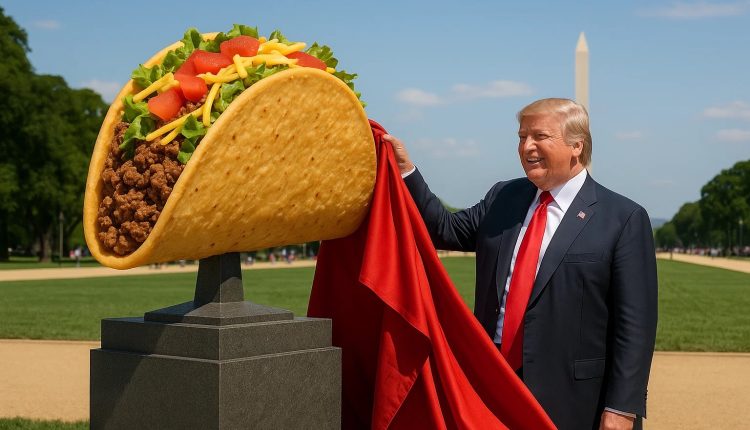
The man who mistook a deadline for a TACO
The acronym originated when a Financial Times journalist, Robert Armstrong, used TACO to describe Trump’s pattern of issuing tariff threats and then pulling back.
By the time you finish this paragraph, Donald Trump could have issued another ultimatum. He would have drawn a bright red line in the sand, a wave would have washed it away, and he will have pretended it was never there. This is not speculation; it is a governing method. His inner circle calls it “negotiating.” His critics, with a taste for culinary shorthand, call it TACO — Trump Always Chickens Out. The acronym originated in May 2025—coined by Financial Times journalist Robert Armstrong to describe Trump’s pattern of issuing tariff threats and then pulling back. It quickly gained traction in the media because the name fits so aptly: loud on the outside, fragile, and hollowed out before you bite.
The latest case study is his pas de deux with Vladimir Putin. First, Trump gave the Russian leader exactly fifty days to agree to a ceasefire in Ukraine. The precision of the number—not forty-nine, not fifty-one—implied calculation, perhaps even strategy. But strategy is like a virus for Trump. Within days, the deadline was compressed to twelve days. The intended message was urgency; the effect was self-parody. And when the countdown ended without any meaningful progress from Russia? Nothing. No sanctions, no pressure, not even the diplomatic equivalent of a dirty look. Instead, Trump announced a summit to be held in Alaska on August 15, 2025, with no substantive concessions from Moscow in the meantime— just him and Putin, no Europeans, no Zelensky—and before even arriving at the table, he gave away the main point: Ukraine would have to surrender the 20% of its territory already occupied, and Russia would “trade” some of its own (perhaps a two-acre potato field), a formulation so lopsided it must have been drafted in the Kremlin. In fact, Putin’s demands continue to include Ukraine’s neutrality, demilitarization, and withdrawal from wide-ranging regions—demands widely rejected by Kyiv and its allies. This was appeasement as pre-game show, capitulation without contest.
If this were a single lapse, one might attribute it to fatigue or bad advice. But the first major proof of concept for TACO diplomacy came in 2017, when Trump threatened North Korea with “fire and fury like the world has never seen” if it continued its nuclear provocations. It was the kind of line that sends Pentagon aides scrambling for bunker maps and cable news producers searching for red chyrons. But by the following year, the nuclear brinkmanship had given way to a courtship ritual unseen in modern geopolitics. Kim Jong-un, once “Little Rocket Man,” became “Chairman Kim,” then simply “Kim,” and finally, to hear Trump tell it, the kind of pen pal you’d save letters from in a shoebox under your bed.
“They’re beautiful letters,” Trump told the cameras in September 2018. “We fell in love.”
The letters were indeed real—lushly written, as if Kim had hired the ghost of Pablo Neruda to moonlight for the DPRK Foreign Ministry. In them, Trump was hailed for his “exalted reputation” and “energetic activities” for world peace. Kim proposed further “historic meetings,” while Trump reciprocated with invitations and self-portraits in the medium of adulation sounding like they were gay lovers. It was a pen-pal romance conducted against the backdrop of missile tests and human rights violations, a duet scored for thermonuclear warheads and diplomatic stationary. And when the two finally met in Singapore and later in the DMZ, the world was treated to the spectacle of a U.S. president striding across the demarcation line into North Korea, grinning like a man surprising an old flame. The summits produced photo albums, commemorative coins, and a shelf’s worth of presidential braggadocio. What they did not produce was denuclearization. North Korea kept its arsenal, expanded its missile program, and returned to issuing threats once the summitry fizzled. But in the TACO method, the outcome mattered less than the optics. Trump had replaced “fire and fury” with a stack of love letters and declared the mission accomplished— more branding and no substance.
A year later, he launched his trade war with China. The tariff announcements came in waves, like a bad weather forecast: sweeping levies in March, delays in April, suspension in May, re-imposition in June, and finally the much-ballyhooed “phase one” deal in January 2020. The deal included commitments from China to purchase additional U.S. goods, but China did not meet the $200 billion additional purchase target, and most tariffs remained in place. That agreement’s enforcement provisions relied on Beijing’s goodwill — a commodity in short supply even in the best of times. American farmers took the brunt, and China’s economic rise continued undisturbed.
His second term rolled out with what he theatrically dubbed “Liberation Day” on April 2, 2025. He invoked emergency powers to slap a 10% universal tariff on nearly all imports, plus steeper “reciprocal” rates—carving out a policy so broad it could tar every country under the sun. Markets tanked. Traders scrambled. A 90-day pause followed—but Chinese tariffs rose in kind, from 84% to as high as 125%, while U.S. tariffs on Chinese goods soared to 145%—the stuff of caricature. Then came the “reset.” In Geneva, both sides agreed to reduce the tariffs—America from 145% to around 30%, China from 125% to about 10%—for 90 days, pending further talks. By summer, the theater continued. A meeting in Stockholm aimed to extend that truce. London hosted rare‑earth license negotiations. Meanwhile, China quietly diverted its exports elsewhere—from Southeast Asia to Africa and the EU.
In the meantime, Trump declared he might meet Xi if a deal is done and even allowed Nvidia and AMD to sell AI chips to China—so long as they handed over 15% of their revenue back to the U.S. Treasury. All this wrapped in soundbites: “China will suffer more,” he said, even as Americans faced fewer dolls (“Maybe the children will have two dolls instead of 30 dolls.” Trump said, in an opulent setting), harder prices, and a court ruling that invalidated many of his “Liberation Day” tariffs as illegal.
So here’s the pattern on display:
- The Ultimatum: A sweeping, blockbuster announcement engineered for optics.
- The Escalation: Tariffs spiral into absurd territory—double, triple digits.
- The Truce: A roll-back with fanfare, labeled as “historic deal.”
- The Price: Consumers pay more, economists flinch, courts push back.
- The Punchline: The “deal” is less a resolution and more a rerun—same tricks, new stage.
Why this qualifies as TACO? Because Trump rarely follows through on the leverage he creates. He builds mountains of pressure—tariffs so high they’d derail a freight train. And then he steps offstage, announces he’s ready to turn it down, and claims credit for lowering the boom.
In July 2019 came Afghanistan. Seated beside Pakistani Prime Minister Imran Khan, Trump boasted that he could “win the war in a week” by “wiping Afghanistan off the face of the Earth” — but that he didn’t want to kill “10 million people.” It was part swagger, part benevolent self-portrait, as if restraint were a gift only he could give. Less than a year later, his administration signed the Doha Agreement with the Taliban, excluding the Afghan government from the talks. The deal committed the U.S. to a full withdrawal in exchange for vague Taliban promises. It was a blueprint for departure, not victory. By the time the last American troops left under Biden in 2021, the chaos was baked in; the Afghan allies Trump had bypassed were left to fend for themselves.
Domestically, the TACO trail is just as rich. The “big, beautiful wall” that Mexico would pay for became a patchwork of steel bollards funded by U.S. taxpayers, with miles of planned construction abandoned. A few sections were so flimsy they could be breached with tools from a hardware store. The “day one” promise to repeal and replace Obamacare evaporated in the Senate when Trump failed to rally his own party. Even his rallying cry to “lock her up” — aimed at Hillary Clinton — was quietly shelved once the campaign ended, replaced by a cordial handshake at a Washington dinner.
His NATO performance was another classic: threatening to “walk away” if allies didn’t increase defense spending, only to sign off on communiqués reaffirming the alliance. European leaders learned to treat his bluster like bad weather — inconvenient but not lasting.
These episodes are not outliers; they are the operating system. Trump’s ultimatums are set pieces, designed to project dominance in the moment but destined to expire unused. The Ukraine affair is merely the latest iteration, with the added irony that Russia is weaker now than at any point since the war began. Its war chest depends on oil sales to China, India, and a few other countries—sales that could be throttled by secondary sanctions. That leverage remains untouched while Trump pre-offers concessions, as if tipping a waiter before placing the order.
The tragedy — and the comedy — is that everyone has learned the pattern. Allies hold their breath until the next pronouncement. Adversaries smile and wait it out. And through it all, the taco shell of the metaphor remains brittle, noisy, and destined to collapse before the first bite.
In diplomacy, as in dining, there is such a thing as overpromising on the menu.
