
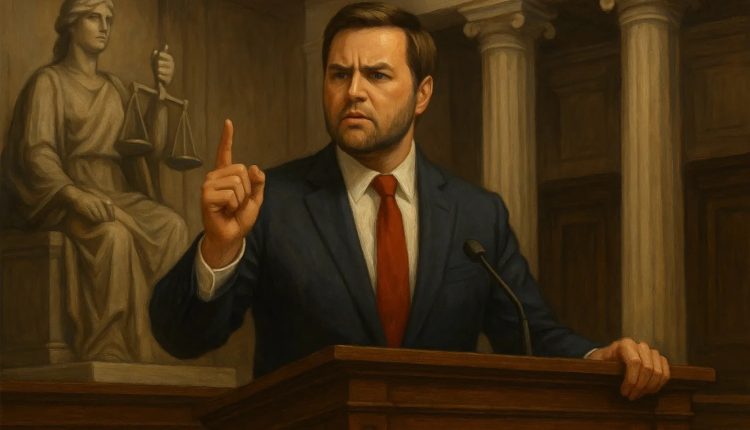
The constitutional illiteracy of J. D. Vance
When Vice President J. D. Vance recently announced that the administration would “follow the law” but not a federal court order mandating full funding for SNAP benefits, he may have believed he was drawing a fine distinction between reason and judicial excess. Instead, he revealed something more fundamental: a misunderstanding of what the law is. For more than two centuries—since Marbury v. Madison, in 1803—it has been “emphatically the province and duty of the judicial department to say what the law is.” That Vance, a Yale-trained lawyer, doesn’t grasp this—or, worse, pretends not to—suggests not just ignorance, but a deliberate political subversion.
The problem with J. D. Vance is not that he fails to understand constitutional law. It’s that he does understand it and prefers a different version, one where the judiciary exists as an advisory board rather than a co-equal branch. His statements over the past year reveal a pattern of hostility toward judicial authority that would have startled even the most hard-boiled Jacksonian. “Judges aren’t allowed to control the executive’s legitimate power,” he said earlier this year, echoing Andrew Jackson’s apocryphal retort to Chief Justice John Marshall: Now let him enforce it. The remark drew applause from parts of the populist right—and uneasy glances from everyone else who remembered the Trail of Tears.
In Vance’s telling, the courts are not a guardian of law but an aristocratic obstacle, thwarting “the will of the American people.” He said as much in May, when he accused the Supreme Court of “literally overturning the will of the people.” It was an astonishing inversion of the very logic of constitutionalism. The Founders did not entrust “the will of the people” to momentary passions or the executive’s self-certified virtue; they designed a system in which courts could say no precisely when presidents and majorities said yes.
To be fair, Vance’s allergy to judicial constraint fits neatly within the broader project of Trumpism 2.0, where legality is treated as a matter of willpower. The courts are legitimate only when they agree with the executive; when they don’t, they are “politicized.” It’s a philosophy of power dressed in the populist rhetoric of democracy. Vance, who once described Donald Trump as “cultural heroin,” now serves as his most dutiful counsellor in the alchemy of grievance into governance.
Consider his recent comment on the Supplemental Nutrition Assistance Program: a federal judge orders compliance with the law; Vance calls the ruling “absurd” during a roundtable with Central Asian leaders at the White House and says the administration will not comply, while nonsensically assuring us that it will “follow the law.” He justifies noncompliance by invoking political circumstance—the Democrats’ alleged obstruction of the budget—as though legality were contingent on convenience. One can almost imagine the footnote in a future casebook: Vance v. Madison (2025), holding that the executive branch need not obey judicial orders that it finds “unreasonable.” One could also imagine a new J.D. Vance School of Law teaching nonsense and following the outline of the fraudulent Trump University.
The deeper irony is that Vance built his career on the mythology of responsibility. His Hillbilly Elegy memoir was, at its core, an ode to order—moral, cultural, familial. Yet as a public official he flirts with anarchy in tailored suits, sanctifying defiance when it flatters his base. Neither attending classes nor participating in the Yale Law Review seems to have taught him that in a constitutional republic even the president’s whims are subject to the law; but the lamentably unschooled crowds in Lima and Findlay, Ohio, reward him for his ignorance.
It would be tempting to dismiss all this as performative bluster, another round of populist theater for the cameras. But words have a way of hardening into doctrines, especially when uttered by men with microphones and ambitions. The line between contempt for courts and defiance of them is shorter than it appears. One day, a senator may call a ruling absurd; the next, an administration ignores it. The Constitution, famously, has no army. Its strength depends on the faith of those who swear to uphold it.
However, there’s a sinister plan behind Vance. A similar posture appears in Project 2025, the Heritage Foundation’s sweeping blueprint for a second Trump administration, which reads like an ideological companion piece to Vance’s pronouncements. Buried in its bureaucratic prose is a revolutionary ambition: to collapse the separation of powers into a single, unitary executive whose will radiates downward through every department and commission. The plan treats the judiciary, like the civil service, as an obstacle to be subdued rather than an equal branch to be respected. It envisions an administrative order staffed by loyalists, liberated from the “deep state” and therefore from independent oversight. Behind its language of efficiency lies the same suspicion of constraint that animates Vance’s defiance of the courts—a conviction that legality should flow from authority, not authority from legality. Where the Constitution imagines tension among the branches, Project 2025 imagines obedience. We have been seeing the project’s implementation piece by piece every day.
So, when J. D. Vance speaks of “the people’s will,” he seems to mean his own. That, in the end, is the oldest heresy in politics: the conviction that power legitimizes itself. Every republic begins with the assumption that law stands above men. Every decline begins when men say otherwise.
