
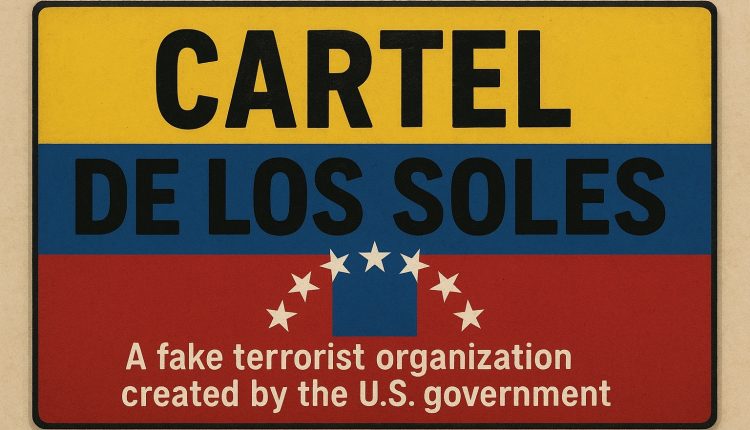
The Cartel de los Soles designation: A useful disguise for regime-change options
U.S. appears to be treating Venezuela’s weak and fragmented criminal networks as if they were an organized terror group — then tying the country’s senior leadership directly to them.
On November 24, 2025, the United States Department of State officially designated the Cartel de los Soles (CdS) as a Foreign Terrorist Organization (FTO). The formal designation, published in the Federal Register, places the alleged network — said to be headed by Nicolás Maduro and his inner-circle lieutenants — in the same legal category as al-Qaeda or ISIS. But what if this designation is less about confronting serious transnational terror, and more about constructing a narrative to legitimize intervention in Venezuela?
When one reads the public record, a curious pattern emerges. The U.S. administration claims the CdS is a structured cartel, traffics cocaine and other illicit goods into the U.S., and is responsible for “terrorist violence throughout our hemisphere.” Yet several respected analysts note that the CdS does not resemble the sort of vertically integrated, command-and-control cartel that U.S. law enforcement typically confronts. Rather, it is more accurately described as a nebulous set of corruption networks within the Venezuelan military and government.
In other words, the U.S. appears to be treating Venezuela’s weak and fragmented criminal networks as if they were an organized terror group — then tying the country’s senior leadership directly to them. The result is a story that turns a modernizing Latin American regime into a narco-terror state, warranting extraordinary responses.
Let’s assume for the sake of argument that the CdS, as the U.S. describes it, does not exist in recognizable form — or at least, that the evidence offered is thin. The Venezuelan government, for its part, denounces the designation as a “ridiculous fabrication … used to justify an illegitimate and illegal intervention” in Venezuela. From this vantage, the designation looks like the creation of a legal and rhetorical vehicle: “We have designated them an FTO, therefore we have options” — options that include military options. As one Pentagon official put it: the designation “brings a whole bunch of new options to the United States.”
Then why invent or exaggerate a terror–cartel structure over Venezuela? The answer is tempting: the U.S. enjoys a broad palette of legal authorities when a group is labelled an FTO — authorities less tied to conventional counter-drug policing and more embedded in the counter-terror-framework. That provides the Administration (and Congress) with greater scope for sanctions, black-listing, asset-freezing, and perhaps even kinetic operations. Indeed, if Venezuela’s government (and thus the state itself) is equated with a cartel/terror organization, then the traditional norms of sovereignty and non-intervention shift. The fog around “narco-terror” becomes a useful disguise for regime-change options.
But this approach is perilous. If the underlying organization is poorly defined or evidence is scant, then we risk conflating political opposition (or strategic adversaries) with terrorists — a classic abuse of power. Worse, it can erode the legal safeguards around war powers, due process, and the right of states to self-govern. In short, by designating the CdS as an FTO despite the fragile underlying case, the U.S. may be opening the door to a militarized intervention framed as counter-terror, but in effect political.
Moreover, the United States has a long and messy history of intervening in Latin America under the guise of drug war and national security. Here, even the name — Cartel de los Soles (“Cartel of the Suns,” based on sun-shaped insignia worn by Venezuelan generals) — suggests the term was coined by journalists and investigators; it was never a self-identified cartel with clear leadership hierarchy. So the label serves more as a narrative tool: you impute to a regime the worst of criminal and terrorist features, bundle them together, and then justify sweeping responses.
Another red flag: governing institutions within U.S. drug-policy and intelligence do not appear to treat the CdS in the same way they treat other cartels. For example, the Drug Enforcement Administration (DEA) national drug threat assessment reportedly does not highlight the CdS in the same term one would expect for an operational cartel smuggling large volumes of cocaine into the U.S. via multiple routes. Meanwhile, the broader context shows that only around 8% of cocaine enters the U.S. via Caribbean routes — with far more coming through Central America and Mexico. That disconnect raises serious doubts about whether the U.S. is simply leap-frogging normal evidentiary thresholds and declaring a foe based on strategic, rather than strictly factual, grounds.
What happens next? The designation permits the U.S. to freeze assets, penalize third-party firms doing business with the named organization or regime, and hobble the participation of foreign financial institutions with ties to the state. More dramatically, it may allow the U.S. to deploy its military in ways traditionally off-limits to domestic law-enforcement agencies — in effect militarizing the “war on drugs” by recasting it as a war on terror. This is a serious shift in U.S. foreign-policy posture in the Western Hemisphere.
In the magazine you read this in, ask yourself: Are we witnessing a fight against genuine narco-terror, or are we witnessing the staging of a geopolitical show-down dressed in the language of terror? If the CdS label is more theatrical than substantive, then the implications are deep. We risk normalizing the use of “terrorist” designations for states or political adversaries, blurring the line between crime, insurgency and legitimate government. Venezuela becomes not just a rogue state, but a narco-terror nexus — and that happens more in Washington’s legal imagination than perhaps in Caracas’s reality.
In conclusion: By designating the Cartel de los Soles as an FTO, the U.S. has erected a legal pretext for intervention — under the bright lights of counter-terrorism. But when the underlying organization is essentially the Venezuelan military/regime loosely accused of drug-trafficking, the line between legitimate counter-narcotics policy and regime-change begins to fade. If we accept the assumption that the CdS is a U.S. fabrication — or at least an inflated construct — then the danger is that we are sliding down a slope where terror-labels become tools of foreign-policy coercion. And once that door is opened, who sets the limit?
