
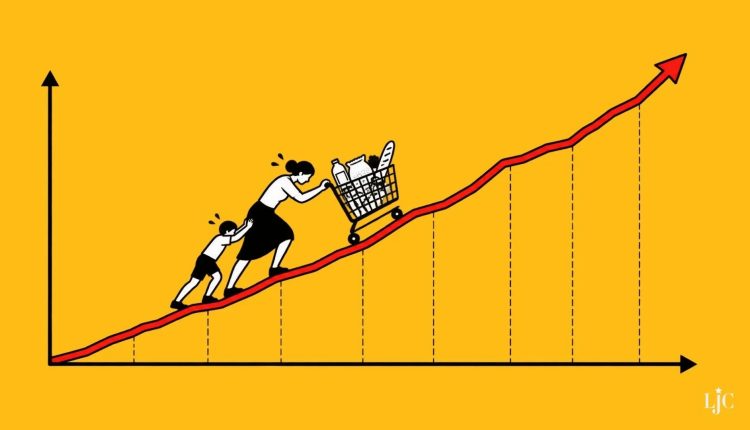
Prices keep climbing on an uphill road
The latest report from Cuba’s National Office of Statistics and Information (ONEI) has just confirmed what any Cuban who has to buy products from the basic food basket already knows: prices keep rising.
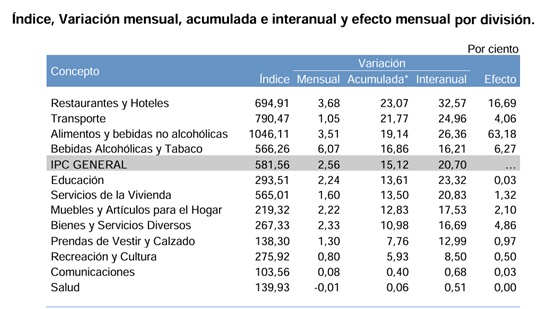
The official figures show that year-over-year inflation in Cuba’s formal market rebounded by more than two percentage points in July to 20.70%, while monthly inflation rose 2.56% from the previous month. For the fourth consecutive month, the cumulative increase in consumer prices through July 2026 exceeded that recorded during the same period in 2025—rising from 8.79% in 2025 to 15.12% in 2026, nearly doubling.
These figures show that inflation is not only remaining high but is accelerating once again, with prices rising at an increasingly rapid pace. This means a sustained loss of purchasing power and greater difficulty for households and businesses in planning spending, saving, or investing. When incomes do not rise at the same pace as prices, families are forced to reduce already severely depressed consumption, substitute products, or go without basic goods and services. Persistent inflation of this magnitude also creates uncertainty, distorts economic decision-making, and ultimately deepens poverty and inequality.
The figures are hardly surprising. Since the beginning of 2026, inflation has remained high, reflecting the country’s overall economic situation, which has been worsened by U.S. sanctions, particularly the oil blockade imposed on the island by the United States since January 2026.
The latest price increase brings a certain degree of normality, in that food, non-alcoholic beverages, and, to some extent, transportation are once again among the categories experiencing the greatest increases.
Some of us economists have argued that the reality may be worse than the official figures suggest. The collection of price data has become more standardized within state entities, while in the private sector there are numerous instances of artificially reported prices for price-controlled products or for products that are actually sold through informal channels.
By category, year-over-year increases are particularly striking in Restaurants and Hotels (32.57%), followed by Food and Non-Alcoholic Beverages (26.36%), Transportation (24.96%), Education (23.32%), and Housing Services (20.83%).
 It is no longer surprising to describe Cuba as being caught in an inflationary spiral, or even to raise the possibility of hyperinflation. Since 2021, when the monetary reform was introduced, the official exchange rate in state entities went from one dollar to one peso to 25 pesos per dollar. On the street, however, the increase was much greater, and that reality has persisted to this day. As of August 25, the Central Bank of Cuba set the exchange rate at 636 pesos to the dollar, while elToque (an e-magazine) reported the informal rate at 670 pesos per dollar.
Whichever figure is used, the exchange rate is extraordinarily high relative to Cuba’s minimum wage, which, after its most recent adjustment, is 3,210 pesos. A worker earning that salary would therefore make only about $5 per month at the official exchange rate, or roughly $4.70 at the informal rate.
In nominal terms, this would place Cuba’s minimum wage among the lowest in Latin America. Even accounting for increasingly inadequate social benefits—health care, education, and the ration book—the situation leaves workers almost completely unprotected against the relentless rise in prices.
Cuba has been mired in a severe economic and energy crisis for more than five years, with experts describing it as the worst in decades. The crisis is evident in shortages of basic necessities such as food, medicine, and fuel; high inflation; economic contraction; growing dollarization; and prolonged daily blackouts. Most importantly, there is still no clear indication that the crisis will end, at least in the short term.
The persistent rise in prices has structural causes, but in the short term, geopolitical factors have played a crucial role. The tightening of U.S. sanctions, including the oil blockade against state entities, has compounded the shortcomings of a centrally planned economic model that has not functioned effectively for a long time.
One indicator of the systematic increase in prices is the Consumer Price Index.
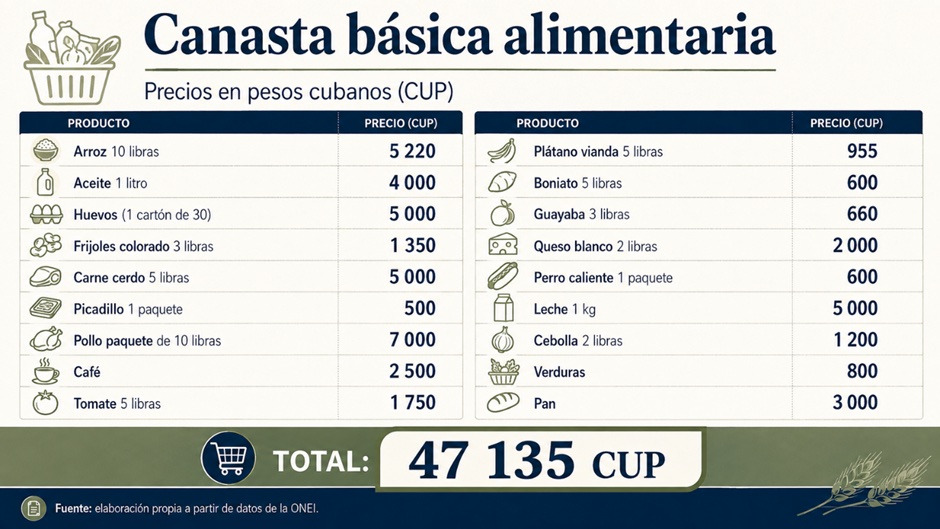
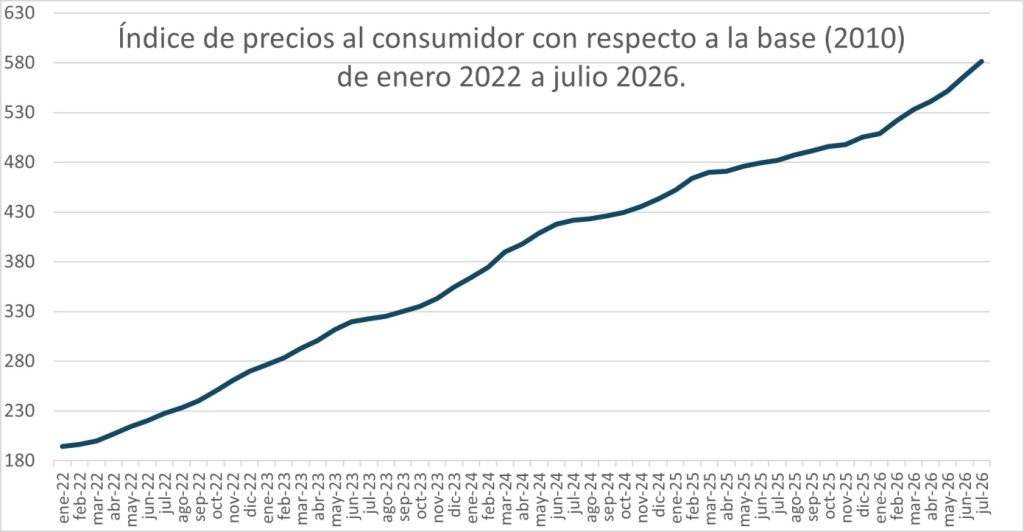 In an analysis previously conducted and now updated with the latest data from the National Office of Statistics and Information, we can see that, in Havana alone—where a significant portion of Cuba’s population is concentrated—a representative food basket for two people has increased in price by nearly 60% over the past year.
Its current estimated cost is 47,135 pesos, equivalent to approximately $74 per month at the official exchange rate of 636 CUP to the dollar, or about $70 at the informal rate of 670 CUP.
 The contrast with household income is striking.
The 47,135 pesos required for this food basket for two people are equivalent to nearly 15 monthly minimum wages. A worker earning the minimum wage could cover only 6.8% of the basket’s cost. Even in a household where two people earn the minimum wage, their combined income of 6,420 CUP would cover only 13.6% of the basket.
A single mother with one child, no additional income, and earning only the minimum wage would need to devote nearly 15 months’ worth of her entire salary to cover the cost of just one month’s worth of this food basket.
And that basket is only part of the picture. Additional expenses must be accounted for in goods and services that for decades were covered or heavily subsidized by the state and that are now increasingly falling on households.
Medicines are one example. The recent authorization of private pharmacies is a step toward expanding the supply that currently exists largely through the informal market. But so far, no mechanism has been announced to subsidize purchases at these establishments. Subsidized prices and social assistance remain largely confined to the state network—the very network experiencing the greatest supply problems.
Something similar is happening with electricity. In 2026, blackouts have at times exceeded 20 hours a day. To maintain even a minimum level of autonomy, households must buy fuel-powered generators, batteries, or solar panels. These products are available only in foreign currency and, in any case, cost more than $1,000 for a small system with a single panel. Their prices have also risen considerably in recent months because ships face difficulties docking at Cuban ports due to White House sanctions.
Public transportation has likewise been reduced to a minimum because of fuel shortages, forcing people to walk long distances or rely on private alternatives that are far more expensive.
As a result, the problem extends well beyond food—already unaffordable for many because of low wages—and also affects basic services that the public system can no longer guarantee regularly.
In general, Cuban families are now in survival mode. Much of the recent deterioration stems from factors over which the Cuban government has limited room to maneuver.
The oil blockade imposed by the United States has not only restricted fuel availability; it has also made virtually every part of the economy more expensive. Producing and transporting food, moving passengers, or keeping a business operating all cost more when fuel is scarce.
This has been compounded by pressure on maritime transportation. Major shipping companies have suspended or reduced operations with Cuba because of the risk of U.S. sanctions, reducing the country’s options for importing goods and adding costs, delays, and uncertainty to products whose final price consumers ultimately pay.
But external restrictions do not mean there is no room for action within Cuba.
Trying to contain inflation through administrative price caps does not solve the underlying problem. If selling a product at the mandated price is no longer profitable, the product disappears from the market—creating shortages—and then reappears in the informal sector at a much higher price.
Cuba’s recent experience with price caps on imported food products demonstrated precisely these difficulties. The measures were eventually eliminated nationwide, although several local governments later resumed using them, despite official recognition that such controls do not work.
The most basic response, therefore, remains to increase domestic food production as much as possible—that is, to expand the national supply. To do so, Cuba must examine which factors, given the country’s new circumstances, obstruct or slow agricultural development.
Several of these measures already appear among the economic transformations announced in 2026, including speeding up land allocation, eliminating limits on usufruct, and creating new avenues of agricultural financing.
But their impact will depend on whether they are implemented quickly and without reproducing the same bureaucracy they are meant to eliminate.
Cuba cannot decide when U.S. sanctions will end. But it can avoid adding to the price of every pound of food the cost of restrictions, controls, and internal obstacles that make producing and selling that food even more difficult.
