
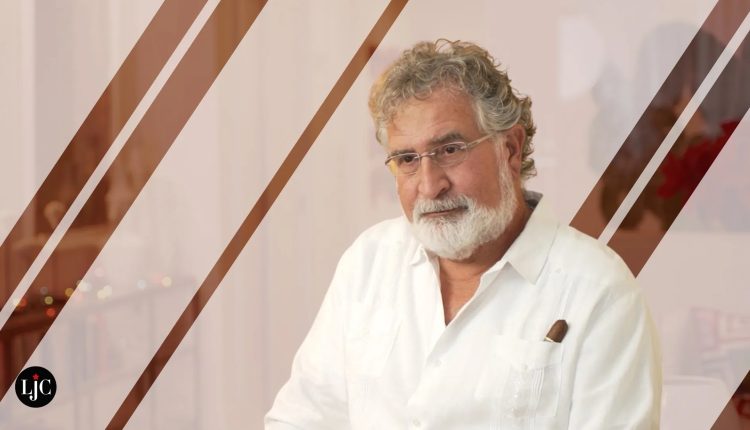
Joe García: “Revenge has never built a nation”
Cuba is changing. If a liberal and a socialist can put their hands over their hearts and speak about hope for a country that is hurting shows only one thing: the national dialogue Cuba needs may finally be within reach.
There is a Cuba where everything is turned upside down—where being a communist is considered a sin deserving public repudiation, and where Cubans allegedly eat excessively. Miami, the land of the opposition and of the aunts. “The place where the money is.”
Economic reforms in Cuba have opened a Pandora’s box. After years of confrontation, the Cuban government is now embracing the exile community more than ever—especially Cuban American entrepreneurs—encouraging them to invest in the island.
Years ago, this interview wouldn’t have taken place. The irony is clear: a left-wing journalist speaks with Joe García, former head of the Cuban American National Foundation. A conversation between wolves and sheep, where no one is quite sure who is who.
But Cuba is changing. If a liberal and a socialist can put their hands over their hearts and speak about hope for a country that is hurting; if a liberal and a socialist can discuss economics without throwing pots and pans at each other and then publish their conversation in a news outlet, it shows only one thing: the national dialogue Cuba needs may finally be within reach.
Joe García was born in Miami Beach, Florida, in 1963. He is the son of Cuban exiles who left the island during the early years of the Revolution. His family emigrated to Florida after Fidel Castro declared the Revolution to be socialist. Far from coming from a family of wealthy landowners or business magnates, his parents rebuilt their lives from the ground up in Miami. His father initially worked as a car washer before transitioning into banking, while his mother was a hairdresser.
Over time, Joe became a leading figure in the Cuban exile community, initially serving as executive director of the Cuban American National Foundation (CANF) and later as a Democratic congressman representing Florida from 2013 to 2015.
Although much of his career centered on U.S. policy toward Cuba, he didn’t visit the island until 2015, when he was already over 50. Like many Cuban Americans, Joe is part of the optimistic camp.
How do you assess the impact of Cuba’s private small and medium-sized enterprises (mipymes), and what challenges do Cuban entrepreneurs still face?
“The legalization of microenterprises (mipymes) was a cautious step for Cuba. When we introduced the idea in Miami, my friend Guennady Rodríguez — who hosts the podcast 23 y Flagler — and I faced significant backlash because it wasn’t well-received here. We brought 70 small Cuban businesses to meet with successful Cuban American entrepreneurs and suppliers from across the country. It was a remarkable event aimed at clearing up many doubts.
“Initially, everything in Cuba was very uncertain for entrepreneurs because of many institutional barriers, price controls, and bureaucracy. However, today, small private businesses are a vital part of the Cuban economy, accounting for nearly 30 percent of the country’s workforce. Entrepreneurs earned this space, and much of the capital comes from here in South Florida—resulting from the efforts of Cubans living abroad.”
According to García, the biggest challenges facing Cuban entrepreneurs stem from operating in a country with heavy external sanctions and a very weak banking system. He says anyone who wants to run a business must overcome both internal and external hurdles to remain financially viable.
“They have to bank outside the country and transfer capital across the border,” he explains.
For Joe García, the main challenges to achieving meaningful economic growth in Cuba are reducing inflation, providing legal and political guarantees to investors, and lifting U.S. sanctions.
The Financing Dilemma
Among the latest measures by the Cuban government, one in particular caught my attention: opening the country to private and foreign banks. Some view it as a necessary step to boost the economy, while others remain cautious, especially since many capitalist countries also strongly protect their own domestic financial systems.
“There are many ways to analyze that issue. However, the reality is that Cuba has maintained one of the most tightly controlled, heavily regulated, and centralized banking systems in the world for decades—and it still hasn’t been effective. We reached a point where official exchange rates had no real connection to economic conditions, and accounting mechanisms became completely detached from the marketplace.”
Joe García is considerably more receptive to international banking involvement. He contends that we live in a dollarized world and that the Cuban economy’s main source of financing is U.S. dollars from abroad, even though the country has struggled for years to operate on them.
He argues that having multiple financial institutions could help the Cuban economy.
“Governments always try to control economic processes. The problem is that when you try to control everything, you often end up controlling nothing. That’s why I believe a more open banking system can create opportunities, attract investment, and encourage more responsible monetary management.”
As I listen, I realize this is one of the reforms that raises the most questions about the future. To what extent could the government keep directing credit toward strategic sectors? What would happen to the already increasing dollarization of the economy?
The impact of this reform will depend not only on who can open banks in Cuba, but also on the rules governing how the financial system functions and on the role the government chooses to maintain in a more open economy.
For García, this is precisely where one of the main debates about Cuba’s economic future rests. In his opinion, Cuba must reconsider the role of the State and focus on creating conditions for investment and growth instead of acting directly as an economic player.
“I don’t think governments should run hotels. The government’s role should be to create the conditions for investment, not to be the main investor.”
From that perspective, García believes the country has assets that could be utilized more strategically.
“Cuba has a solid hotel infrastructure for a country of its size. Some of those assets could be used to create resources that would strengthen strategic sectors like agriculture, education, and healthcare.”
In his view, Cuba spent years prioritizing tourism investment while neglecting other productive sectors.
He applies the same logic to other parts of the economy. The State, he argues, should not run restaurants or have direct control over sectors where private businesses are more efficient. He believes that the recent reforms are moving in that exact direction. Activities that used to be under state monopoly are now opening up to new economic players—a process that might cause short-term disruptions but will also encourage investment, competition, and greater efficiency.
Therefore, he concludes, “We are reaching the end of an era.”
The conversation naturally raises a broader question. If Cuba’s economic reforms began over thirty years ago—from the legalization of the U.S. dollar in the 1990s to current measures—where is this process ultimately heading? Because the debate is no longer about whether Cuba should adopt a market economy, but rather about what kind of economy it aims to create and what the ultimate goal of this transformation will be.
To answer, Joe García cites recent conversations with some of Cuba’s most prominent economists. He explains that for years, he asked them why certain technical recommendations were never implemented. According to him, their answer was always essentially the same: economists can design policies, but politicians make the final decisions.
“Ultimately, it’s the Council of State that makes the decisions, and those decisions don’t always match what the economy truly needs.”
García believes that Cuba’s economic debate has been too influenced by ideological conflicts. He argues that the discussion should focus less on fears or political preferences and more on identifying which policies actually deliver results.
For now, he believes that the debate over a definitive economic model is less urgent than addressing the country’s immediate crisis. The main focus, he says, is on boosting production, increasing supply, and creating wealth in an economy that is critically fragile.
Before Cuba decides on the economic system it will adopt, the country must first find a way to grow again.
Which sectors do you think Cuba should focus on to recover economically?
Interestingly, Joe does not begin by mentioning agriculture, tourism, or ports—the sectors he highlighted during our discussion. Instead, his first response highlights something less obvious but equally crucial: financing.
He explains that Cuba has historically had limited relationships with many multilateral financial institutions, which have restricted its development opportunities. In his view, organizations like the Inter-American Development Bank could play an important role in any future process of economic rebuilding by providing resources to revive production, finance investment, and improve living conditions for the Cuban people.
At the same time, he acknowledges that the challenges remain significant and that no one should underestimate the severity of the country’s crisis.
Still, he thinks Cuba has begun to overcome some of the obstacles that caused the current situation.
What is still missing, he says, is something even more difficult: “If the government has truly decided to change course, then it is up to all of us to push in a direction that benefits not a government, nor a political group, nor any particular sector inside or outside the country, but the entire Cuban nation.”
The Exile Community Wants to Participate Again
What role should Cubans on and off the island play in rebuilding the country?
“Right now, it seems like half of Miami wants to become president of Cuba. And I’m serious—there are people who truly believe in their own story. They have every right to aspire to that, of course, just as anyone has the right to be eccentric. But sometimes it seems Cuba needs fewer prisons and more psychologists, psychiatrists, and mental hospitals for some of those self-proclaimed future presidents,” he says with a laugh.
For García, what lies ahead will require much more than presidents. It will require many Cubans committed to doing things well.
“When someone improves his own life, helps his family, and strengthens his community, he is also helping his nation.
“We must learn to live together better, be more civil to each other, and help every Cuban find their place and role in rebuilding the country. Some of us might not live to see the end of this journey, but maybe we’ll live long enough to see others working toward a more promising Cuba for future generations.”
The idea of rebuilding the country keeps coming up throughout our conversation. And if Joe insists that all Cubans will have a role in that process, it’s unavoidable to ask what role will be played by a community that has spent decades gathering capital, business experience, and international connections outside the island.
In which sectors of the economy could Cuban American entrepreneurs play a key role?
García becomes visibly enthusiastic. The opportunities, he says, are so extensive that it is difficult to list them all. Banking occupies a prominent place.
He notes that Miami is one of the leading financial centers in the United States and has extensive experience in international financial services—expertise that, in his view, could be especially valuable for Cuba.
He also highlights logistics, international trade, and business brokerage—activities that have long been viewed with suspicion within Cuba.
Yet, he argues, much of the global economy operates because of networks that connect producers, consumers, investors, and markets.
From there, the conversation once again shifts back to Cuba’s structural advantages.
García emphasizes the island’s tourism potential, its extensive agricultural areas, the strategic location of its ports, and opportunities in aviation, ship repair, technical services, and other industries where Cuba’s geography and labor force intersect.
“When you sit down and consider Cuba’s economic possibilities, the issue isn’t a lack of opportunities—it’s the overwhelming number of them.”
That optimism, however, clashes with a tough question.
For decades, much of the Cuban exile community has shaped its political identity through direct opposition to the government in Havana—especially to the Castro family.
How, then, do some Cuban American entrepreneurs respond when they see Raúl Guillermo Rodríguez Castro, known as “El Cangrejo” (“The Crab”), participating in discussions about Cuba’s economic future despite never having been a major figure in Cuban politics?
“Revenge has never built a nation. It has never created a future, nor has it generated opportunity.”
For García, the debate cannot be framed in terms of winners and losers.
“There are many things that could bother me, but we need to be more serious now. We’re no longer fighting an ideological battle. The merit of our arguments has been recognized—even by those who were once our enemies. The main difference is that those enemies are also our fellow countrymen.”
He believes the main challenge is telling justice apart from revenge.
“Revenge has never built a nation. It has never created a future, nor has it generated opportunity.
“Justice, by contrast, involves creating conditions that prevent the mistakes of the past from happening again and allow for a shared future to be built.”
He acknowledges that such a vision requires accepting contradictions and recognizing that any process of national transformation will inevitably involve imperfect compromises.
He recalls a recent conversation with a senior Cuban government official. “I told him it was difficult to accept an invitation when the wolf invites the sheep to dinner. He replied, ‘And who is the wolf, and who is the sheep?'”
According to García, that anecdote sums up one of the biggest barriers to reconciliation: years of mutual distrust and conflicting stories.
“For a long time, the Cuban people were taught that we were the enemy.”
Similarly, he admits that many exiles do not completely understand the realities faced by those who stayed on the island.
That is why he insists that the goal should not be to reopen old battles but to find common ground from which everyone can move forward.
“Our goal is to forge a new path and progress toward the future together. That requires thinking in terms of justice, not revenge.”
But reconciliation is more than just a political or symbolic challenge. It also has a very concrete economic dimension.
As debate over opening Cuba to international investment intensifies, an unavoidable question arises: What conditions would potential investors demand before committing their money to Cuba?
Within both the Cuban-American and broader American business communities, there is no single stance. Opinions vary widely—and sometimes are sharply divided. Some believe that a broader political opening is necessary before making major investments. Others mainly focus on unresolved legal and economic issues, such as compensation for property confiscated after the 1959 Revolution.
So I ask: What conditions must be met to generate the confidence needed to turn interest into a genuine investment?
“I see enormous possibilities, whether Cuba develops a Vietnamese-style economy, a Chinese-style economy, or its own uniquely Cuban model.”
But, he says, several issues must first be addressed.
First, the Cuban government needs to release political prisoners.
“Regarding the second point, we’ve already taken initial steps with economic liberalization. The third involves compensating Americans, as required by international law. I don’t believe that’s particularly difficult. There are many appropriate compensation mechanisms, and I have sources indicating those discussions are already in progress—at least concerning businesses that were confiscated.”
García clarifies that he is not personally enthusiastic about compensation itself, “But if it’s structured in a way that transforms that debt into value, it creates all kinds of opportunities.”
In his view, “The only thing Cuba truly has to offer is land—and you can’t pack land into a suitcase and carry it back to Miami. Nor can Cuba become one vast landed estate owned by those receiving compensation. Therefore, if those properties are not productive, the State should put them to productive use.”
The Secret Negotiations
That naturally leads to my next question. Very little is known about the contacts and negotiations occurring between Cuba and the United States. We’ve seen reports suggesting that “El Cangrejo” is playing some role, despite never having been a particularly influential figure in Cuban politics.
So I ask: Who do you think is negotiating? What is being negotiated? And, above all, is this economic opening the result of those negotiations?
“To me, these measures reflect a combination of factors,” Joe replies.
“Cuba took action out of necessity, but also in a way that benefits what might become its biggest trading partner. If you have the chance to sell something more than once, take it. The truth is that Cuba’s measures were driven both by necessity and by practical reasoning in the current context. Whether it acted voluntarily or out of obligation, the key point is that it took action.”
According to Joe, these changes were long overdue because the system had reached its limits.
He emphasizes that the situation is not very different from what occurred in the Soviet Union, although Cuba has its own particular characteristics because of its island geography and the way it has managed its resources.
Still, he says, the model’s exhaustion had become unmistakable.
Don’t you believe the sanctions regime is a major factor here—that this is fundamentally a coercive relationship?
“Certainly, the U.S. embargo has been a major barrier. But we also need to acknowledge that the Soviet Union had no embargo and still managed to transform itself. China and Vietnam were not subjected to a similar embargo, yet they also reformed their economies.”
He reiterates that whether Cuba acted out of choice, necessity, or circumstances, all of those reasons are valid if they lead to reforms that were ultimately necessary.
In that sense, he argues, Cuba is just ninety miles from the United States, which is the natural market for much of what the island produces.
“Moreover, a very large portion of the Cuban nation lives on this side of the Florida Straits, and that community will be a decisive factor in Cuba’s future.”
We’ve talked extensively about what the Cuban government must do. But what does the United States have to do to make change in Cuba possible?
Joe García says the United States must do three things:
First: Lift the sanctions.
“I want people to understand that these are more sanctions than the United States imposed on Russia during the Cold War, more sanctions than it has ever imposed on China at any point. Cuba is probably the most heavily sanctioned country in the world, and, in many ways, those sanctions exist because of the influence of us Cuban Americans.
“If the Cuban government takes the first four steps I mentioned, then the U.S. government should completely eliminate all sanctions through legislation. Donald Trump is possibly the first president with the political power to do that. No previous president has been able to accomplish it, whether for political reasons or because of the circumstances.”
Joe explains that the second thing the United States should do is allow Cuba to rejoin international financial institutions.
“Cuba needs to rejoin not only the Organization of American States but also the Inter-American Development Bank, the World Bank, and the International Monetary Fund—institutions that help establish fiscal discipline and financial oversight.”
The third condition, he states, would be for the United States to grant Cuba preferential trade status, with either no tariffs or very low tariffs.
“Like many Caribbean nations, Cuba should have free access to the U.S. market.”
He also highlights another issue both governments need to address: the roughly 500,000 Cubans the United States aims to repatriate to the island.
“Obviously, if they’ve lost their work permits, if access to the Cuban Adjustment Act has been restricted, and if people are being deported even to countries as distant as some in Africa or as close as Mexico, that’s an issue both governments have to settle.”
For García, the problem isn’t just that Cuba should accept back those Cubans who want to return.
Rather, the two countries should also negotiate so that many of them can remain in the United States. “They continue contributing services, economic activity, and wealth, just as they do today.”
Sovereignty, Opposition, and National Reconciliation
Throughout the interview, we have spoken repeatedly about justice.
Yet, when we examine the actual impact of sanctions, the embargo—or the blockade, regardless of what each side calls it—on everyday Cubans, an unavoidable question arises.
Beyond the dispute between the exile community and the Cuban government, beyond the argument that sanctions were meant as a strategy to regain control of the country, what about the suffering endured by the Cuban men and women who stayed on the island?
“The simplest answer would be to say that we all bear some degree of responsibility. But if we’re talking about who bears the primary responsibility for the well-being of the Cuban people, that responsibility falls first and foremost on the Cuban government.”
According to Joe, the governments led by Fidel and Raúl Castro had multiple chances to pursue some form of reconciliation with those on the losing side of history, but they failed to do so.
“Every great national project also requires understanding the opposition.
“Yes, we are responsible for promoting a policy of sanctions. But I also ask myself: what other effective tool was available? We didn’t want a war or bloodshed. We were stripped of political participation, our voice, and our vote; we were expelled from the country. Our options were limited: either sit back and watch Cuba’s destiny unfold or try to influence it in some way.
“It’s no coincidence that you and I are having this conversation about Cuba from outside Cuba. Many of the 176 measures recently approved would have meant prison just six months ago. And yet we also know that many of those measures were already operating de facto within the country.”
But don’t you think the simplest option for many exiles would have been simply to rebuild their lives, help their families, and move on?
“Certainly. That’s exactly what millions of Cubans did—they rebuilt their lives, supported their families, and looked forward. But another group chose to spend decades trying to have a say in their country’s future. Some did so more passionately than others, but they’ve spent over sixty years striving to influence Cuba’s destiny.”
At this point in the conversation, we disagree.
There is an entire history that precedes us.
For half of the twentieth century, Cuba served as a satellite of the United States. The country that the Cuban American lobby allied with to defend its political interests has also backed some of the bloodiest wars humanity has ever seen.
While the Cuban government bears significant responsibility for refusing to recognize as Cubans those it drove into exile, I believe the end does not justify the means.
As we say in Cuba: “It’s a lion’s fight against a monkey.”
But just as compensation for those whose property was expropriated is considered one of the conditions for normalizing U.S.-Cuba relations, I cannot help asking:
Where does compensation for the Cuban people who suffered under decades of economic sanctions fit into the equation?
Hopefully, that essential national dialogue will start only when all sides recognize and compensate those who have been affected.
Joe, the United States has historically pursued an interventionist policy throughout Latin America. There are countless examples of direct and indirect intervention, and many Latin Americans believe Washington has treated the region as its own backyard. There are also cases such as Puerto Rico, whose political status remains unresolved. Do you think Cuban American business leaders and the more politically active sectors of the diaspora are genuinely concerned about Cuba’s sovereignty? Do they want an independent Cuba—or one subordinate to the United States?
“I believe one thing has become clear from the positions of almost all the influential players, both inside and outside Cuba: no one is advocating for the elimination of Cuban sovereignty. That includes Cuban Americans, Cubans living abroad, and many political actors on the island.”
But isn’t there still a very real risk? Cuba will remain a small country just ninety miles from a superpower.
“Of course, there is a risk. There always is. But nations are meant to take risks. A ship is safe in the harbor, but ships were not built to stay in port—they were built to sail.
“The same applies to countries. Their mission isn’t just to protect sovereignty. They must also foster prosperity, create opportunities, and secure the well-being of their citizens.
“For too long, Cuba’s strategy has focused solely on resistance. As a result, the ship never even left the harbor—it crashed before setting sail. Every nation, especially a small one near a great power, must learn how to navigate risks. That is simply the reality.”
For Joe, the first form of sovereignty is the ability to live with dignity, participate in the country’s life, and build a personal future within it.
He argues that when citizens are deprived of every means of participation—when they are prevented from influencing public affairs, dissenting, or advocating a different course for the nation, and when efforts to create alternatives are criminalized—a serious problem exists.
“Every citizen should have the right to envision a different future for their country and to defend that vision peacefully. There are still many places in the world where that right does not exist. That is also a discussion Cuba will have to confront.”
After all the difficult questions, let me ask you a friendlier one, I tell him, and he laughs. Can you imagine yourself participating in politics inside Cuba?
“Honestly, I’m not considering a political career. I’m in a different stage of my life now. Besides, I see many young, talented, and well-prepared people who could take on those responsibilities.”
Joe hopes that Cuban entrepreneurs will continue to gain greater freedom to operate.
According to him, many have shown remarkable abilities despite encountering very challenging conditions.
“Just imagine what they could achieve if they had more economic freedom and better institutional support.
“Maybe some of them will eventually go into politics as well. After all, someone who has learned how to create wealth, generate jobs, and solve problems in tough conditions might have a lot to offer in building the country.
“The key is that Cuba’s future should be guided by new generations. When we think about tomorrow’s Cuba, we should imagine a nation led by people who still have decades ahead of them to invest their energy into building a better country.”
