
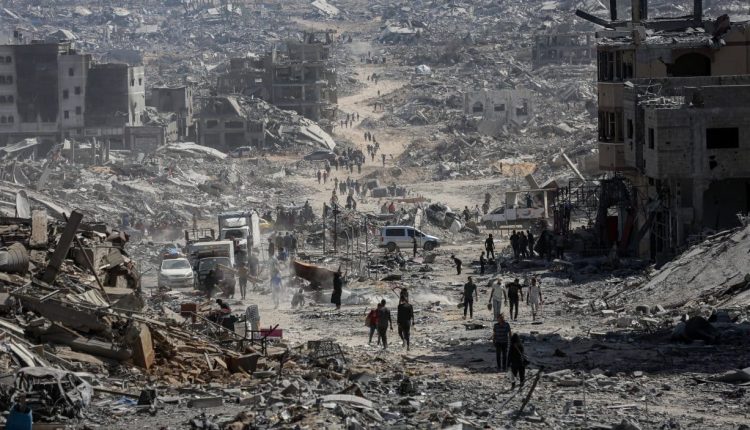
Israel seeks redemption in the Gaza ruins
This genocide has transformed Israel’s image, but resolved nothing. It has revealed the full extent of Israel’s capacity to destroy.
Since the outbreak of Israel’s genocidal war, there has been a curious preoccupation in Israeli political discourse with finding the right name for it. Every campaign, it seems, must be christened with an appellation that gives it narrative coherence. The name chosen early on, “Swords of Iron,” was steeped in the language of force and glinting with the symbolic metallurgy of statehood and defense. It gestures, too, toward a past both mythical and ideological — the “Iron Wall” that has long underpinned Zionist doctrine, and the fantasy of unbreakable security through permanent domination.
Yet the proliferation of iron in the discourse is, paradoxically, a sign of its corrosion. What does it reveal about a state that, after 75 years of existence, still insists it is fighting for its independence? Or still has to remind itself of the iron it imports from the U.S. and uses it on Palestinian bodies?
Names are instruments of meaning, and in Israel, they have become battlegrounds of interpretation. The struggle over what to call this war reveals a deeper struggle over its purpose. Prime Minister Netanyahu has recently proposed renaming it to the “War of Redemption,” a gesture at once desperate and theological, seeking to transfigure political brutality into divine necessity.
What attracts Netanyahu to the language of redemption is the conviction that Israel — and by extension, himself — is forever being tested. Redemption isn’t a matter of repentance or transcendence, but endurance. The familiar choreography of crisis and recovery offers Netanyahu a kind of moral alibi, allowing him to convert disaster into destiny.
Here, the language of redemption becomes a mirror for his political mythology: the leader as both savior and survivor, the state as both victim and victor. In scripting his role in Israel’s history, Netanyahu casts himself as the one who both presided over disaster and redeemed the nation from it.
The Israeli military prefers to call it the “October 7 War,” a choice that gestures, perhaps, toward accountability — or more likely, toward the familiar psychology of perpetual victimhood. The name fixes the war to a date of trauma, as if to anchor the nation’s moral position in the moment of its own suffering.
Permanence through crisis
If every name gestures toward an ending — toward the moment when the story can be told in the past tense — then Israel’s present war is, by its own logic, unwinnable. It cannot end because it cannot be narratively resolved. Its objectives shift with every press conference, its justifications mutate with every image of destruction that leaks through the rubble. “Victory” is declared and retracted in the same breath, for what would victory even mean in a war fought not for territory but for meaning itself? The violence cannot conclude because the state’s sense of self depends on its continuation.
This is the paradox of permanence through crisis. To stop fighting would be to discover that the war was never a passage to salvation but the condition of Israel’s political being. Closure would mean reckoning with what the war has destroyed: not merely Gaza, but the very moral and historical coherence the state claims to defend.
Narrative closure requires a moral horizon — a point at which action can be understood as justified, completed, or redeemed. Yet the genocidal logic of the current campaign forecloses such a possibility. Every bomb deepens the moral abyss it claims to fill.
And this performance unfolds before an audience no longer captive to its illusions. The world now sees Israel for what it is. The veil has thinned, perhaps irreparably. Livestreamed images from Gaza have rendered abstraction impossible. Those who once found refuge in the old fictions of security and self-defense now hesitate to repeat them.
Even Donald Trump, a man hardly burdened by moral reflection, has conceded that Netanyahu has lost the world. You cannot bomb your way to legitimacy, and you cannot fight the world and win.
Yet Netanyahu’s politics depend on precisely this illusion. His power requires an enemy vast enough to sustain his myth — first Iran, then Hamas, and now, inevitably, the world itself.
In his imagination, Israel stands alone because it must: its isolation is proof of its righteousness, its brutality the cost of its endurance.
But because the rhetoric of redemption has curdled into spectacle, what remains is not the image of a nation defending itself, but of a state so entranced by the story of its own survival that it can no longer imagine how to live among others.
The so-called “War of Redemption” cannot redeem, because redemption implies transformation — and transformation requires the capacity to imagine a world beyond domination, beyond the permanent impasse of the struggle over Palestine.
This genocide has transformed Israel’s image, but resolved nothing. It has revealed the full extent of Israel’s capacity to destroy — sustained by the indulgence of its allies and amplified to the point of grotesque excess — but has also clarified its limits. For all its destructive reach, Israel remains condemned to reckon with the people it seeks to erase. In performing its strength, Israel has only exposed its dependence — on Western approval, military subsidy, and, most of all, on the impasse itself.
