
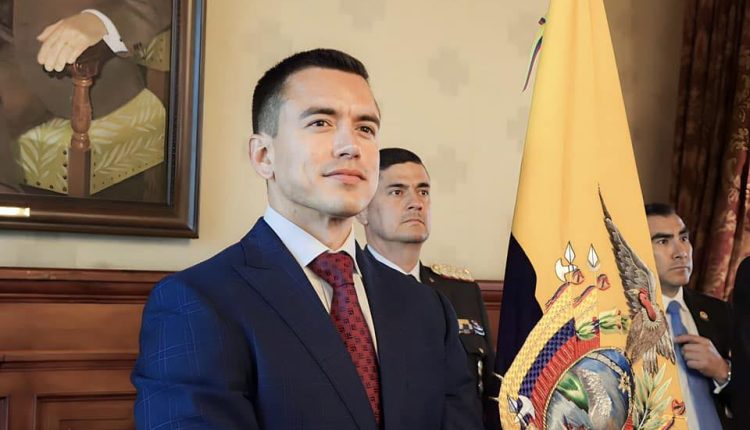
 President Daniel Noboa of Ecuador.
Ecuador: Noboa’s semi-dictatorship seeks to win by eliminating opponents
The outcome is an election in which candidates are decided in the courts rather than at the polls.
President Daniel Noboa governs Ecuador with increasingly authoritarian methods. Elected in 2023 and reelected in 2025, he has centralized power in the executive branch, clashed with the Constitutional Court, misused states of emergency, and turned the justice system into a weapon against his opponents. Analysts and human rights groups describe a shift toward a dictatorial edge: a leader who maintains the appearance of democracy while undermining its core principles. The lead-up to the local elections on November 29, 2026, provides the clearest example of this approach, focused on winning by blocking opposition candidates.
A Two-Part Maneuver
The maneuver involves two elements that can only be understood together. The first: on March 6, 2026, following a complaint filed by the Attorney General’s Office, a judge from the Contentious-Electoral Tribunal (TCE) suspended the Citizen Revolution (RC)—the largest opposition party and movement led by former President Rafael Correa—for nine months. The measure was upheld weeks later and, in July, endorsed by the Constitutional Court.
At the same time, Unidad Popular, a left-wing party, and Construye, a right-wing movement for which Fernando Villavicencio—who was assassinated in 2023—ran for president, were removed from the registry of political organizations by the National Electoral Council (CNE) because they did not meet the legal minimum number of members. The appeal was denied in Construye’s case, which accused the CNE of ‘judicial persecution of critics and opponents’ and called the decision democratic fraud. Unidad Popular proved that the CNE acted outside the legal time limit (23 days late) and that the cancellation lacked enough evidence regarding the actual number of members.
The second piece is the calendar. In March, the National Electoral Council (CNE) moved up the local government elections—originally scheduled for February 2027—to November 29, 2026, citing the risk of rains linked to the El Niño phenomenon; neither the 1998 El Niño nor the pandemic had previously justified such an early date. The effect of combining these two pieces is clear: the new candidate registration period—from August 2 to 17, 2026—falls within the nine-month period during which the opposition is suspended. Moving the elections earlier to align with the suspension prevents the government’s main rival (RC) from submitting slates under its own name.
The Alternative Party, Also Shut Down
Faced with this deadlock, the Correístas looked for a legal workaround by registering their candidates under the allied Amigo movement. The alternative was short-lived. On July 16, the Attorney General’s Office notified the TCE of an investigation into alleged money laundering involving that movement; the next day, the Court also suspended it for 9 months, and the CNE implemented the measure immediately, just 2 weeks before the registration deadline.
The conduct of the Executive Branch raises suspicions. On July 23, Noboa stated that pre-candidates could register through ‘any other party that has not been involved in money laundering,’ mentioning the Socialist Party in the same breath—essentially presenting an alleged crime still under investigation as a fait accompli. His Secretary of Public Administration, José Julio Neira—former head of the government agency that manages confidential financial information—publicly explained the origin of the suspicions. Legal expert Mauricio Alarcón warned that what is concerning is not the investigation itself, but the fact that the government seems to have access to confidential files “that are not even in the hands of the parties involved,” and he questioned ‘the selectivity’ of the investigation and its timing concerning the electoral calendar. If the RC candidates register through the Socialist Party, it wouldn’t be surprising if that party were also disbanded or suspended.
Torture, Disappearances, and Killed Activists
All of this is happening against a menacing backdrop. In June 2026, Ecuadorlist for the first time in the World Organization Against Torture’s Global Torture Index, classified as ‘high-risk’: the organization recorded 369 reports of torture and at least 51 enforced disappearances linked to state agents between 2024 and 2026, amid the ‘internal armed conflict’ declared by the government. The government has imposed 21 states of emergency, 9 curfews, and 272 days of movement restrictions—measures that have had little to no impact on reducing crime and have caused an increase in internal displacement due to threats, extortion, and pressure from criminal groups.
Two deaths occurred within this climate. Robinson del Pezo, who was covering land disputes in Santa Elena province, was murdered in November 2025. Anti-corruption activist Mónica Silva, of Polish origin and a resident of the country for over a decade, who had demanded justice for that crime and reported threats against her life, was found dead on June 8, 2026. The Minister of the Interior suggested suicide, but the autopsy revealed a blow to the head and strangulation. Silva was investigating alleged cocaine shipments hidden in banana containers belonging to a company linked to the president’s family, as well as a land-trafficking network. The UN Special Rapporteur on human rights defenders called on Ecuador to ‘cease the persecution’ and protect activists.
Corruption at Home
The official narrative depicts the cases against the opposition as an anti-corruption campaign. However, the largest scandal of the period involves the executive branch itself: in the Progen case, the State Comptroller General’s Office estimated the loss to the government at roughly $104 million due to emergency thermal power generation contracts signed in 2024 with that U.S. company, whose equipment never became operational. There are also the eight shipments of cocaine found in the Noboa family’s banana exports.
The outcome is an election in which candidates are decided in the courts rather than at the polls. The government maintains that these cases are unrelated to the executive branch; the opposition and part of the legal community argue that the selectivity of the proceedings and their timing suggest otherwise.
