
Cuban migrants: From exceptional to excluded
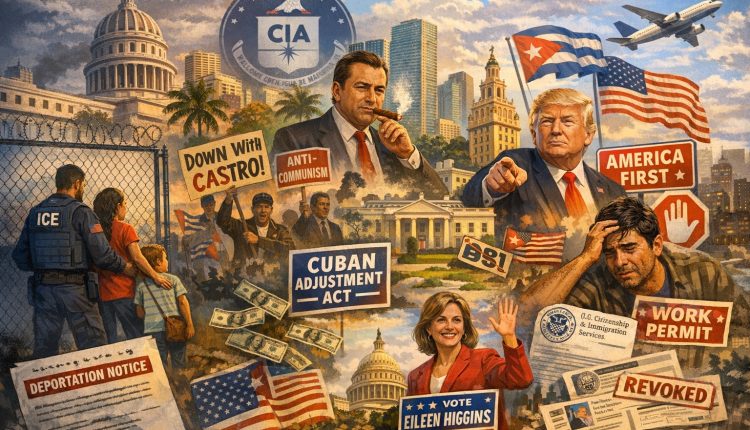
For the first time, Cuban immigrants live in fear of ICE raids on Miami’s streets and of deportation.
According to the latest data from the U.S. Census Bureau, nearly 2.5 million people of Cuban origin live in the United States, representing about 80% of those who emigrated from Cuba and their descendants.
Approximately 1.8 million, or 72%, were born in Cuba, confirming an extraordinary increase in migration in recent years, given that in 2020 this share stood at around 50% of the Cuban American population.
In the 2022–2023 biennium, some 625,000 Cubans were processed by U.S. Customs and Border Protection (CBP). Although they left Cuba legally, without pending charges or obstacles to return, they presented themselves to U.S. authorities as asylum seekers. Almost all were granted temporary status, with the advantage that after one year of residence in the country they could apply for permanent residency under the Cuban Adjustment Act.
Another 110,000 Cuban immigrants entered during those years through the so-called “humanitarian parole” program, established by the Biden administration for various groups of immigrants of different nationalities. They were also awaiting an adjustment of status, but for Cubans, their situation could be resolved through the Cuban Adjustment Act, which applies exclusively to them.
The problem arose when the Trump administration rejected the legitimacy of these processes and, for the first time, placed Cuban immigrants in a legal limbo that could lead to their deportation. In this way, the relationship between the privileges granted to Cuban immigrants—unparalleled in U.S. history—and the role these migrants play in U.S. policy toward Cuba has been disrupted.
In the Cuban case, the United States implemented measures to encourage emigration that it has not replicated with any other country. The objectives were to drain the Cuban economy of its human capital, introduce instability into society, create a social base for counterrevolution abroad, and discredit the revolutionary process internationally.
Cuban migrants were admitted indiscriminately into the United States, where they could quickly obtain residency and benefit from specific programs designed to facilitate their settlement and integration into American society. The so-called ‘golden exile’ in Miami was built on these premises, as well as on others that were far more insidious.
In violation of the law prohibiting its operations within national territory, the CIA established its largest station in the world in Miami to wage war against Cuba, investing vast resources in building an operational infrastructure that propelled Cuban immigrants into positions of privilege in the region’s economic and political life.
With the impunity afforded by this association, Cuban counterrevolutionaries organized some of the most lethal and ruthless terrorist groups on the continent, collaborated in the crimes of far-right dictatorships and Latin American criminal gangs, murdered people within the United States, and imposed far-right positions on local Miami politics.
Many Cuban Americans also served as operators, financiers, and legal intermediaries for the drug trafficking networks established in South Florida at the end of the last century, transforming the region into one of the main entry points for drugs into the United States.
Miami, already burdened by a past dominated by the mafia and corruption, became the epicenter of anti-Cuban politics and the capital of the Latin American right wing. This positioned Cuban Americans on the far right of the American political spectrum—an orientation alien to Cuban traditions but adapted to the “Deep South” of the United States, where they settled.
From this platform, Cuban American power groups emerged. They rose through the American political structure, reaching their pinnacle during the Donald Trump administration, when Florida was chosen as a refuge for the president—pursued by New York courts—and as the headquarters of the MAGA movement.
Up to this point, this is a fairly well-known story. The paradox is that the rise of Cuban American politicians to more prominent positions within the American political system coincides with the erosion of the privileges that, until now, have distinguished Cubans from other immigrants in the United States.
Several reasons explain this phenomenon. First, the strategy toward Cuba that justified exceptional treatment for Cuban immigrants has changed. Inspired by a proposal from the Cuban American right wing, the U.S. government no longer encourages emigration but instead seeks to limit it as much as possible in order to increase domestic social tensions. As a result, the Cuban American right wing—which largely rose in American politics by leveraging the exceptional status of Cuban immigrants—is now complicit in their repression.
Second, the privileges granted to Cuban immigrants were possible in a different economic environment and through treatment that effectively equated them with the white American middle class. This approach is incompatible with the system’s current needs and with the anti-immigrant and xenophobic philosophy that serves as the cohesive force of Trumpism’s political base. Moreover, what was once a relatively acceptable, middle-class, white immigration—the so-called “historic Cuban exile” of the first few decades—was transformed into a “despicable Latino rabble” as working-class sectors joined the migratory flow from Cuba.
Why are Cuban American politicians exempt from this discriminatory logic? Because this is not truly a problem of race or national origin, but ultimately one of class. After all, even the president’s wife and the wealthiest man in the country are immigrants, and in those cases, few remember this detail.
While Cuban American magnates and the politicians who represent them bask in the advantages of Trumpism, Cuban immigrants have been lumped together with “… every damn country that’s been flooding our nation with killers, leeches, and entitlement junkies,” as Homeland Security Secretary Kristi Noem put it.
As a result, the doors to Cuban emigration are now closed; Cuban nationals are not even accepted as visitors. Those who arrived in recent years find their ability to apply for the Cuban Adjustment Act—or any of the other benefits they once enjoyed—severely limited. Even residency and citizenship processes for those who arrived earlier have been stalled, and a “thorough review of those already processed” has been announced.
For the first time, Cuban immigrants live in fear of ICE raids on Miami’s streets and of deportation to Cuba or to any other country in the world. Work permits have been canceled, and even bank accounts can be seized if immigration status in the United States cannot be proven.
What impact might this situation have on the political behavior of the Cuban American community, the only Latino voter group that overwhelmingly supported Donald Trump in the last election?
Those who voted for Trump—that is, those who are citizens—have not been the most harmed by these policies. Many may even participate in the discrimination against their own community, as frequently occurs in American society. Still, at least some must feel affected by the climate of insecurity and contempt established by this administration, and this may be reflected in their political behavior.
This does not mean that major changes should be expected in the political structure that governs the Cuban American community. The influence of the far right has never depended on the actual electoral power of this vote, but rather on the functions it fulfills within the system and its connections to sectors of American power, especially those linked to the Republican Party.
Nor is any “revolution” likely in the ideological sphere. The conservatism of most Cuban Americans is associated not only with the conflict with the Cuban Revolution, but also with the reactionary currents prevalent in the state of Florida itself, regardless of which party holds power. Added to this is the difficulty of breaking with the rules of traditional consensus, which bind individuals to their reference group—especially when those rules have served to rationalize a decision as traumatic as emigrating from one’s country of origin.
In short, it is highly unlikely that Cuban Americans will elect a figure like Zohran Mandani. However, discontent with Donald Trump’s policies could lead to the defeat of one of the three Republican members of Congress of Cuban origin in Florida, who in practice serve as the leading spokespersons for the Cuban American far right on Capitol Hill. Such an outcome would represent a significant shift in existing political dynamics.
A notable sign—though it should not be attributed solely to changes in the Cuban American vote—is the recent election of Eileen Higgins as mayor of Miami. She defeated, by a wide margin, a candidate publicly endorsed by Donald Trump himself, becoming the first woman to govern the city and the first Democrat and non–Cuban American to hold the position in the last thirty years.
Cuba, too, is facing a new situation with regard to migration. Although, amid a very unfavorable economic environment, restrictions on emigration will undoubtedly increase domestic tensions, it is also true that containing migratory outflows is beneficial for the country, given their impact on the economy, demographics, and social psychology.
For this reason, a review of existing policy is necessary, requiring significant economic and social changes: to offer opportunities for personal fulfillment to potential migrants; to anticipate how returning citizens will be received; and to establish new mechanisms for integrating Cubans living abroad into national life, strengthening their ties with their families as migration opportunities diminish. The answers cannot be the same as before, because the questions are different.
