
Cuban homes and hurricanes
Lessons learned from other hurricanes regarding the impact on homes could be applied to the aftermath of Melissa.
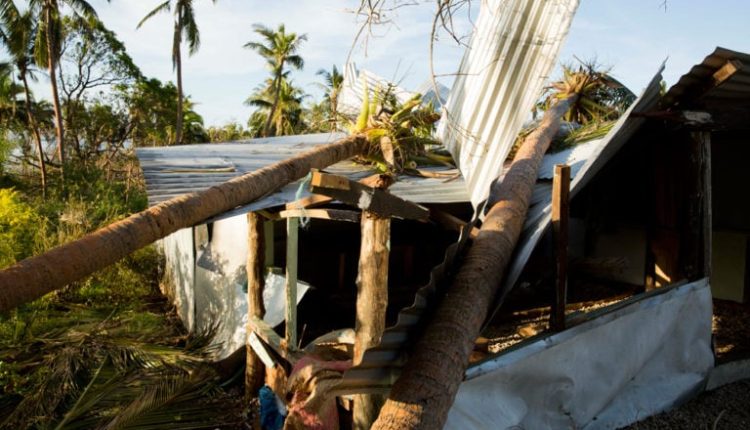
By the time Hurricane Melissa left Santiago de Cuba Bay, almost no houses on Cayo Granma had roofs, and dozens had been completely destroyed.
Many residents spent that night sheltering in the few remaining homes with concrete or French tile roofs on the islet. Others hid in bathrooms, closets, or kitchen counters made of concrete and masonry. A week after the hurricane passed, a national television crew gathered testimonies that highlighted how easily the storm had ripped off the metal and asbestos cement roofs that covered most of the houses. “First it took all the tiles, room by room, and then the beams. It was as if they hadn’t even been cemented to the wall,” a survivor told journalist Lázaro Manuel Alonso.
Similar scenes occurred across communities in the rest of Santiago province and in the neighboring provinces of Granma and Holguín, the three hardest-hit areas by Melissa. Despite the extensive damage to agriculture and public infrastructure, housing is expected to be the most challenging area for recovery from the hurricane’s effects.
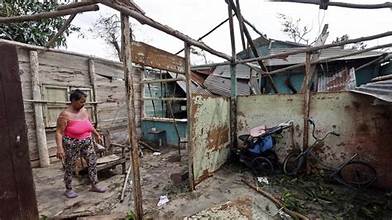 The extent of the disaster became clear a few days ago when a United Nations commission raised the estimate of damaged homes, which the Cuban government had recently reported. While authorities initially claimed that 76,689 properties were affected, international organizations concluded—after touring the eastern region—that over 90,000 homes had suffered various levels of destruction. “This is the most complex damage,” the EFE news agency noted in its report on the matter.
From Manuals and Everyday Experience
Regardless of the final number of damaged homes, experience shows that the highest percentage of incidents will be roof damage. This was confirmed by the initial statistics published by the Ministry of Economy and Planning, which indicated that three-quarters of the damage caused by Melissa was concentrated on roofs: 12,056 total (15.7%) and 47,753 partial (62.3%).
These damages were primarily observed in houses with lightweight roofs, which in Cuba are typically constructed using metal or asbestos cement tiles. These two types are the most common and widely used in the country.
“It’s not a matter of taste, but of necessity. With the high prices of materials, especially cement and steel, and the scarcity of fiber cement, metal roofs have become the only option for most families. It’s true that they don’t offer the same security as concrete slabs and can’t be used as intermediate floors, but the math is clear. An average zinc tile can cover up to 3.5 square meters. Adding the cost of hooks, leveling, and purlins, roofing that area costs less than 12,000 pesos. Meanwhile, for a concrete slab of the same size, the investment easily exceeds 50,000 pesos. And that’s just for materials, excluding labor and finishing,” explained Antonio “Tony” Oliva, a bricklayer from Camagüey who has recently specialized in installing lightweight roofing. “None of them have been damaged by hurricanes,” he proudly pointed out.
A metal roof installed according to current technical standards should generally not be vulnerable to the impacts of a hurricane or tornado, according to studies by the Ministry of Construction (Micons) and several Cuban universities. In fact, in countries like Spain, the United States, and Mexico, construction codes require these structures to withstand winds of around 200 kilometers per hour (for comparison, Hurricane Melissa made landfall in eastern Cuba with sustained winds of 195 kilometers per hour).
A “Family Guide for the Installation of Safe Roofs,” published by Micons and the United Nations Development Program, based on the experiences of Hurricane Irma (which affected the island in 2017), lists 11 practical tips for those planning to install lightweight roofing. Among them are several that might seem obvious but are sometimes overlooked, even by specialized companies. For example, purlins (metal beams) must be welded to the building’s roof frame or truss to prevent the structure from being torn away by the wind. It is also recommended that they not be spaced more than 1.20 meters apart, and that the fixing hooks or screws be spaced at intervals of less than 30 centimeters. Finally, it is advised that the eaves project only 30 centimeters beyond the exterior face of the wall; “it is the most vulnerable point of the roof,” the guide emphasizes.
At first glance, the completely roofless houses on Cayo Granma violated these and other recommendations. Television footage showed how the purlins had been cleanly ripped out by the wind, barely damaging the masonry walls, evidence that their fastening was superficial. There was also no indication that sandbags or earth had been placed on the roofs, nor that they had been secured with wire, rebar, or even poles. These simple measures are usually very effective for roof protection, as they add support from the top surface, the most vulnerable section when hurricane gusts hit with the greatest force.
“A dry bag of sand or dirt weighs around 80-100 pounds. After it gets soaked by rain, that weight increases and can double. More weight means more stability for the roof. It’s almost like throwing a piece of metal on top. If you also secure it, even with barbed wire, you can rest easy. The wind gust has to be really strong to lift even a single tile,” commented Tony Oliva.
These are empirical observations that the “Guide” recognizes as valid and recommends adopting when preparing for storms. However, this success is offset by a glaring error: suggesting that the screws or hooks be fixed in the “valley” of the tiles (the lower part of the channel). This recommendation contradicts previous studies that have scientifically demonstrated that fasteners should be placed on the “ridge” (or top) to prevent leaks and increase resistance to the elements.
For over 20 years, Cuba has had a Wind Load Standard (NC-285-2003), which, among other things, sets the wind speed differences for different regions of the island and the resistance requirements that roofs must meet. But like many other regulations and research efforts, it seems to be gathering dust in some archive.
![]() In the absence of a concrete slab…
In the absence of a concrete slab…
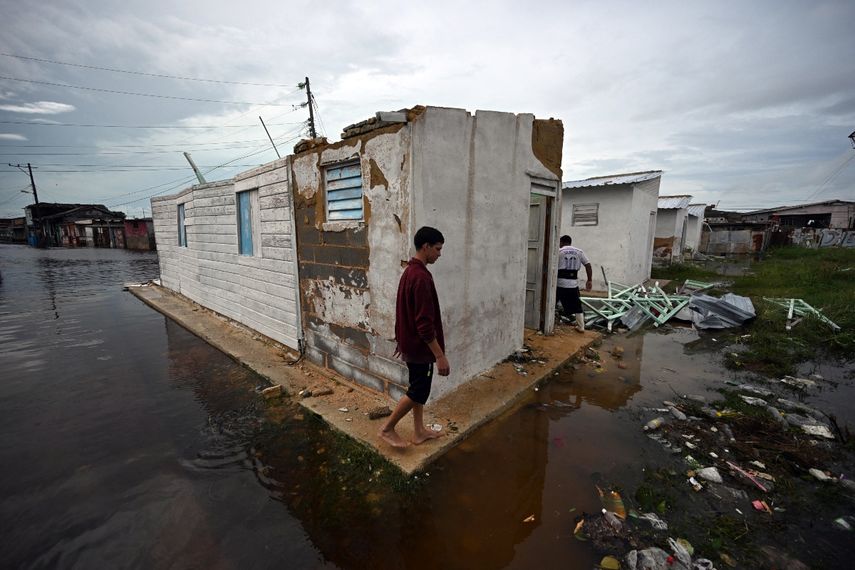 In the absence of a concrete slab…
At the start of November, convoys delivering construction materials began arriving in Oriente province. Among the most common shipments were asbestos cement roofing tiles, which, by November 8th, had already been used to repair 2,190 partially damaged roofs.
Asbestos is still used in Cuba despite its proven toxicity, which has led to its ban in many parts of the world. Also, roofs made from this material are much more fragile than metal ones and usually can’t be reused after hurricanes. “A fiberglass roof tile ripped off by a hurricane is shattered into pieces. First of all, because they haven’t been manufactured with the same resistance for years. On the other hand, a zinc tile that’s been blown off can be salvaged, the creases removed, and it reattached. It’ll be more or less okay, maybe with a few leaks, but it’ll help solve the problem. With fiberglass, forget about it,” commented Francisnel Duany, a resident of the Jaronú community in the Camagüey municipality of Esmeralda.
Eight years ago, Hurricane Irma caused almost total devastation there, destroying hundreds of houses. Until aid arrived, residents in neighborhoods like Moscú rebuilt their homes using the wood and metal sheets the hurricane had taken. Months later, new houses in the neighborhood were constructed with roofing materials distributed by the government, but the walls didn’t need to be sourced far. Thousands of royal palms felled by Irma in nearby pastures provided the lumber for the community, which has since been nicknamed “petropalmas” (petropalms).
Had they waited for the centralized allocations of cement, aggregates, and steel needed to build the houses of types 1, 2, and 3, recommended by the National Housing Institute (INV), hundreds of families in Jaronú would still be living in temporary housing.
In 2018, when the National Housing Policy was approved, aiming to eliminate the country’s housing deficit within 10 years, the INV insisted that new houses should have sturdy roofs (cast-in-place or prefabricated concrete slabs, beams, and slabs, or other similar technologies). This requirement quickly became meaningless because of the decline in domestic cement and steel production.
With no quarterly data for 2025 available, the most current information relates to the 2024 fiscal year. Examining this data shows the full extent of the collapse of the national construction materials industry and, as a result, the reduced ability to build the “ideal” homes needed to withstand hurricanes.
Last year, national production of gray cement was about 257,000 tons, which is only 25% of the amount produced in 2020, a year that was already considered poor. For steel billets and reinforcing bars, the decline was even sharper: the 6,500 tons made by the Antillana de Acero rolling mill accounted for just 6% of the levels seen at the start of the pandemic.
Under these circumstances, it is impossible to achieve not only the objectives of the National Housing Policy but also the more modest goals of earlier regional programs. For example, in the late 2000s, the Villa Clara government estimated that 75% of new homes built in the province would be hurricane-resistant. These buildings were required to have solid roofs, a requirement that was gradually extended to other housing projects.
Driven by that program, hundreds of houses were built in the city of Santa Clara, along the southern edge of the Central Railway, facing Capiro Hill, most with roofs made from polystyrene blocks and welded wire mesh. By 2010, the three polystyrene foam plants operating in the country, located in Artemisa, Sancti Spíritus, and Santiago de Cuba, were supplying roofing modules for about 10,000 houses annually. The goal was for this technology to become the most popular choice for single-family home construction by the end of the decade.
The fact that polystyrene foam roofs used less than half the reinforced concrete of traditional slabs and allowed for buildings of up to five stories was soon complemented by the advantage of a modern welded wire mesh production line, which lowered costs and increased availability.
It was an expectation that was never fulfilled. The production of that plant, located in the Camagüey municipality of Minas, was almost entirely allocated to the construction of “Forza” buildings, hotel investments, and projects such as the Mariel Special Development Zone. Meanwhile, the plans for the polystyrene foam factories were being scaled back due to a lack of imported raw materials.
Another economic alternative was the so-called “Mambí Project,” which the Pinar del Río authorities promoted in 2009 as a local solution to the housing shortage caused by the hurricanes that regularly affect the westernmost part of the island. Like the “petropalmas” (a type of palm-shaped shelter), it was based on using trees felled by these natural events, but with a distinctive feature: a masonry bathroom with a concrete slab roof (sometimes the kitchen also had a rigid roof), which in extreme cases could serve as a refuge for the family or, at the very least, a place to store their most valuable belongings.
It was a project that led to the construction of nearly 2,000 homes in small rural communities in Pinar del Río province, and it could now be replicated in the Cauto plains and other areas of eastern Cuba, taking advantage of the large number of trees felled by Hurricane Melissa. Additionally, the idea of building part of the house with masonry has already proven effective in the past. This was the case within the framework of the nearly defunct subsidy program, which focused on allocating resources for constructing a “basic unit” (bedroom, kitchen, and bathroom). The premise was that the house could then be expanded from this initial structure.
All options should be considered, given the serious economic situation the country is facing. For example, in eastern Guantánamo, hundreds of families are still living in temporary shelters and tent camps, a year after losing their homes to Hurricane Oscar. Many had previously been affected by other hurricanes. If this cycle of poor reconstruction and even worse preparation continues, after future hurricanes, more and more Cubans will face the harsh reality that all that remains of their homes are a few posts and tiles “spared” by the wind.
