
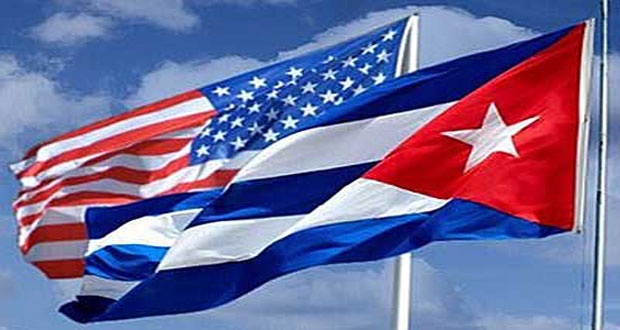
Cuba-US: Are they negotiating or will they negotiate?
Talking doesn't create conflicts or wars, but it's often how they end.
Obviously, if they don’t do the first, they’ll do the second, but the moment has come. In 2014, the presidents of Cuba and the United States, Raúl Castro and Barack Obama, respectively, announced the normalization of diplomatic relations. This moment was made possible by mutual political will, astute calculations, and protracted negotiations, supported and mediated by other countries, the Cuban Catholic Church, and the Vatican. Now or later, it will be no different. Such assistance is generally necessary.
So, the announcement, received with jubilation by most Cubans, was a bitter pill for some—perhaps a few, though influential—because, according to certain viewpoints, it meant fraternizing with the empire. The same seems to have happened in the United States, where Obama was criticized for making a pact with an abominable communist regime. What is certain is that, on both sides, majorities enjoyed the moment when détente arrived and normalization progressed. There was opposition, open in the United States, where criticism of the president is common, and veiled in Cuba, where such criticism is not the norm.
Then, Obama came to Cuba. For the first time, Air Force One landed at Rancho Boyeros, and “The Beast,” the Cadillac Obama used, cruised through Havana. In a gesture of trust and friendship, he brought his wife and daughters, met with entrepreneurs, attended a baseball game, and, at the National Theater, spoke to a diverse audience. He said some interesting things and others that weren’t well received, but Raúl, who was there, applauded.
The visit, which seemed like a magical moment, the agreements, and the gesture of trust in traveling with his family were reciprocated by Raúl Castro with refined diplomacy and sincerity; he even, in a characteristic gesture, raised the American president’s arm at one point.
In those days, Havana and other cities were filled with cruise ships and tourists. Owners of classic cars stripped the roofs off their vehicles to convert them into convertibles. Money changed hands, and thousands of Americans and Cuban-Americans strolled through the cities.
Long before Raúl Castro conducted those negotiations, enjoyed the moment, and made those gestures, Fidel Castro agreed in 1963 to receive Jean Daniel, a French journalist sent by President John F. Kennedy. This, in itself, was a conciliatory message that Fidel appreciated.
Elier Ramírez, a young historian who became one of the leading Cuban figures of the time, meticulously described Jean Daniel’s mission and the meeting between the Commander and the Frenchman, which was preceded by discreet negotiations among Cuban and American officials and prominent figures.
When Fidel received Daniel as a messenger, President Kennedy had already issued the Executive Order establishing the blockade against Cuba, which is still in effect; carried out the Bay of Pigs invasion; endorsed Operation Mongoose, a vast counterrevolutionary plan that included sabotage, espionage, terrorism, and all kinds of crimes; and the Cuban Missile Crisis had erupted.
Nevertheless, acting with the stature of a statesman, setting aside antipathies and reservations, and without prejudice, Fidel prepared to listen and respond in Cuba’s best interests.
In recent weeks, with striking insistence, the President of the United States, Donald Trump, and his Secretary of State have made time in their schedules to repeatedly allude to Cuba. The good news is that, although they launch diatribes and intensify the blockade, they now speak of dialogue and, even if only verbally, express their intention to reach agreements. It seems to me that, before, when they referred to invasions and bombings, it was worse.
Now, as before, there are those in Miami who criticize Trump and Rubio and demand accountability, while in Cuba, with airtime on the media, there are those who warn Díaz-Canel not to listen to the siren songs of “these guys,” who, in negotiations, conceal their treachery and, unable to enter directly, sneak in through the back door.
It seems some of the rhetoric is superfluous, and it’s not necessary to constantly repeat certain positions. Those Americans who want to fight will be fought, and those who want to talk will be talked to. Talking doesn’t create conflicts or wars, but it’s often how they end. See you there.
