
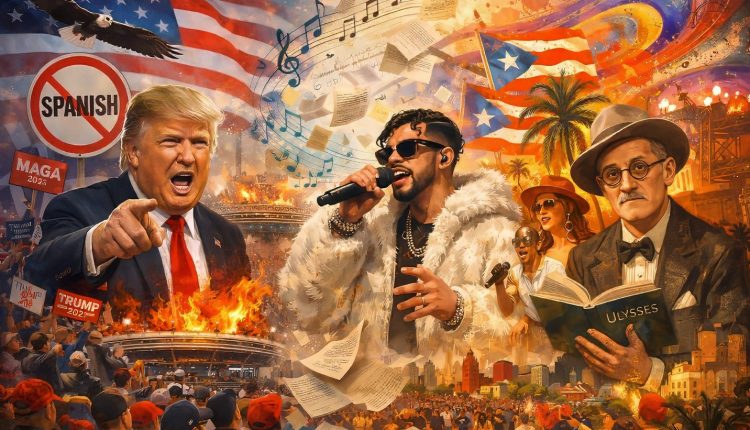
Bunny talk: No translation required
Bad Bunny’s performance was not a failure of communication; it was an outstanding exercise in a different mode of it.
Before Bad Bunny ever stepped onto the Super Bowl stage, Donald Trump had already announced his displeasure. He criticized the choice of artist, complained that the performance would be “in Spanish,” and hinted that something more conventionally “patriotic” and more politically congenial would have been preferable. After the show, he escalated: the performance was “absolutely terrible,” “one of the worst, EVER,” a “slap in the face to our country.” It made “no sense,” failed to meet American standards of “Success, Creativity, or Excellence,” and, he insisted, “nobody understands a word this guy is saying.”
Every part of that complaint collapses under minimal scrutiny.
Bad Bunny’s performance was not a failure of communication; it was an outstanding exercise in a different mode of it. Much of what he sang was not discursive Spanish at all, but a deliberately non-semantic vocal register: percussive syllables, slang shards, elongated vowels, phonetic gestures. These sounds function musically rather than propositionally. Trump’s insistence that the words were “unintelligible” mistakes the nature of the act. Intelligibility, in the narrow sense he demands, was never the point.
Bad Bunny was not delivering sentences for parsing. He was deploying the human voice as an instrument—rhythmic, textural, expressive—drawing on long-standing Afro-Caribbean and diasporic traditions in which cadence, attitude, and sonic force matter more than syntactic clarity. Meaning arises there through pulse, repetition, timbre, and affect, not through orderly semantic transmission.
Trump’s complaint that “nobody understands a word” is mistaken in two distinct ways. First, it collapses the presence of Spanish—and Spanish-derived forms—into a claim of unintelligibility, treating what he does not grasp as effectively nonexistent. Second, and more fundamentally, it assumes that musical meaning must be reducible to immediate semantic comprehension, an assumption the performance explicitly rejects. Even the subtitles did not track the words precisely—and it did not matter. No translation was needed.
What Trump’s reaction exposes is not a problem with the performance but with his assumptions. First, linguistic literalism: the belief that language exists only to convey clear, translatable propositions. Second, cultural illiteracy: an inability to recognize musical forms in which voice operates as rhythm and gesture rather than as a conveyor belt for sentences. Third, performative chauvinism: the reflexive equation of “American” expression with English semantic transparency, and the suspicion of anything that refuses that norm. Bad Bunny’s performance did not need semantic clarity; its joyful, affirmative message was communicated through sound, movement, staging, and happily shared community affects. Trump’s instinctive error is to treat semantics as the only carrier of meaning, ignoring pragmatics, prosody, and embodied signification altogether.
In this sense, the outrage is not really about Spanish—except insofar as racial bias is never far away. It is about opacity. It is about an expressive form that does not pause to explain itself, that does not grant the listener mastery, that refuses to perform legibility on command. What provoked Trump was not foreignness alone, but the presence of an art that declines his terms entirely. That art was not only successful; it reflected the status of its creator as the most prominent popular artist in the world at this moment.
A useful parallel is Ulysses. From its first appearance, readers and censors complained that it was unintelligible, obscene, or not really literature at all. The charge rested on the same category error. Joyce was not trying to produce prose that submitted to immediate semantic clarity. He was staging language as an event: fragmented, rhythmic, polyphonic, resistant to paraphrase.
Like Bad Bunny’s vocal performance, Ulysses frequently abandons discursive transparency in favor of sound, cadence, association, and bodily rhythm. Puns, invented words, syntactic distortions, and multilingual interference are not obstacles to meaning but the means by which meaning is relocated—from neat propositions to lived experience. Understanding, in the sense of extracting a stable paraphrase, is neither immediate nor primary. The reader is asked to inhabit language as sensation.
The early hostility to Joyce mirrors Trump’s reaction almost perfectly. Critics demanded clarity, decorum, and discipline; Joyce’s refusal to comply was experienced as an affront. The issue was never simply difficulty or obscenity. It was control.
That is what connects Joyce to Bad Bunny. In both cases, the voice—textual or musical—operates autonomously, unconcerned with whether every audience member is linguistically prepared or culturally initiated. Meaning emerges through rhythm, repetition, tone, affect, and, in Bad Bunny’s case, through staging, symbolism, and the unapologetic display of Puerto Rican and Latin culture. The message of joy and unity across the Americas was unmistakable without ever being spelled out.
Trump’s complaint belongs to a long tradition of reactionary responses to modernist and postmodern expression. It reflects linguistic literalism and cultural insecurity in the face of forms that do not seek permission or offer translation. Joyce’s Dublin and Bad Bunny’s Puerto Rico are separated by time, medium, and politics, but they provoke the same anxiety: the fear of language that refuses to make itself legible on demand.
In the end, the objection is never really about Spanish, just as it was never really about obscenity in Joyce’s case. It is about sovereignty—art’s insistence on speaking in its own register. Both Ulysses and Bad Bunny’s performance assert that sovereignty without apology. And that, more than anything else, is what enrages those who mistake comprehension for control.
