
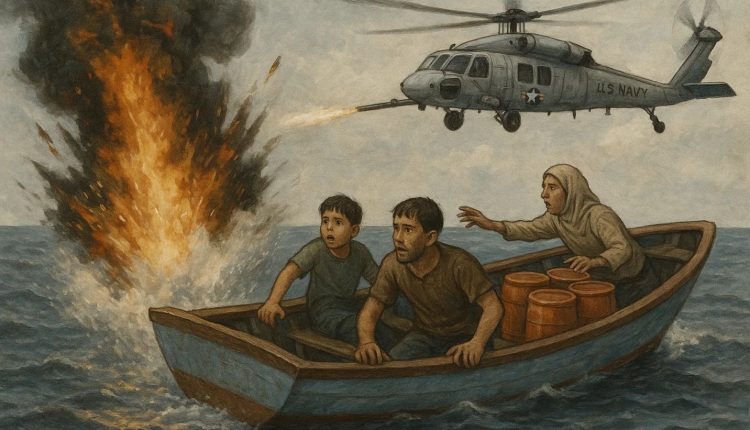
“A global force for good” not “Kill Them All”
For months now, Americans have watched the news of boat attacks in the Caribbean and Pacific with a kind of numb disbelief.
On March 16, 1968, U.S. Army troops carried out what later became known as the Mỹ Lai massacre, killing hundreds of unarmed Vietnamese civilians. Many of the victims, including women and children, were raped and assaulted before being slain. The killing would have been even worse had Chief Warrant Officer Hugh Thompson Jr. and his helicopter crew not intervened; upon seeing what was unfolding, they landed, confronted the soldiers on the ground, and evacuated the remaining survivors, stopping the execution of the final group.
For months now, Americans have watched the news of boat attacks in the Caribbean and Pacific with a kind of numb disbelief. Small vessels—some carrying the desperate (perhaps children driven by poverty to become ocean mules), some possibly carrying nothing more threatening than gasoline drums and bad luck—have been hit by U.S. forces far from any battlefield, often without warning, and sometimes even after the first strike had already disabled the boat. Survivors in the water have described second rounds of gunfire or explosions. According to recent revelations, Secretary of Defense Pete Hegseth had given a verbal order to “kill them all” in an incident this past September where two survivors clung to the hull of a shattered, small vessel that never presented a threat to the U.S. military. International observers have called the pattern what it increasingly resembles: extrajudicial killings on the high seas. These incidents bring to mind the Mỹ Lai Massacre and may require many Hugh Thompsons to prevent more people from being murdered. They are also a betrayal of the Navy’s motto, “A Global Force for Good,” used extensively in recruitment and public-facing doctrine for years, capturing the Navy’s claim that its purpose extends beyond warfare to humanitarian response, deterrence, and maintaining the safety of international waters.
The administration, for its part, insists without evidence that these are operations against “narco-terrorist” vessels. But in some cases, governments or families have denied the U.S. characterization of struck vessels as traffickers’ boats, arguing they were civilian fishing or transport boats; human-rights organizations have flagged the credible risk that innocent civilians have been hit. We don’t know the facts for sure because none have been provided; in fact, the evidence has been purposely destroyed. One would expect it would be made public if the government’s assertions are true. The United Nations’ human-rights office has condemned the practice as unlawful, and several U.S. allies have begun distancing themselves from the program to avoid complicity. Even if the boats that have been attacked had been carrying narcotics, drug running is not punishable by death, let alone without due process.
Given the enormity of what’s happening, the question now is less about the facts and more about the future. Is there anything that can be done within the American legal system to halt these killings?
The maddening truth is that the American legal landscape is both powerful and powerless at the same time. It offers tools to challenge executive overreach, but places most of them behind locked doors. The courts have traditionally been reluctant to interfere with anything that smells like foreign policy or national security. If a President orders a military action on the other side of the world, judges tend to defer. The Constitution never envisioned presidents with global drones and satellite tracking, but here we are.
And yet, there are pathways—narrow, difficult, but real. Families of the victims can file lawsuits in federal court, accusing the U.S. government of carrying out extrajudicial killings in violation of a statute that was designed precisely to prevent this sort of conduct. Human-rights groups can attempt to force the administration to produce the legal memos that purport to justify the violence. These actions rarely succeed in stopping wars, but they can force disclosures, embarrass agencies, and begin the slow work of accountability. The relevant legal firewalls are not meant to protect “terrorists,” as some would have it. They are meant to protect American servicemen were they to find themselves in similarly vulnerable situations.
Members of Congress could, if sufficiently outraged or sufficiently pressured, do even more. Congress holds the power of the purse, and the President cannot spend money on unauthorized military campaigns without congressional consent. It would not take much, in legislative terms, to restrict funding for maritime strikes or force the military to shift back to traditional law-enforcement methods. The obstacle is not law but appetite. Washington has a long tradition of looking the other way when presidents stretch their war powers. That habit is hard to break, especially for the current do-nothing Congress.
There are other, quieter forms of resistance. Military officers are trained to refuse manifestly unlawful orders. Most will never confront that obligation directly, but the patent illegality of these strikes places a moral weight on the chain of command. If even a small number of officers raise concerns internally, that friction can slow operations and force policymakers to reconsider. Those officers would know, for example, that the U.S. Naval Handbook unambiguously states that under the law of armed conflict “attacking shipwrecked personnel, including survivors of ships and aircraft lost at sea,” is a war crime. This principle comes straight from the tradition of the Second Hague Convention of 1899, the 1907 Hague X, later reaffirmed in customary international humanitarian law: shipwrecked, wounded, or defenseless persons must not be attacked. The Navy Handbook explicitly codifies this norm for U.S. forces, so it is binding military doctrine.
Outside the United States, the avenues multiply, though their force depends on political will. Governments whose citizens have been killed can demand international investigations or bring cases before human-rights bodies. The U.N. can issue findings that, while not compulsory, carry reputational costs. The Inter-American Commission on Human Rights can open inquiries that put public pressure on Washington. Even the threat of an International Court of Justice filing—whether it succeeds or not—signals that the world is watching.
None of these mechanisms, by themselves, is likely to make the president stop. But taken together, they become something more than symbolic. They raise the political temperature. They stir public debate. They force officials to answer uncomfortable questions. They widen cracks in the legal façade, secrecy, and absurd arguments that the government has built around the program. They bring the specter of possible prosecutions in a few years when the defense of “I was just following orders” will be unavailing.
The hardest truth is that illegality alone will not end the killings. There must also be outrage, and persistence, and the slow, grinding work of democratic pressure. There must be families willing to testify, lawmakers willing to challenge their own government, judges willing to scrutinize executive claims of necessity. There must be, in other words, a citizenry still capable of moral recoil.
What is happening on the water is not just a policy dispute. It is a test of whether the United States can recognize when it has crossed a line—even a line drawn far from its shores––and what America stands for. The victims of these strikes will never see justice if the conversation remains confined to technicalities. They were people in boats, not enemy combatants. They deserved the chance to be arrested, tried, proven guilty or innocent. They deserved humanity. And we deserve a military that continues its traditions of discipline, restraint, and fidelity to law, a force that understands its strength is measured not merely by its firepower, but by its refusal to kill even if killing is the easy path. Even the most powerful nation on earth must follow rules written not just in law books, but in our collective conscience.
