
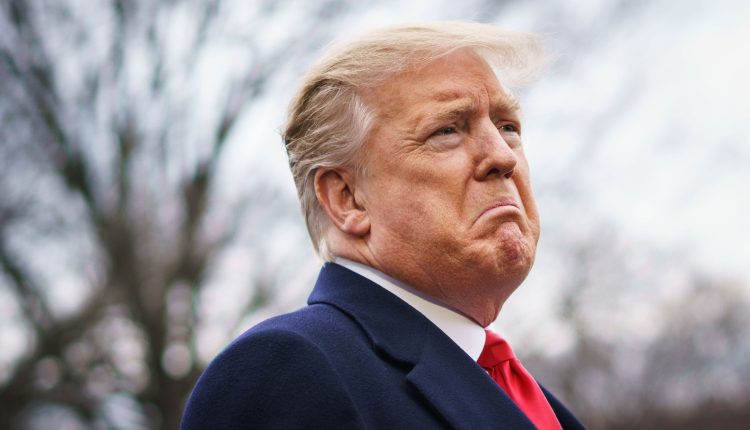
Trump asked voters to put him on the ballot. They did. And he lost.
Donald Trump made a bold political wager in the 2026 midterm elections. He repeatedly challenged Americans to vote as if he were personally on the ballot. He said it 47 times throughout the campaign, apparently convinced that his presence and political influence would be enough to carry Republicans to victory.
American voters accepted the challenge. But the result was not what the president had anticipated.
Tuesday’s Democratic electoral wave was more than an ordinary midterm setback. It was a resounding rejection of Donald Trump, his leadership, his priorities and the political direction he has imposed on the country. In an election he personally transformed into a referendum on his presidency, Trump received an unmistakable answer.
And it was a defeat of historic proportions.
According to early estimates, Democrats were heading toward a national popular-vote advantage of approximately 13 percentage points in House races, a margin not seen in a congressional election in at least half a century. That is not simply a warning light flashing for Republicans. It is a political earthquake.
The significance of the results goes beyond how many congressional seats Democrats may ultimately capture. Redistricting and increasingly manipulated congressional boundaries may limit how many seats can change hands. But they cannot disguise the message coming from millions of voters: the country is growing increasingly dissatisfied with Donald Trump.
The president’s political formula, which carried him back to the White House, appears to be losing its appeal. The coalition that once embraced his promises of economic relief, national strength and political disruption is showing serious cracks.
Americans who expected lower prices instead confronted persistent inflation and expensive gasoline. Those who wanted an administration focused on domestic problems found themselves watching a new war with Iran disrupt energy markets and raise the cost of living. Consumers who were promised better economic conditions felt the consequences of tariffs. And voters who expected an administration concerned with working families increasingly questioned the ethics of a president and his associates facing allegations of personal profiteering.
Immigration, once a powerful political advantage for Trump, also became more complicated as voters reacted to aggressive enforcement practices involving people who had lived in the United States for years.
In other words, the president’s promises collided with the everyday realities of American life.
But perhaps the most damaging aspect of this election was Trump’s insistence on making it about himself. He selected candidates, dictated the Republican message, demanded loyalty and discouraged political independence within his party. He wanted personal credit for victory. He cannot now escape personal responsibility for defeat.
The losses of Republican Senate candidates Ken Paxton in Texas and Darline Graham in South Carolina, both personally favored by Trump over potentially more electable alternatives, demonstrate the dangers of a political party that increasingly puts presidential loyalty ahead of electoral judgment.
Even more revealing was Trump’s reaction when the results became impossible to ignore. Rather than acknowledge the magnitude of the defeat, he suggested that Republicans had lost because he himself was not on the ballot and therefore could not bring enough voters to the polls.
It was an extraordinary explanation from a president who had spent months telling Americans precisely the opposite: that they should vote as if he were on the ballot.
The contradiction speaks volumes about a politician accustomed to claiming credit for everything that goes right while searching for someone else to blame when things go wrong.
There is also a larger political lesson here. For years, Republicans have increasingly surrendered their institutional independence to Trump. Many elected officials have chosen silence over disagreement, loyalty over principle, and political survival over independent judgment. The result is a party whose identity has become inseparable from one man.
That strategy has now suffered a major test, and the consequences are evident.
Democrats, meanwhile, have an opportunity they should not squander. Their victory was fueled largely by opposition to Trump, but defeating an unpopular president is not the same as offering Americans a compelling alternative. They must show they can govern, address the cost of living, protect democratic institutions, and respond to Party stalwarts who refuse to make room for the party’s progressive wing.
Still, the immediate political responsibility rests with Republicans. They must decide whether to remain a party organized around the personal interests and instincts of Donald Trump or begin recovering the independence needed to represent a broader electorate.
History offers reasons for caution. Republicans recovered from the Democratic victories of 1974 and Democrats survived the Republican landslides of 1994 and 2010. A midterm election does not automatically determine the next presidential election. Trump remains president for another two years, with considerable executive power and the ability to shape the national political conversation.
Nor should anyone assume that the MAGA movement will simply disappear.
But something important has changed. The aura of political invincibility surrounding Trump has been damaged. His ability to command unquestioning support has been challenged, and his party has discovered that loyalty to the president does not necessarily translate into loyalty from voters.
The 2026 midterms may not mark the immediate end of Trump’s presidency, but they could mark the beginning of the end of his political dominance.
Donald Trump wanted Americans to imagine that he was on the ballot. They did exactly that. And in doing so, they delivered a verdict that he cannot explain away, blame on someone else, or dismiss as another political conspiracy.
It was a defeat for the Republican Party, a rejection of his leadership, and, above all, a personal repudiation of Donald Trump. He asked the country to vote for him, but the country answered by voting against him.
