
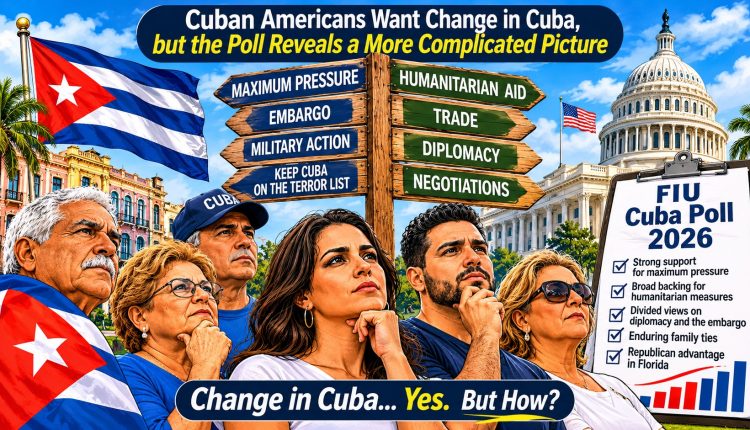
Cuban Americans want change in Cuba, but poll reveals it’s more complicated than that
The latest Florida International University Cuba Poll delivers a message that Washington will find difficult to ignore: Cuban Americans in South Florida remain deeply opposed to Cuba’s political system and overwhelmingly favor policies intended to bring about its transformation. But beneath that hard-line position lies a more complicated picture of a community that also supports humanitarian assistance, maintains family ties to the island, and shows considerable openness to diplomacy.
The 2026 survey, based on responses from 1,004 Cuban Americans in South Florida, examines attitudes toward U.S.-Cuba relations, the Trump administration, immigration and the November elections. Its findings make clear that support for confronting the Cuban government remains strong, particularly among Republicans and those who arrived in the United States before 1995.
Yet the results also raise a fundamental question: Is the goal to punish the Cuban government at any cost, or to develop a policy that can produce political change while reducing the suffering of the Cuban people?
The answers suggest that many Cuban Americans want both.
Maximum pressure remains the dominant position
The poll shows that 77% favor emphasizing maximum pressure on the Cuban government. Sixty-five percent support a blockade of oil imports, and 69% favor keeping Cuba on the U.S. list of State Sponsors of Terrorism.
The most striking finding may be the 73% who support U.S. military action to overthrow the Cuban government. Among those who favor military action, 43% prefer a clandestine operation.
These numbers demonstrate the depth of opposition to Havana among Cuban Americans in Miami. They also show how strongly the community still views regime change as a legitimate objective of American policy.
That determination is reinforced by the finding that 69% believe maximum pressure will bring about regime change. Republicans are particularly confident, with 81% expressing that belief, compared with just 37% of Democrats.
Still, expectations about the timing of change vary considerably. While 22% expect major political change within a year and 40% within five years, 29% believe it will never happen.
After decades of sanctions and confrontational policies, that last figure deserves attention. It suggests that even among a community strongly committed to change, there is no universal confidence that the existing strategy will succeed.
The human cost presents a difficult question
One of the poll’s most revealing findings concerns the suffering of the Cuban people. Respondents are evenly divided on whether that suffering is an acceptable price to pay for regime change.
That split is important because it exposes a tension at the heart of U.S. policy toward Cuba.
A policy designed to weaken a government through economic pressure inevitably raises questions about who bears the consequences. The Cuban government remains responsible for its own political decisions and economic failures. But ordinary Cubans also face the consequences of trade restrictions, fuel shortages, and limited economic opportunities.
The poll does not suggest that Cuban Americans are abandoning their opposition to the government in Havana. Rather, it shows that the question of how much suffering is acceptable has no unanimous answer, even within a community that strongly favors pressure.
That distinction matters. Wanting political change is one thing; deciding which policies are most likely to achieve it, and at what human cost, is another.
Humanitarian assistance enjoys broad support
The survey’s findings on humanitarian policy are particularly revealing.
Seventy-three percent favor unrestricted sales of medicine to Cuba, while 70% support unrestricted food sales. Seventy-four percent favor U.S. assistance to Cuba’s private sector to help alleviate the humanitarian crisis, and 70% support giving private businesses a greater role in supplying household fuel.
Moreover, 69% agree that the United States should emphasize policies designed to improve the economic well-being of the Cuban people.
These are not marginal positions. They demonstrate that substantial majorities support measures intended to help ordinary Cubans, even as they favor maintaining pressure on the government.
Indeed, 77% support maximum pressure while 69% support policies aimed at improving the Cuban people’s economic circumstances.
The two positions are not necessarily contradictory. Many Cuban Americans may believe that the government must be confronted politically while independent businesses and ordinary citizens should receive greater opportunities to improve their lives.
But these views can coexist, creating an important policy challenge: Can Washington maintain pressure on Havana without undermining the very people it says it wants to help?
The poll does not answer that question. It does, however, demonstrate why policymakers should not assume that support for a hard-line Cuba policy automatically translates into opposition to humanitarian assistance.
Diplomacy has not disappeared
The findings on diplomatic relations and negotiations further complicate the image of a uniformly hard-line community.
Fifty-eight percent favor maintaining diplomatic relations between the United States and Cuba. Forty-eight percent support negotiating with influential members of Cuba’s leadership, and the same percentage favor international mediation.
Even more significantly, 67% approve easing sanctions in exchange for establishing a free-market economy within two years.
These results suggest that a substantial portion of the community is willing to consider conditional engagement if it produces meaningful economic change.
The poll also finds that 46% approve of a transition in which the current government remains in power until multiparty elections take place. Meanwhile, 51% support a multiparty system in which the Communist Party would be permitted to compete.
These are not endorsements of Cuba’s existing political system. They are indications that respondents differ over how a transition should unfold and whether negotiations might help bring it about.
The findings on unrestricted travel for all Americans are almost evenly divided, with 51% in favor and 49% opposed.
Taken together, the results suggest that while confrontation remains the dominant instinct, diplomacy and conditional engagement retain a place in the community’s thinking.
The embargo remains popular, but not universally so
Among respondents who expressed an opinion, 61% favor continuing the U.S. embargo. When those who answered “Don’t Know” are included, support falls to 56%.
The partisan divide is pronounced. Seventy-nine percent of Republicans favor continuing the embargo, while only 23% of Democrats support it.
These figures reinforce how closely Cuba policy remains tied to political identity. For many Republicans, maintaining the embargo is an essential component of opposing the Cuban government. Democrats are considerably more likely to reject that approach.
Yet the overall findings also suggest that support for the embargo should not be confused with opposition to every form of engagement. A majority favor maintaining diplomatic relations, and large majorities support unrestricted food and medicine sales.
The distinction between maintaining economic pressure and allowing humanitarian or diplomatic channels to operate is central to understanding the poll.
Family ties continue to connect South Florida to Cuba
Despite decades of political estrangement, the personal connections between Cuban Americans and the island remain remarkably strong.
Seventy-one percent of respondents have close relatives in Cuba. That proportion rises from 63% among those who migrated before 1995 to 92% among those who arrived after 2020.
Sixty percent sent food or other goods to the island during the previous year, while 45% sent money.
These figures provide an important counterpoint to the poll’s findings on political confrontation. The relationship between South Florida and Cuba is not simply a story of ideological opposition. It is also a story of families, obligations, and continuing personal connections across the Florida Straits.
Those ties help explain why humanitarian measures receive broad support even among respondents who favor an aggressive policy toward Havana.
At the same time, the prospect of returning to Cuba remains remote for most respondents. Seventy percent say they would be unlikely to return to live on the island even if its economy improved. Sixty-three percent say they would still be unlikely to return if Cuba underwent political change.
Economic improvement and political transformation, therefore, would not automatically reverse decades of migration or persuade most Cuban Americans to make the island their home again.
Immigration is another point of disagreement with Washington
The poll also identifies an area where Cuban Americans strongly oppose the administration’s approach.
Seventy-six percent disapprove of increased deportations of Cuban nationals who have no criminal record, including 63% who strongly disapprove.
Meanwhile, 87% agree that the government should resume processing immigration benefits for Cubans already in the United States.
These findings matter because they show that strong support for the Republican Party and a hard-line Cuba policy does not necessarily translate into support for every immigration measure.
For a community with extensive family ties to the island, immigration policy has direct and personal consequences. The results suggest that many Cuban Americans distinguish between opposing the Cuban government and supporting the deportation of Cubans who have no criminal record.
That distinction deserves consideration in Washington, particularly as immigration enforcement remains a major political issue.
Republicans retain a substantial political advantage
The poll also offers a snapshot of the political landscape ahead of Florida’s November 2026 elections.
Among registered voters, 53% identify as Republicans, 27% as independents and 18% as Democrats. Younger respondents are more evenly distributed: Among those under 40, 40% identify as Republicans, 34% as independents and 24% as Democrats.
The Republican advantage is reflected in the statewide contests. Among respondents who named a candidate in the U.S. Senate race, Republican Ashley Moody leads Democrat Angela Nixon by 51% to 26%. However, 44% of the full sample remain undecided.
In the gubernatorial contest, Republican Byron Donalds leads Democrat David Jolly by 60% to 24% among respondents who named a candidate, while 39% of the full sample remain undecided.
Sixty-eight percent say they would vote for the Republican running in their congressional district.
Looking further ahead, 58% favor Marco Rubio for the Republican presidential nomination in 2028, while 54% say they would support no Democrat.
These results demonstrate the continued strength of the Republican Party among Cuban American voters in South Florida. Nevertheless, the large undecided shares in both statewide races caution against treating the poll as a final election forecast.
The administration also receives substantial support on foreign policy. Sixty-six percent approve of its handling of Cuba, 68% of China, 64% of Russia, and 60% of relations with Israel. Fifty-seven percent approve of U.S. military action against Iran.
But on the economy, respondents are evenly divided, with 50% approving of the administration’s performance.
That finding matters because the economy and health care rank as the community’s two most important issues, scoring 4.78 and 4.73, respectively, on a five-point scale. Immigration follows at 4.35, with Cuba policy at 4.18.
Cuba remains important, but it is not the only issue shaping the community’s priorities.
A community united by its objective, divided over the means
Perhaps the most useful lesson from the 2026 FIU Cuba Poll is that Cuban Americans cannot be understood through a single political label.
Republicans and those who arrived before 1995 express the strongest support for maximum pressure, the oil blockade and military action. Democrats express the weakest support for those measures. Respondents under 40 and those born outside Cuba are more receptive to negotiations with Havana’s leadership.
Yet across party lines, majorities support selling medicine to Cuba, resuming immigration benefits and assisting the island’s private sector.
Those common positions deserve as much attention as the disagreements.
The poll’s findings do not indicate that Cuban Americans have softened their opposition to the Cuban government. Nor do they establish that the community has reached a consensus on what should replace the current policy.
Instead, they reveal a community that broadly agrees on the desired outcome but remains divided over the most effective route to achieve it.
For Washington, that distinction should matter.
If the objective is political change in Cuba, policymakers must confront a basic question: Are the policies being pursued likely to produce that change, or do they risk prolonging a stalemate while ordinary Cubans continue to suffer?
The FIU survey cannot determine which strategy will succeed. Public opinion alone cannot establish whether sanctions, negotiations, humanitarian assistance or some combination of approaches will bring about political transformation.
But the findings make one thing clear: Support for confronting the Cuban government does not eliminate the demand for policies that help the Cuban people.
A policy that recognizes both realities would not require abandoning the goal of political change. It would require examining whether the means being used are consistent with that goal.
The 2026 FIU Cuba Poll offers Washington an opportunity to look beyond the familiar image of a uniformly hard-line Cuban American electorate. Beneath that image is a community with strong convictions, enduring family connections and differing views about the costs and possibilities of U.S. policy.
Understanding those distinctions is essential to understanding not only Cuban American politics, but also the continuing debate over the future of U.S.-Cuba relations.
