
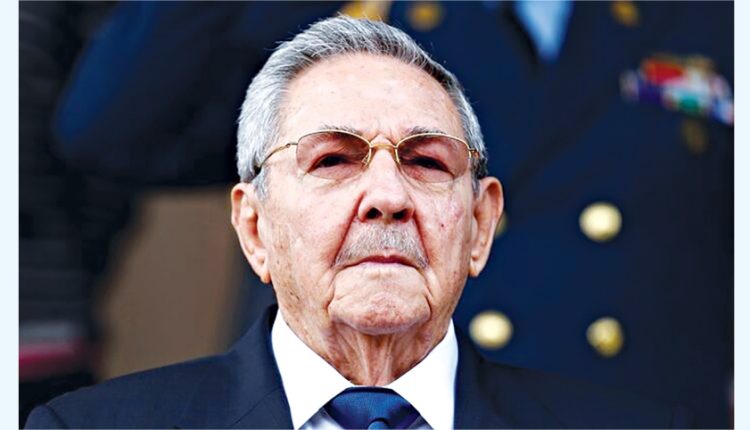
Raúl Castro’s indictment: Justice or regime change?
The downing of the Brothers to the Rescue planes was not only used to demonize Cuba. It also influenced U.S. policy for many years.
Violence — including terrorism — against Cuba has long been tolerated in Washington; Cuba’s response to it has not. That double standard is once again fully evident as the Trump administration today indicted former Cuban President Raúl Castro for the shoot-down of two planes 30 years ago — even as the U.S. military regularly destroys boats in the Caribbean and eastern Pacific, killing nearly 200 people with impunity.
The 1996 shooting down of two Cessnas owned by the Miami-based group Brothers to the Rescue was not an immediate or isolated event. It resulted from repeated provocations, incursions, numerous warnings, and the U.S. government’s failure to restrain a political group openly seeking confrontation.
Presented in Miami and Washington as a long-overdue quest for accountability for the deaths of four men, the indictment is based on a familiar foundation: selective outrage, historical amnesia, and legal exceptionalism.
From Rescue Missions to Provocation
Brothers to the Rescue was founded by José Basulto, a veteran of the failed Bay of Pigs invasion and CIA collaborator known for violent actions against Cuba. In 1961, Basulto was involved in a plot to blow up a missile base in Havana. A year later, he helped position a boat armed with a 20mm cannon off the coast of Havana and fired on the Hotel Rosita de Hornedo, where he believed Fidel Castro would be dining.
“I was trained as a terrorist by the United States,” Basulto told the Miami Herald.
Brothers to the Rescue began in 1991 by conducting search-and-rescue missions for Cuban rafters. However, after an agreement significantly reduced the flow of migrants across the Florida Straits, the group shifted from rescue operations to outright provocation. “They started…to carry out a political agenda of harassing and threatening the Cuban government,” recalled Richard Nuccio, then White House special advisor on Cuba. Brothers to the Rescue pilots repeatedly violated Cuban airspace, dropping religious medallions and anti-government leaflets over Havana, including one urging Cubans to “Change Things Now.”
Basulto was upfront about the flights’ purpose. After a 1995 flyover of Havana, he said, “We want confrontation.” The mission, he explained, was designed to demonstrate that “the regime is not invulnerable.”
The Cuban government repeatedly warned Washington that the flights were illegal and dangerous. Cuban officials filed diplomatic protests, sent evidence to the Federal Aviation Administration (FAA), and made clear that if the incursions continued, Cuba could shoot down the planes. U.S. officials understood the danger was real. In a January 1996 email, FAA official Cecilia Capestany informed her superiors that “one of these days the Cubans will shoot down one of these planes.”
Yet Washington failed to stop the flights. Cuban officials used every means of communication available: diplomatic notes, military briefings, intermediaries, and back-channel contacts, to make clear their patience had run out.
On February 24, 1996, three Brothers to the Rescue Cessnas took off from Florida after submitting a false flight plan claiming they were searching for rafters at sea. In reality, the mission was intended to penetrate Cuban airspace again.
As the aircraft approached the island, Cuban controllers immediately warned them not to cross into their airspace. “You run danger by penetrating that side,” they replied.
“We are ready to do it,” Basulto responded. “It is our right as free Cubans.”
Not long after, Cuban fighter jets shot down two of the aircraft, killing all four men onboard. Basulto’s plane returned to Miami.
Weaponizing a Tragedy
The downing of the Brothers to the Rescue planes was not only used to demonize Cuba. It also influenced U.S. policy for many years.
Before the incident, the Clinton administration had cautiously explored limited openings with Havana. But after the planes were shot down, hardliners in Congress seized the moment. Inside the White House, some officials warned against overreaction. Brothers to the Rescue had “been playing with fire,” Richard Nuccio told senior adviser Sandy Berger. “They got exactly what they were hoping to produce.”
The warning went unheeded. Clinton quickly supported the Helms-Burton Act, which codified the U.S. embargo into law and, through Title III, expanded its extraterritorial reach, allowing U.S. nationals to sue foreign companies accused of “trafficking” in property nationalized after the Cuban Revolution. Clinton and every president since then suspended Title III for more than two decades, until Trump activated the provision in 2019, unleashing dozens of lawsuits that led to an exodus of foreign investment from the island.
The Brothers to the Rescue shoot-down also played a central role in the prosecution of Gerardo Hernández, one of the Cuban Five, a group of operatives sent undercover to South Florida to monitor terrorist organizations linked to attacks against civilians in Cuba. In 1998, Cuban officials provided extensive documentation detailing dozens of U.S.-financed terrorist plots. The FBI responded by arresting the agents who had infiltrated these terrorist networks. Hernández was convicted in 2001 in a highly controversial trial on conspiracy charges related to the Brothers to the Rescue shoot-down, despite the lack of evidence that he participated in, ordered, or had foreknowledge of the decision to down the aircraft.
Nearly three decades later, the same incident is once again being used to target Raúl Castro, without considering the broader context in which it happened. The Justice Department’s indictment omits the long history of violent, Florida-based extremists who have targeted Cuba, and this violence has continued to the present day.
Florida-Based Terrorism and Decades of Impunity
On February 25, 2026, a Florida-registered boat carrying ten armed men exchanged fire with the Cuban coast guard one mile off Cuba’s northern coast. According to Cuba’s Interior Ministry, the men opened fire first, injuring a Cuban commander. After the firefight, five of the men were killed, and the boat was seized, along with more than 12,000 rounds of ammunition, sniper rifles, Molotov cocktails, bulletproof vests, and night-vision equipment. All 10 men on board were reportedly Cuban-born U.S. residents.
The incident was the latest in a decades-long series of armed attacks, sabotage, and terrorism aimed at Cuba from U.S. soil, often carried out with impunity and, at times, with covert political protection in Miami and Washington.
The most notorious example is Cubana Flight 455. Orlando Bosch and Luis Posada Carriles are widely believed to have planned the 1976 bombing of the civilian airliner, which exploded off the coast of Barbados, killing all 73 people on board. At the time, it was the deadliest act of airline terrorism in the Western Hemisphere. The victims included children and every member of Cuba’s national fencing team.
The FBI later described Bosch’s organization, CORU (Coordination of United Revolutionary Organizations), as an “anti-Castro terrorist umbrella organization,” while former U.S. Attorney General Dick Thornburgh called Bosch an “unrepentant terrorist.” Posada Carriles was involved in a long series of violent operations spanning decades, including a 1997 bombing campaign targeting hotels in Havana that killed an Italian tourist and injured several others.
Rather than prosecuting Bosch and Posada Carriles, the United States ultimately shielded both men. In 1990, President George H.W. Bush allowed Bosch to stay in the country despite a 1989 Justice Department ruling that aimed to deport him, citing “substantial proof concerning his past and present terrorist activities.” Posada Carriles, meanwhile, escaped from a Venezuelan prison while awaiting trial for the Cubana Flight bombing and later resurfaced in Central America during the Iran-Contra scandal. After illegally entering the United States in 2005, Posada Carriles was protected from extradition to Venezuela and Cuba and was never tried in the U.S. for the bombing of the Cubana flight.
Both Posada Carriles and Bosch lived freely in Miami until their deaths.
Miami is ground zero for the double standard shaping U.S. policy toward Cuba. The Cuban-American hardliners who dominate the city’s politics have long supported violence, terrorism, and collective punishment against Cuba in the name of “freedom” and “human rights.” Unsurprisingly, the current push to indict Raúl Castro came three months after Cuban-American hardliners from Florida urged the Justice Department to do just that.
“This was a long thought-out thing that I wanted to do,” Rep. Mario Díaz-Balart (R-FL) told USA Today. “And I thought this was the president who would do it.”
Cuba on Trial, Washington Above the Law
The hypocrisy doesn’t end at the Florida Straits. Since the start of the 2000s, the U.S. has bombed targets in multiple countries without declaring war, lacking UN approval, and often ignoring civilian casualties. More recently, in the Caribbean and Pacific, the U.S. has conducted military strikes with such impunity that Cuba’s actions in 1996 seem restrained by comparison.
While Washington and Miami indict a 94-year-old man over a three-decade-old incident, the Trump administration has spent recent months executing people on boats in international waters with zero accountability. Since September 2025, the United States has launched nearly 60 military strikes against vessels in the Caribbean and Pacific under Operation Southern Spear, claiming to target “narco-traffickers” and “terrorist organizations.”
The operations have killed at least 193 people, partly due to tactics such as disguised military aircraft and “double tap” strikes on an already disabled vessel targeting survivors after an initial attack. Almost no evidence has been made public. Satellite images are classified. Intercepts are withheld. Even the names of the dead are not released. Victims of U.S. firepower are rarely afforded the dignity of public acknowledgment.
These extrajudicial killings reveal a familiar double standard in U.S. foreign policy: that the United States’ own violence is justified, while the violence of its enemies is condemned, even in cases of self-defense.
Repackaging Regime Change as Justice
The Raúl Castro indictment is not just a way to settle a decades-old score; instead, it aligns with current foreign policy goals, aiming to turn weak criminal charges into a legal excuse for regime change and possibly military action.
According to NBC News, Trump “has grown increasingly frustrated with the Cuban government’s ability to maintain power” and has been “pressing his advisers” about why the collapse has not yet occurred despite unprecedented extraterritorial sanctions and an oil blockade that is causing a humanitarian crisis. While administration officials believe the Cuban government will fall before the end of the year, Trump “has found that timeline insufficient.”
As economic warfare fails to topple the Cuban government, the Department of Defense develops a plan for potential military action against Cuba.
The only missing piece is a legal pretext. The “narco-terrorism” charge used to justify the abduction of Venezuela’s President Nicolás Maduro cannot easily be applied to Cuba. For decades, the “consensus position” within the U.S. intelligence community has been that Cuba does not sponsor terrorism. Meanwhile, the State Department has long considered Cuba a key U.S. partner in counternarcotics cooperation.
The indictment against Castro may serve as a weak justification for military action. Instead of ending a long pursuit of accountability, the case seems to lay the legal foundation for a more aggressive and violent phase in Washington’s siege on Cuba.
