
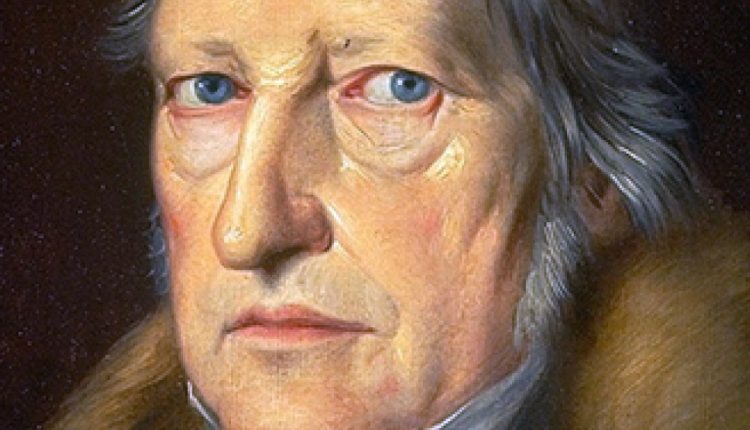
 Georg Wilhelm Friedrich Hegel
The spirit of our times
The spirit of our time is defined by technological development, especially AI, but I am inclined to think that what is truly decisive is individualism and militarism in international relations.
The German philosopher Georg Wilhelm Friedrich Hegel popularized the concept of the “spirit of the age” to define the set of ideas and values that characterize a given historical moment.
For some, the spirit of our time is defined by the development of technology, especially artificial intelligence, but I am inclined to think that what is truly decisive is individualism in people’s behavior and militarism in international relations—two direct consequences of the development of capitalism in its modern imperialist phase.
When Donald Trump boasts of having assassinated a foreign religious leader along with his entire family, including his granddaughter, and most people react by focusing their concern on rising fuel prices, we are witnessing the crisis of values that characterizes the prevailing ideology in the contemporary world.
Marx conditioned the concept of the “spirit of the age” by arguing that it is determined by the concrete social and economic relations existing at a given moment. “The ruling ideas of each age have always been the ideas of the ruling class,” he asserted. It is therefore worth asking what balance of domination is reflected in the current situation.
After the debacle of the Soviet Union and the European socialist bloc, the capitalist system established itself everywhere. Even in countries such as China, Vietnam, and Cuba—where the socialist model of social organization has persisted—there has been no choice but to adapt their economies to the demands of the global capitalist market.
“Neoliberal globalization”—that is, the removal of national barriers to international trade and capital flows, the privatization of public enterprises, and the restriction of state intervention in the economy—was considered the “end of history” and led to the consolidation of neocolonialism as a system of domination in Third World countries.
It was taken for granted that the United States would be the great beneficiary of this new situation. Backed by the dollar, American capital would impose the rules of the financial markets, its products would flood global trade, and its technology would dominate humanity’s scientific development. And where economics and diplomacy failed, brute force stood ready to impose U.S. dominance. In the post–Cold War era, the country has carried out fifteen major military interventions across much of the world.
However, things did not unfold exactly as expected, and rather than strengthening it, neoliberal globalization has contributed to the deterioration of U.S. hegemony. According to data from the International Monetary Fund (IMF), although it remains the largest economy in the world and accounts for about a quarter of global GDP, the gap between the United States and emerging countries—especially those grouped around the BRICS—has narrowed significantly, affecting Washington’s ability to impose its dominance in the international political balance.
The most notable case is China, which in 2000 accounted for one-tenth of the U.S. economy and now accounts for 63% of its size, with a much higher growth rate. In terms of trade, this phenomenon is even more evident: whereas at the beginning of the century the United States dominated the global market, today it accounts for barely 10% of transactions.
This is linked to a decline in its industrial capacity, resulting from the relocation of investment to less developed countries offering higher returns on capital. While in 2000, U.S. industrial production accounted for 28% of global output, today it barely reaches 16%. By contrast, China has grown from 6% in 2000 to 32% today.
Not even in high-tech sectors—the current engine of the U.S. economy—can it be said that the United States enjoys a decisive advantage over China, which is advancing every day.
The slogan “Make America Great Again” (MAGA), which fuels the American ultraconservative movement, is not detached from reality. Although it does not affect everyone equally and coexists with an extraordinary concentration of capital, the decline of the United States is a tangible fact reflected in its internal contradictions, the deterioration of its institutions and the rules governing domestic politics, as well as in the conduct of its foreign policy.
A review of the government’s recently published National Security Strategy is enough to perceive a strategic retrenchment in the projection of American imperialism. Faced with this reality, the use of force appears to be the only alternative and reflects more the system’s weakness than the power it seeks to demonstrate.
In Europe as well—the other center of Western capitalism—the system shows signs of exhaustion. Structural economic problems affect all countries, and their declining political importance on the international stage is evident. Ursula von der Leyen is not wrong in stating that one cannot rely on an international order whose civilizational norms have been blown apart. According to Josep Borrell, former head of European diplomacy, these countries “sank their moral lighthouse” by accepting the Israeli genocide in Gaza.
However, the same cannot be said of the ideology that underpins capitalist culture. As a result of the extraordinary development of the media and their control by the system’s power structures, the ideas and values of capitalism penetrate people’s consciousness even in the most remote corners of the planet. Particularly decisive is the promotion of an individualism that alienates the masses from their social class and shapes popular responses to political crises in their countries.
According to this view, the struggle for social demands “lowers” people into the ranks of the losers and distances them from achieving their “dream identity” as part of the so-called “middle class,” defined by its capacity to consume the excesses offered by the market.
Capitalist ideology teaches that there is no dignity in poverty, that personal “success” depends on merit and individual effort, and that it is not worth dedicating one’s life to the collective good. Solidarity with others and individual sacrifice in pursuit of common goals have been eliminated from today’s political discourse—even within leftist movements. The apostles are gone.
The success of capitalist ideology is explained by the contradiction that people act against their own interests and seek to overcome the system’s crisis by supporting the far-right agenda. Under the argument that this brings greater “stability” to the system—as a basis for “social mobility” and entry into the class group one aspires to join—trade union struggles are discredited, and social gains are rolled back. So much so that progressive movements have lost votes precisely as their policies succeed in lifting more people out of poverty.
Thanks to the spread of this mindset, Donald Trump can establish himself as a leader of a large segment of American workers, a disturbed figure like Javier Milei can become president of Argentina, or the neo-Nazi José Antonio Kast can win elections in Chile—not to mention the advance of fascism in Europe itself, where it once existed in its most abhorrent forms.
In this way, nationalism in its most xenophobic and chauvinistic version once again becomes the domain of imperialist countries, while others are expected to accept limited sovereignty as a sign of “modernity.” Popular rebellion has become a tool of far-right “color revolutions,” and in this narrative, truly emancipatory processes are labeled as mere “terrorism.” Migration, with its share of humiliations, has become the life alternative for the discontented.
All of this leads us to the curious contradiction of living through a period of rising capitalist ideology while witnessing the system’s degeneration—at least with regard to U.S. hegemony. At this pace, dominated by complicit indifference, we risk sinking like the Titanic: listening to violins and surrounded by luxuries—unattainable for most—that merely adorn the tragedy.
