
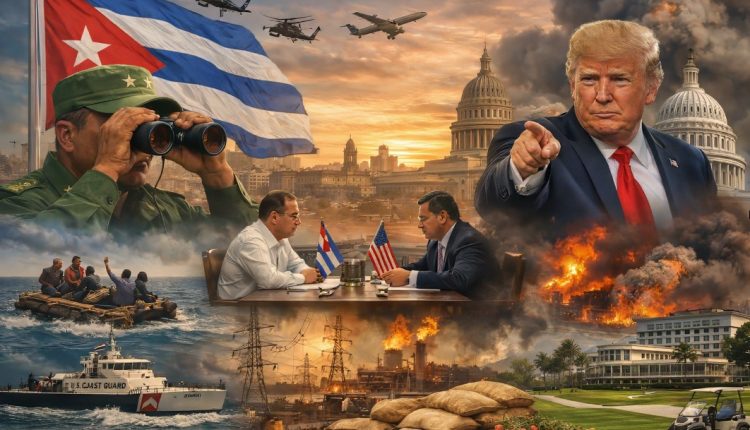
How Cuba is about to defeat the United States
Many of the ideas circulating in Washington fit well with positions the Cuban government has been taking for years.
Álvaro Fernández recently reminded us in Progreso Weekly that once upon a time, among Cuban exiles, the word dialogue turned into something worse than an ordinary pejorative. Beginning in the 1970s—especially after the first serious proposals for engagement between Washington and Havana—the very idea of talking to the Cuban government was treated as heresy.
A new insult appeared: the derivative term dialoguero.
To be labeled a dialoguero was to be accused of weakness, appeasement, even treason. For decades that accusation carried enormous political weight within the exile community.
History, however, has a taste for irony.
Because today the United States itself increasingly seeks what those condemned dialogueros were advocating all along: dialogue with Cuba. Even Secretary of State Marco Rubio, the right-wing extremist whose parents were Cuban immigrants, appears to have joined the parade.
The first small crack in the wall appeared during the Carter administration. In 1977 Washington and Havana opened Interest Sections in each other’s capitals, establishing a diplomatic channel that had been frozen since 1961.
The opening did not last. Domestic politics in both countries intervened, and Cold War tensions in Africa and Central America hardened attitudes on both sides.
Yet the logic of contact never entirely disappeared.
Two decades later another opening materialized. In 1994, amid the balsero crisis, the United States and Cuba negotiated migration accords that remain in force today. Even during periods of hostility, both governments quietly acknowledged a fact: some problems cannot be managed without communication.
That same logic resurfaced during the Obama administration. In December 2014 Obama and Raúl Castro simultaneously announced the normalization of diplomatic relations. Embassies reopened. Travel restrictions loosened. Economic contacts began to expand.
For a moment it seemed as if the Cold War between Washington and Havana might finally be ending. Then came the Trump reversal of everything Obama.
Yet even during renewed hostility the underlying reality did not disappear. The United States and Cuba still had to talk.
Here is where the paradox becomes difficult to ignore.
Many of the ideas circulating in Washington fit well with positions the Cuban government has been taking for years.
Cuba has long said it is willing to discuss migration agreements to ensure orderly and legal migration. Washington wants exactly that now, although the United States has failed to comply with the 1994 accords already in the books.
Cuba has repeatedly proposed increased cooperation on drug interdiction and maritime security in the Caribbean. The United States knows that such coordination is essential. And there has been more cooperation than most people realize—but it has been quiet, technical, and intermittent, not a formal alliance. It operates at the level of coast guards, law enforcement, and intelligence sharing, not grand diplomacy, but recognizes that even at the height of conflict, the United States could not enforce its own security in the Caribbean without Cuba’s help.
Cuba has invited foreign investment in tourism, renewable energy, biotechnology, and infrastructure, not through rhetoric alone; it has built a legal and institutional framework—gradual, controlled, but genuine—designed to attract capital while preserving state control. American investors have been eager to participate, and many in the diaspora are looking forward to it after Cuba announced they are invited too. The president could jump for joy also with an offer of partnership between The Trump Organization and the GAESA conglomerate in a couple of hotels and golf courses.
Even on issues of economic reform, private enterprise, and foreign capital, the direction of change inside Cuba—slow, uneven, sometimes contradictory, but unmistakable—has moved toward exactly the kinds of economic openings that American policymakers once claimed to be demanding. Even the release of political prisoners has continued to trickle quietly after a Vatican arrangement in 2025 and more Vatican intercessions this year.
Migration flows, narcotics trafficking, aviation safety, hurricane response, environmental protection, and maritime coordination do not disappear because governments refuse to acknowledge one another.
The contradiction becomes sharper in the current crisis. Washington has attempted to impose extraordinary economic pressure on the island, including measures to shut down the flow of petroleum that keeps the Cuban economy afloat. The resulting shortages have produced nationwide blackouts and a severe economic shock.
Yet even as pressure intensifies, negotiations resume.
After sixty-five years of confrontation, the United States still finds itself sitting across a table from the Cuban government discussing migration, economic relations, and regional security. Now when pressure is meant to force capitulation, dialogue again proves unavoidable.
Notably, for decades, Cuba’s position vis-a-vis the United States has been that everything is negotiable—except sovereignty and the political system. This includes compensation for confiscated properties. Cuba’s position has been expressed in different formulations by leaders from Fidel Castro to Raúl Castro and more recently Miguel Díaz-Canel.
Another layer of irony concerns investment.
For more than sixty years the United States attempted to isolate Cuba economically through the embargo, hoping to deprive the government of resources until the system collapsed or transformed under pressure.
That objective has never been achieved.
Instead, American companies spent decades watching from the sidelines while competitors from Canada, Europe, and Asia occupied sectors of the Cuban economy that American firms once dominated in the Caribbean.
Tourism infrastructure, telecommunications, ports, renewable energy, and biotechnology all represent sectors thirsting for investment. Even under onerous restrictions American agricultural exporters already sell hundreds of millions of dollars in food to Cuba each year. Airlines, cruise companies, and telecommunications firms have repeatedly explored opportunities whenever political conditions briefly allowed it.
If relations normalize, American investment will almost certainly begin flowing into sectors that have been closed for decades.
Seen from Havana, that would not represent the defeat of Cuba’s strategy. It would validate it.
From the beginning of the revolution, the Cuban government argued that the United States should simply accept Cuba as it is and maintain normal economic relations with it. After decades of sanctions and hostility, Washington may be slowly drifting toward exactly that position.
But not without something that can be presented as victory.
Justifying a major shift in policy demands a concession dramatic enough for the United States to claim that pressure worked, or as Trump puts it, “the honor of taking Cuba … in some form.” That concession could be personal rather than structural.
Trump and influential Cuban American political figures have suggested that a significant thaw in relations would require a visible leadership change in Havana. The Cuban president stepping aside—which appears to be the current call—would allow American leaders to argue that sanctions and economic pressure forced the system to bend. Other influential figures associated with Fidel Castro’s ideology may have to follow suit, but not necessarily Alejandro Castro, who could play a similar role to Delcy Rodriguez in Venezuela.
Cuban political history could offer another interpretation. Revolutions sometimes sacrifice individuals to preserve the system that produced them.
If a leader disappears from the stage—retiring, resigning, or quietly replaced by another figure within the same political structure—the essential institutions remain intact. The Communist Party continues to govern. The political architecture of the revolution survives. Free education and universal health care do not disappear. Nothing non-negotiable is negotiated away.
Washington might present the moment as regime change.
Havana might rationalize it simply as tactical adaptation to temporary Trumpian conditions.
Ancient religions offered sacrifices to appease the gods while leaving the temple standing. Diplomacy occasionally follows a similar logic.
On the other side, the United States wouldn’t be the first great power to discover that long struggles against smaller adversaries rarely end as originally planned.
France fought eight years in Algeria to preserve its colony, only to depart under terms recognizing Algerian independence.
The Soviet Union invaded Afghanistan to stabilize a friendly government and withdrew a decade later without achieving its objective.
The United States fought twenty years in Afghanistan before leaving the Taliban in power almost exactly where they had been before the war began.
Vietnam offers the loudest historical echo. Washington entered that conflict determined to prevent the victory of a communist government in Hanoi. Years later negotiations in Paris settled on “peace with honor,” while the political outcome Washington had tried to prevent unfolded anyway.
Great powers seldom describe such outcomes as defeat. More often they redefine victory. We see the war against Iran possibly moving in that direction. Something similar may now be unfolding in the Caribbean––a tropical TACO.
For sixty-five years the United States attempted to isolate, pressure, and transform the Cuban political system.
Cuba’s objective was far simpler: survive, remain independent, and eventually oblige Washington to deal with it as a permanent reality—respectfully, as sovereign equals.
If negotiations ultimately produce normalized relations, the final irony will be unmistakable.
The United States will say its pressure forced change.
Cuba will know that after six and a half decades of sanctions, covert operations, diplomatic confrontation, and economic siege, the revolution endured long enough for its adversary to accept the relationship Havana wanted from the beginning. It might say it defeated the United States.
