
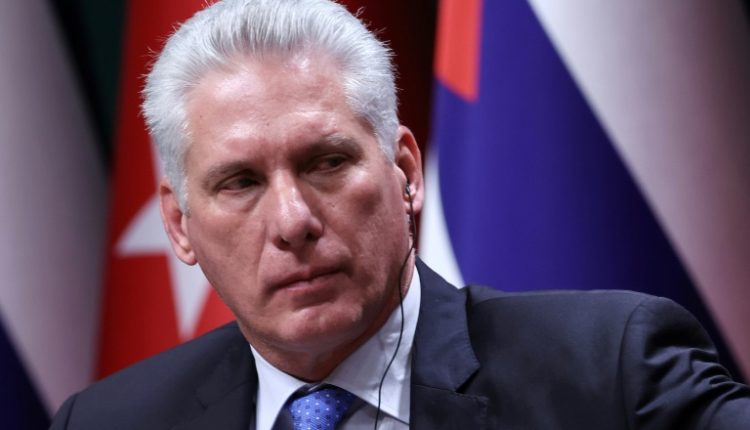
Díaz-Canel breaks the silence: Cuba confirms talks with Washington
Díaz-Canel warned that the contacts are still in early stages. Negotiations, he said, require time.
For weeks, rumors circulated in Washington, Miami, and Havana that quiet contacts were happening between the United States and Cuba. Some analysts even suggested that the Cuban leadership might not be fully united about the talks. But the confirmation came directly from the top: Miguel Díaz‑Canel publicly acknowledged that negotiations with the Trump administration have started.
The announcement, reported by The New York Times in coverage by Frances Robles and David C. Adams, took place during a nationally broadcast address in Cuba. Díaz-Canel stated that the discussions aimed to explore “solutions, through dialogue, to the bilateral differences between our two nations.”
The importance of this moment goes beyond the words themselves. For months, rumors spread that the Cuban president might be pushed aside or excluded from key diplomatic talks. His public confirmation of the discussions effectively puts those rumors to rest. Not only is Díaz-Canel aware of the negotiations — he is the one announcing them.
A Crisis Forcing Conversation
The talks are taking place amid one of the worst economic crises Cuba has faced in decades. The island has been dealing with severe fuel shortages that have caused frequent blackouts across much of the country.
The crisis worsened after the United States sharply increased pressure on Venezuela, which has been Cuba’s main supplier of subsidized oil for a long time. With Venezuelan shipments stopped and new U.S. threats against any country selling oil to Havana, Cuba suddenly faced the risk of running out of fuel entirely.
The effects are clear across the island: public transit reduced, hospitals forced to delay non-urgent procedures, and entire neighborhoods without electricity for hours or days. Analysts cited by the Times warned that Cuba, which depends heavily on imported energy, could quickly reach a breaking point without new supplies.
In that context, the diplomatic channel between Havana and Washington seems less like a surprise and more like a necessity.
Early Stages, Uncertain Outcome
Díaz-Canel warned that the contacts are still in early stages. Negotiations, he said, require time: agendas need to be developed, positions clarified, and trust gradually established.
In other words, the announcement signals the beginning of a process—not its conclusion.
Washington’s stance has been quite different in its political messaging. Trump has repeatedly predicted that the Cuban government is close to collapsing. At a recent White House event, the former president suggested that significant change on the island could be coming soon, describing the moment as part of a larger shift across the region.
That remark came as Trump celebrated a sports event with soccer icon Lionel Messi, whose team had just won the Major League Soccer championship with Inter Miami CF. Also present was team co-owner Jorge Mas, son of the late Jorge Mas Canosa.
The symbolism was clear: sports, politics, and the long shadow of U.S.–Cuba relations coming together in a single moment.
The Real Stakes
If negotiations move past initial discussions, both sides will face substantial demands.
Some analysts quoted in The New York Times argue that any meaningful agreement would require sweeping political changes in Cuba — including the release of political prisoners, expanded civil liberties, and legal space for independent political organizations.
Indeed, Havana recently announced plans to release dozens of prisoners, a move some observers see as a possible sign of goodwill.
But the more profound question remains unanswered: what kind of agreement could satisfy both governments after more than sixty years of conflict?
The United States has long conditioned normalization with Cuba on political reforms. Meanwhile, the Cuban government has consistently insisted that the lifting of economic pressure — especially sanctions and restrictions — must occur first.
Dialogue After Decades of Conflict
None of this is entirely new. The two countries have sporadically sought rapprochement, most notably during the 2014–2016 thaw under Barack Obama. However, each attempt has eventually stalled, thwarted by domestic politics on both sides of the Florida Straits.
What makes this moment different is the severity of Cuba’s economic crisis, combined with Washington’s increasing pressure strategy.
That combination might create a small window where dialogue becomes unavoidable.
Whether that window results in genuine compromise or just another chapter in the ongoing saga of U.S.–Cuba tensions remains to be seen.
For now, however, one fact is clear: the confirmation came from the very figure some observers thought might be sidelined. By publicly acknowledging the negotiations, Miguel Díaz-Canel has clearly placed himself — unmistakably — at the heart of the process.
