
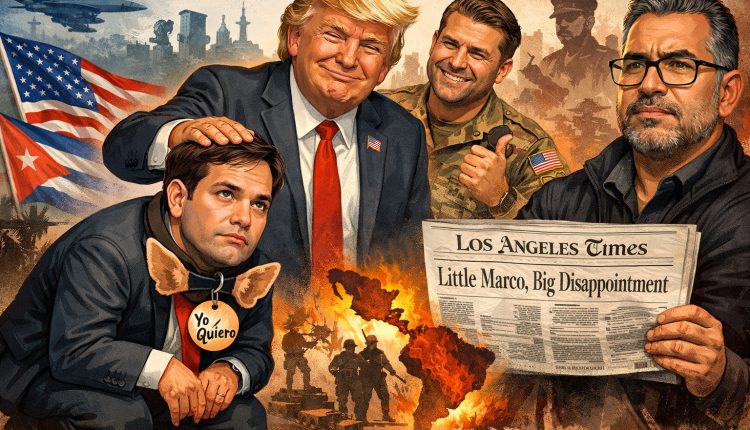
Marco Rubio proves he really is Little Marco
Rubio has become one of the chief enforcers of a political project that thrives on resentment toward migrants and hostility toward the very region his parents fled.
By invoking the nickname that once defined his political humiliation, Gustavo Arellano did more than mock Marco Rubio in his recent column in the Los Angeles Times. He exposed a deeper truth about power, identity, and political opportunism in the age of Donald Trump.
The moment that triggered Arellano’s commentary was almost absurd in its smallness. At a gathering in Miami of Latin American leaders, Rubio spoke Spanish — hardly shocking for the son of Cuban immigrants addressing a hemispheric audience. Yet Trump joked that Rubio might be “better in Spanish,” while Defense Secretary Pete Hegseth quipped that he spoke only “American.” Rubio responded meekly, “I only speak Cuban,” drawing laughter and a paternal pat on the back from the president.
It was a brief exchange. But as Arellano wrote, it spoke volumes. Rubio — arguably the most powerful Latino politician in U.S. history — was reduced to a punch line, a novelty, “the Chihuahua that says ‘Yo quiero Taco Bell.’”
And yet, as Arellano correctly insists, Rubio deserves little sympathy. If anything, the episode represents the inevitable end of a political journey defined by submission.
Rubio did not stumble into Trump’s orbit. He crawled there.
For those who remember the 2016 Republican primaries, the transformation is astonishing. Back then, Rubio denounced Trump as a dangerous demagogue unfit for the presidency. Today he praises him as “one of the most historic figures in American history.” The distance between those two positions is not merely political evolution — it is moral collapse.
Arellano calls Rubio a vendido — a sellout. The word fits.
Rubio built his early reputation on the story of the immigrant dream: the son of Cuban exiles who rose from modest beginnings to the highest levels of American politics. For many Latinos, his ascent symbolized something hopeful — the possibility that representation in power might produce a more humane politics toward immigrants and toward Latin America itself.
Instead, Rubio has become one of the chief enforcers of a political project that thrives on resentment toward migrants and hostility toward the very region his parents fled.
Consider the rhetoric. Rubio recently warned European leaders about “an unprecedented wave of mass migration that threatens the cohesion of our societies.” This from a man whose own family arrived in the United States during the upheavals of the Cold War Caribbean.
Or consider the policy. As secretary of state, Rubio presides over an aggressive foreign policy that pressures governments in Venezuela and Cuba while embracing strongman allies such as Nayib Bukele and Javier Milei. In Arellano’s devastating phrase, Rubio has become the “unholy child of Bush-era neoconservatism and MAGA.”
The tragedy here is larger than Rubio himself. For decades, American politics has debated what the rise of the Latino population would mean for the country. Some predicted a progressive transformation; others warned of cultural upheaval.
Rubio represents a different outcome: assimilation through imitation of the worst instincts of American power.
The irony borders on the grotesque. The United States has long treated Latin America as a backyard — intervening in its politics, supporting dictators, and shaping its economies to Washington’s liking. Many Latinos believed that the arrival of one of their own in high office might finally temper that tradition.
Instead, Rubio now carries the torch.
Arellano notes that Latin America has spent centuries yearning for prosperity and independence free from U.S. interference. That dream has fueled revolutions, literature, music, and political movements across the hemisphere. Yet again and again, it has been crushed by leaders backed or tolerated by Washington.
Rubio — the child of immigrants from that very region — now helps manage that same system of pressure and control.
Perhaps that is why the Miami episode felt so revealing. In that moment, Rubio had the credentials, the authority, and the cultural fluency to stand before Latin American leaders as something rare in American diplomacy: a bridge between worlds.
Instead, he asked permission to speak his own language.
That small gesture captured the deeper reality of his career. Rubio has spent years bending himself to fit into a political culture that will never fully accept him. The reward for that loyalty is the occasional pat on the back — and a reminder that, to the nationalist forces he serves, he will always remain a curiosity.
“Little Marco,” Trump once sneered.
The nickname was meant as an insult. Ironically, Rubio has spent the last decade proving it was accurate — not because of his stature, but because of the smallness of the principles he was willing to surrender to climb the ladder of power.
The future Rubio once dreamed of, as he wrote in his memoir American Son, has arrived. He sits at the top of American diplomacy, shaping the nation’s relationship with the world.
But if Gustavo Arellano’s column is correct, the price of that ascent is clear.
Rubio didn’t just shrink before Trump.
He shrank before history.
