
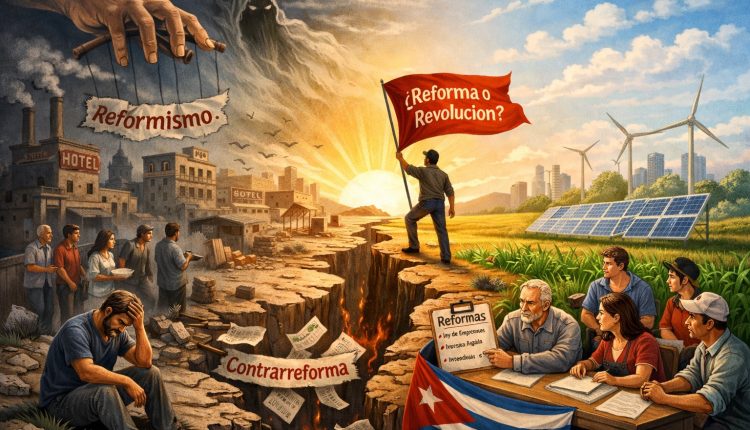
The reform that never was (and the counterreform that was)
A genuine reform implies comprehensiveness, planning, citizen participation, evaluation, and correction.
Opinion article based on “La Contrarreforma,” by Rubén Padrón Garriga, published in La Joven Cuba.
***
In the Cuban political debate, an old ghost has returned under a new name. Yesterday it was “centrism”; today it is “reformism.” The objective, however, remains the same: to discredit, silence, and exclude those who dare to question the immobilism that has brought us to where we are today. Rubén Padrón Garriga lays this out clearly in his article “La Contrarreforma,” published in La Joven Cuba—a text that presses on a wound that can no longer be hidden.
According to the new defenders of orthodoxy, Cuba is now suffering the consequences of “the reforms.” But this accusation collapses as soon as one seriously examines what has actually been reformed. As Padrón Garriga notes, a genuine reform implies comprehensiveness, planning, citizen participation, evaluation, and correction. None of that has occurred in Cuba. What we have seen instead are isolated, belated, and desperate measures, applied only once collapse was already evident.
Neither the expansion of the private sector, nor the failed Monetary Ordering, nor the authorization of micro, small, and medium-sized enterprises constitute a structural reform. They are patches. They changed certain survival dynamics, but they did not address the core knots of the problem: the lack of autonomy of state-owned enterprises, their chronic bureaucratization, and, at the same time, the regulatory stranglehold that suffocates the private sector. The result is plain to see: low domestic production, dependence on imports, runaway inflation, and accelerated impoverishment.
In this context, blaming the “reformists” for the crisis is—as the author aptly ironizes—an invocation of the babujal: an imaginary enemy that exists only to instill fear and justify inaction. Reform proposals not only exist; they have been developed in detail by Cuban economists from diverse perspectives, many of them published in La Joven Cuba and in state academic journals. Eliminating ministerial subordination of enterprises, changing investment policy, creating real incentives for food production, and fiscal and credit reforms—the ideas are there. What has been missing is the political will to implement them coherently.
The contradiction reaches the point of absurdity when those who attack reform appropriate the language of change. What do “a change in mentality” or “doing things differently”—phrases repeatedly used in official discourse—mean, if not an implicit admission that the current model does not work? Yet these sectors prefer not to confront real power. It is easier to lash out at intellectuals and journalists than to point to concrete decisions: empty hotels while food is scarce, the dollarization of basic goods, key laws endlessly postponed.
The slogan “Reform or Revolution?” sounds epic, but it is hollow. What revolution are they talking about? Against whom? To change what, and how? As Padrón Garriga reminds us, even Rosa Luxemburg—so often cited and so often misread—understood reform as an indispensable tool for improving the lives of the majority and creating the conditions for deeper transformations. Using her thought out of context is not radicalism; it is intellectual dishonesty.
Meanwhile, countries of the Global South have shown that reforms can produce tangible results: Vietnam with Doi Moi, Brazil under Lula, and Mexico with Morena. None is a paradise, but all have achieved material improvements for broad sectors of the population. Should they also be condemned for failing to conform to an abstract ideological purity?
The lesson is clear: without economic reform there is no way out, and without political reform that opens real spaces for participation and deliberation, neither. This does not necessarily mean immediate multipartisanship, but rather effective mechanisms that connect citizens’ voices to decision-making. The alternative is a sterile war between factions while the country sinks.
Today, Cuba cannot afford more counter-reforms disguised as an epic revolution. Manufacturing internal enemies, lying, and defaming will not solve power outages, inflation, or mass emigration. Defending socialism—or simply saving the country—requires assuming responsibility, debating honestly, and changing what does not work.
As Rubén Padrón Garriga warns in La Joven Cuba, staying where we are is not resistance; it is resignation. And that, without metaphor, leads us straight to the abyss.
