
Breaking news: Greenland buys the United States; throws in Trump as a finder’s fee
Greenland, it turned out, was not buying America to exploit it. Greenland had bought America because it felt sorry for it.
Following talks with NATO Secretary-General Mark Rutte on the sidelines of the Davos forum, Trump announced that he and allies had developed a “framework of a future deal” concerning Greenland. No details were offered and the whole thing was mysterious because of Trump’s penchant for ambiguity and contradiction, but news has leaked that explains everything.
In an unexpected turn of events, a transaction finalized somewhere between a melting iceberg and a malfunctioning golf cart calls for Greenland to officially purchase the United States of America essentially by buying its unsustainable $38.4 trillion national debt in the first ever bankruptcy of a superpower.
Trump publicly confessed he would receive a “very classy commission,” payable not in currency but in Trillion-Dollar Equivalency Units (TDEUs), a newly invented accounting trick defined as “any asset, honor, or gesture that would reasonably feel like a trillion dollars to a very successful person.” These include ceremonial titles, pardons, and exclusive rights to sell red MAGA parkas in Nuuk. His children and closest associates, having sneaked into the negotiation room, also received commissions, in the form of ambassadorships to places with no extradition treaties and extremely long winters. As a bonus, Greenland threw in Trump, calling it a “finder’s fee. “You can keep him for all infinity,” the agreement reads.
Most importantly, Trump’s campaign for the Nobel Peace Prize finally resolved itself into the No-Bell Peace Prize––a close enough homophone to Nobel to satisfy Trump’s illiteracy––. It will be awarded just once to the individual who speaks with maximum confidence and minimum factual interference, a distinction Trump claims he has already won “many times, frankly,” because no one has ever delivered more bull (close enought to “bell”) per hundred words of press conferences. The No-Bell Committee, chaired by Trump himself in a ballroom full of the usual sycophants, praised his historic ability to declare peace wherever conflict inconveniently exists, to end wars in a single day with a magic wand, and to pacify adversaries by insisting they are terrified, humbled, or secretly grateful for escaping drone attacks.
In the official citation, written in Sharpie, the committee noted that peace is not the absence of violence but the absence of follow-up questions, and that Trump’s greatest contribution to global harmony has been his mastery of the bull sentence: declarative, aggressive, immune to evidence, and instantly self-certifying. When critics object that no actual peace has occurred, Trump waves them off, explaining that peace is a vibe, a branding exercise, a tremendous feeling people are having, and that anyone who says otherwise is very nasty, very unfair, and clearly full of bull, whereas he, by definition, is a bull only in a China shop.
The American public learned of the sale the way it learns most things now: by accident, while browsing lies in Truth Social. At first there was panic. Had we been sold like a distressed shopping mall? Was this even legal? Then the Committee calmly explained that legality was a psychotic American hallucination and that, in any case, the Constitution had been included in the purchase “as a historical artifact,” to be displayed next to a harpoon and a 19th-century Danish tax ledger in Copenhagen’s Believe it or Not museum. Congress, according to habit, had no say in the matter, and the Supreme Court decided that Trump had complete discretion to sell the country.
Once more details emerged, resistance softened. Greenland, it turned out, was not buying America to exploit it. Greenland had bought America because it felt sorry for it. Under the new arrangement, healthcare becomes free, universal, and boring. No more insurance networks, no more heroic GoFundMe campaigns to survive appendicitis. Doctors could stop asking what plan you are on and start asking what is wrong. Instant polls showed that Americans find this deeply unsettling; respondents smelled a rat. But eventually, they relaxed, realizing that a society can function without treating illness as a moral failure or a profit center.
Education follows the same pattern. Schools would be funded because education is considered useful in Greenland and Denmark, not because test scores could be monetized. College no longer would resemble a lifelong mortgage with a campus tour attached. Professors could still be eccentric, students could continue to procrastinate, but no one would graduate owing the equivalent of a small aircraft carrier. Conservatives struggle with this, too. Accustomed to debt as character-building punishment, they ask how young people would learn responsibility without crushing financial anxiety. Greenland explains that responsibility could be learned in other ways, such as being trusted.
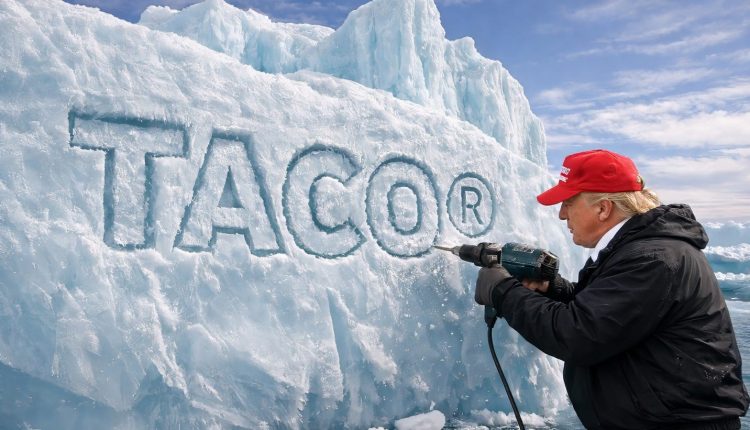
Perhaps the most shocking reform involves land. In Greenland, land is not owned in the American sense. It belongs to the collective. You can live on it, build on it, care for it, but you cannot hoard it, flip it, or turn it into a speculative instrument that makes housing impossible for everyone else. This causes an immediate crisis among American real-estate developers, who wander the streets clutching deeds like obsolete passports. Trump himself reportedly tried to register the word mark “TACO” in connection with marketing glaciers before being reminded that ice does not recognize trademarking and is not merchandise.
Democracy also will require adjustment. Greenland’s version is quieter, less theatrical. No endless campaigns, no billion-dollar elections, no cable-news blood sports disguised as civic discourse. Politics should became a periodic affair, not something that screams at you 24 hours a day. Americans, immediately detoxing from outrage, will start to experience withdrawal symptoms. A few might attempt to start culture wars over the proper way to pronounce Kalaallit Nunaat, but this will fizzle when no one takes the bait.
Work would change, and Fox hosts warned that it was a slippery slope to communism. People would still work, but fewer would work themselves into early graves. The idea that one must justify existence through exhaustion is firmly rejected. Time off will not be a reward for loyalty; it will be assumed. And the workweek goes down to 20 hours. Americans will find themselves with free afternoons, evenings, whole weekends, which conservatives see as a horror. Some declared they didn’t know what to do with them. Some have begun to panic. Others start to rediscover hobbies, friendships, or the radical pleasure of being unavailable.
Given their innumeracy, Trump and his family are delighted with the arrangement. They toured Greenland announcing that they had “closed the greatest deal in human history,” while Greenlanders smile politely and hand them commemorative scarves. They are given an honorary role: mascots of the old system, wheeled out occasionally as cautionary exhibits. Schoolchildren listen in fascinated horror as guides explain how a society once believed that wealth proved virtue and that shouting constituted leadership.
In the end, pundits predicted, Americans would adjust. They would not become saints. They would remain loud, inventive, contradictory. But under Greenlandic ownership, they would be less afraid. Less precarious. Unconvinced that cruelty is the price of freedom. Greenland does not gloat. It simply gets to work repairing the pipes, calming the noise, and reminding its latest collective member that a country, like land, works best when no one claims to own it outright or he is the only one that can fix it.
