
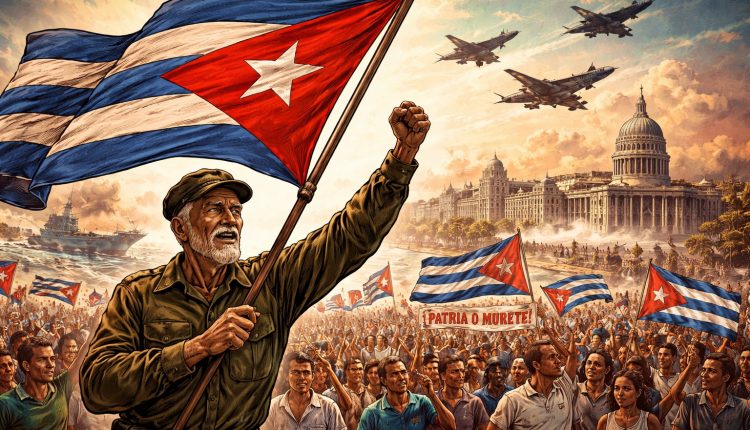
Cuba has heard this before — and it still stands
Long before Fidel Castro, before socialism, even before the United States itself emerged as a world power, Cuba sat squarely in the crosshairs of U.S. ambition.
(This editorial is written in response to an article that appeared in the Miami Herald, written by Nora Gámez Torres, titled: “For decades many have predicted the downfall of Cuba’s regime. Is this time different?” where they cite many of the same old tired voices who dream of bringing Miami-style democracy, or should we call it kleptocracy, to the island.)
***
Once again, Washington declares that Cuba is on the brink of collapse.
Once again, U.S. officials speak of “opportunities,” “transitions,” and “off-ramps,” as if the fate of a sovereign nation were theirs to design. And once again, journalists ask whether this crisis — this president, this sanction package, this regional shock — will finally succeed where 11 U.S. administrations have failed.
The answer remains unchanged.
Cuba has heard this story before.
Long before Fidel Castro, before socialism, even before the United States itself emerged as a world power, Cuba sat squarely in the crosshairs of U.S. ambition. Thomas Jefferson wrote in 1805 that Cuba was “the most interesting addition which could ever be made to our system of states.” John Quincy Adams described the island as a “natural appendage” destined to fall into U.S. hands by “the laws of political gravitation.”
This was not ideology. It was geography — and empire.
From the earliest days of the republic, U.S. leaders understood that control of Cuba meant dominance of the Gulf of Mexico, Caribbean trade routes, and hemispheric power. When Spain refused to sell the island, Washington waited. When independence movements arose, the United States intervened — not to free Cuba, but to replace Spain.
The result was the 1898 occupation, the Platt Amendment, and a half-century of neocolonial rule in which Cuba’s economy, politics, and security were subordinated to U.S. interests. Havana’s presidents rose and fell with Washington’s approval. U.S. corporations controlled sugar, utilities, land, and banks. Dictators like Fulgencio Batista ruled with U.S. arms and blessing.
The Cuban Revolution of 1959 did not create hostility with the United States — it interrupted control.
What followed was not merely disagreement over communism. It was retaliation for defiance.
Since that moment, the United States has attempted virtually every mechanism of regime change short of sustained invasion: economic strangulation, covert sabotage, biological warfare allegations, assassination plots, mercenary landings, terrorist attacks, diplomatic isolation, financial blockade, and the longest sanctions regime in modern history.
When that failed, Washington waited.
When that failed, it tightened the embargo.
When that failed, it tried again.
And now, once more, we are told that Cuba is finished.
The Miami Herald article cited above portrays Cuba’s economic suffering as evidence of ideological failure. But this framing deliberately omits the central variable: no country on Earth has been subjected to economic warfare as prolonged, comprehensive, and internationally condemned as Cuba.
The U.S. blockade is not symbolic. It penalizes third countries, shipping companies, banks, insurers, and humanitarian suppliers. It restricts fuel access, blocks credit markets, criminalizes investment, and weaponizes scarcity. Every United Nations General Assembly since 1992 — including U.S. allies — has voted overwhelmingly to condemn it.
Cuba’s hardships are real. But they are not accidental.
To present deprivation while erasing the policy that produces it is not journalism — it is narrative laundering.
The current moment is described as unique because Venezuela’s oil support has been disrupted and because Washington now brandishes the threat of military force more openly. But Cuba has survived far worse.
It survived the collapse of the Soviet Union — an 85% loss of foreign trade almost overnight. It survived starvation-level caloric intake during the “Special Period.” It survived waves of migration engineered and then politicized by Washington. It survived terrorism that killed civilians in hotels and airplanes. It survived decades when the island had no meaningful allies and no access to global finance.
What allowed Cuba to survive was not abundance — it was political cohesion born of historical memory.
Cubans understand that U.S. pressure is not about democracy. It never was.
Washington supported Batista. It supported Somoza. It supported Pinochet. It supported dozens of dictators across Latin America so long as they aligned with U.S. interests. Cuba’s crime was not repression — many regimes were repressive. Its crime was independence.
This is why U.S. officials speak openly of who must govern Cuba, which economic system is acceptable, and which leaders are permitted to remain. No sovereign nation accepts such conditions without resistance.
The Miami Herald article suggests Cuba should negotiate “before it’s too late.” But history shows that every concession extracted under coercion becomes the precondition for the next demand. The embargo was never lifted when Cuba withdrew troops from Africa. It was not lifted when it opened tourism. It was not lifted when it allowed private enterprise. It was not lifted when relations were restored under Obama.
Because normalization has never been the goal.
Submission is.
Cuba’s leadership understands this reality. That is why Díaz-Canel’s rejection of negotiations “based on coercion or intimidation” is not bravado — it is survival logic learned through six decades of confrontation.
This does not mean Cuba is perfect, nor immune from criticism. The country faces profound economic dysfunction, bureaucratic inertia, demographic loss, and public frustration. Reforms are necessary. Debate exists within Cuban society. Change will come — but it must come from Cubans, not from aircraft carriers or sanctions’ offices in Washington.
What the article ultimately cannot accept is this: Cuba may be battered, but it is not broken.
Its institutions remain intact. Its armed forces remain unified. Its population — despite exhaustion and hardship — understands that collapse under foreign pressure would not bring sovereignty; it would only bring dependency.
The United States has waited more than 200 years to control Cuba.
It has waited 67 years for the Revolution to fall.
And it may wait many more.
Because history has shown something Washington refuses to learn: nations do not surrender simply because they are poor, isolated, or threatened.
They surrender only when they forget who they are.
Cuba has not forgotten.
