
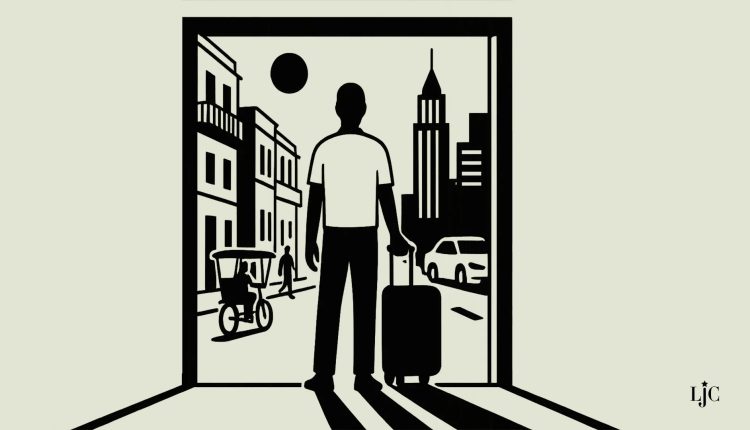
The problem with emigration
Rebuilding Cuba requires a serious, horizontal conversation with all parties, but the leading role must remain with those who, despite everything, continue to choose to stay.
The political debate over Cuban emigration has mostly been shaped by two extremes: one views it as a democratizing force that can transform the country from outside, while the other considers it a threat to national stability. These are not the only ways in which emigration has been politically approached, but they are the discourses that have gained the most support. Both perspectives are flawed. Emigration should not be ignored, but it also should not control Cuba’s direction. It can participate, contribute, and support, but not lead.
A significant part of the emigration has shown that it does not consistently defend democratic values as per its historical responsibility. Often, it calls for freedoms in Cuba but supports or overlooks authoritarian policies, intolerant rhetoric, and exclusionary strategies in the countries where it lives. This does not cancel out its right to voice opinions or participate in debates about the country it left. However, it does make us question its legitimacy and the type of democracy it advocates.
The rise of Trumpism among Cubans is telling. According to surveys, nearly 70% of Cuban-Americans in Miami support Donald Trump, a politician who has openly challenged US democratic institutions, pressured judges and lawmakers, and attacked the press. Trump promotes xenophobic policies, including the mass detention and deportation of migrants, many of whom are Cuban. Yet, many still praise him. The double standard is clear: they criticize the Cuban government but remain silent about Trump. This double standard, which is troubling, is also dangerous because it suggests they prioritize political rivalry over defending democracy. And that shifts everything.
A similar situation is occurring in Spain, where most Cuban emigrants support the Popular Party and, to a lesser extent, Vox, parties that, like Trumpism, combine anti-communism with an exclusionary and authoritarian tone. Many of our fellow countrymen there support American Christian nationalism and the heirs of Spanish fascism. Others who do not join their ranks remain silent about it. More than a contradiction, it shows that, for them, some authoritarian regimes are acceptable while others are not. Are they the ones who will save Cuba?
Another segment of emigrants actively participates in conversations about Cuba, but they do so from a safe distance: opinions, debates, campaigns… all from the outside. Many do not consider returning or taking on the direct implications of a process of change. This isn’t necessarily a bad thing, but there is a difference between speaking about change and truly committing to implementing it—something that can only be genuinely promoted by being in the country.
I speak from within. I am part of that diverse, conflicting emigrant community, shaped by personal history. We all feel a strong connection to Cuba and have the right to be involved in its future. But we must also acknowledge an unavoidable tension between our homeland of birth and the land that welcomes us. Many emigrants carry painful memories of separation, rejection, or survival, and it’s not always easy to distinguish the desire for justice from the desire for revenge. An emigrant’s patriotism is no less genuine, but it is different and sometimes limited by their wounds. Instead of trying to direct change, our role is to contribute humbly, understanding that most of us will not face the direct consequences of those decisions firsthand.
Idealizing emigration is as naive as dismissing it. There are people willing to contribute from abroad with resources, knowledge, and support networks, and that should be acknowledged. But integrating emigration doesn’t mean relinquishing control to it or making it the final authority on national transformation. This is my personal opinion, and I may be wrong. But that, too, is part of the democracy we should strive to build, which includes the ability to dissent without fear.
Emigration can contribute to national reconstruction in many ways: by supporting civic and social initiatives with resources and networks, investing in small productive projects with local impact, providing technical and professional knowledge in education, health, or institutional development, and creating platforms for dialogue that bring Cubans together inside and outside the country. They could also participate, when the time comes, in legal reform processes or the development of a new social pact. But all of this must be done with respect for the sovereign will of those living on the island.
Prejudices still persist within the Cuban state toward emigration, especially criticism from sectors that have not moved past the old view of it as merely a threat. This instrumental outlook on emigration or the defensive attitude toward it limits opportunities for dialogue. Accepting their participation also means accepting their political diversity, without demanding ideological loyalty or punishing criticism. Yet even today, it remains difficult for authorities to step outside their comfort zone, which only encompasses solidarity groups and unconditional allies. Conducting politics and public diplomacy requires reaching further.
What cannot happen is for national reconstruction to be continually postponed or to be shaped by nostalgia or the geopolitical convenience of those who no longer live in Cuba. Even less should this be the case when part of this emigration has lost touch with the reality of the country it seeks to change. To repeat myself: emigration must be genuinely heard, but it should not shape the economic, political, and social model of the future that others will live in. The right to vote is a fundamental right that must not be taken away. As in all countries where this is possible, it defines the future, but it would not be decisive compared to those on the island.
If the Cuban government doesn’t soon recognize the people’s desire for change, it will happen without them. These changes are urgent and must come from internal consensus, not from external pressure or initiatives promoted from Miami, Madrid, or Washington. Rebuilding a country is difficult if emigrants don’t accept the legitimacy of the current government, especially when a large number of emigrants directly impact family economies. It is also difficult if the government fails to foster a truly open and inclusive environment and cannot handle dissent politically because it cannot have an open dialogue with those who have left if it cannot do so with its own citizens.
Rebuilding Cuba requires a serious, horizontal conversation with all parties, but the leading role must remain with those who, despite everything, continue to choose to stay, whatever the reason.
Many people, from a distance and often with a courage they lacked in Cuba, authoritarianly tell Cubans what they should think and do, often from positions of privilege. In this closed environment, rather than one of political détente and mobility that would allow for a different analysis, if emigration can offer anything, it is support, not leadership. Participate without imposing and accompany without deciding. And above all, do not put their identity, pain, or political preferences before the well-being of their fellow citizens. That would be, perhaps, the greatest demonstration of love for their country.
